
Updated: 05 August 2025
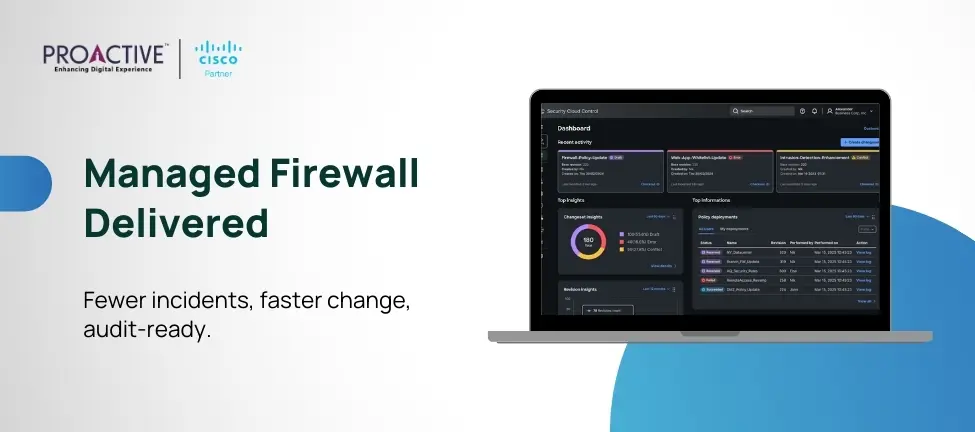
Your attack surface has exploded across branches, remote users, SaaS, and data centres. You can buy more boxes, or you can buy outcomes. Managed firewall, delivered as a service, gives you prevention, visibility, and continuous policy hygiene without adding headcount.
For years, teams in Bengaluru, Pune, and Noida racked, stacked, and patched firewalls, then chased rules, NATs, and VPNs. Threats moved faster. Policies aged. Encrypted traffic hid malware. The workload turned from security to maintenance.
Managed firewall flips the model. You retain control of intent, while your provider runs policy lifecycle, inspection tuning, threat intel ingestion, change windows, and audits. You still get the console, logs, and alerts. You stop doing undifferentiated heavy lifting.
So what do you actually buy when you choose a managed firewall, beyond a box and a licence?
Teams moving from devices to service often ask what changes. In plain terms, your unit of value shifts from hardware to a managed run that keeps policy clean, inspection current, and evidence ready. Here is what that run includes.
You do not buy a device. You buy a run outcome.
Policy lifecycle. Baseline, clean up, and keep rules minimal. Remove any-any and shadow rules. Tie rules to applications, users, and business owners.
Inspection that matches real traffic. TLS inspection at scale, HTTP2 and QUIC awareness, DNS sinkhole, application control, IPS with context, sandbox detonation when needed.
Threat intelligence that lands on policy. Curated feeds, auto enrichment, and confidence scoring are wired into block and monitor decisions.
Change that never drifts. Versioned changes, approvals, pre-checks, and quick rollback. No weekend firefights.
Audit artefacts on tap. Evidence packs for RBI, CERTIn, PCI DSS, and ISO 27001. Log retention and reports are mapped to control statements.
A fintech in Gurgaon added two sites and a new partner API in one quarter. The team could not keep up with rule requests and overnight changes. We moved them to a managed run, anchored on a modern next-gen firewall platform with zero-touch branches. Outcome in 60 days: policy bloat reduced by half, blocked high-risk outbound to unknown ASNs, and change success rate moved to near perfect. Your stack can see similar gains if you treat policy as a product and assign owners.
SASE and Zero Trust are policy-first. Identity, device posture, and application context need a tight, continuous policy. A service model keeps that discipline.
Encrypted traffic dominates. Decryption, selective bypass, and certificate pinning exceptions need expertise and careful guardrails.
Attackers automate. You need playbooks that merge firewall signals with EDR and identity, not more manual checks.
Scarce skills. You can hire, train, and retain, or you can buy an SLA with named experts who do this every day.
You should never lose visibility or decision rights.
Shared console. Full read and role-based write. Every change is tagged to a requester and a business owner.
Guardrails. Golden templates for branches, factories, and cloud edges. Deviation alerts create tickets.
Metrics, not guesswork. Policytoincident ratio, rule age, change success, mean time to detect, and mean time to respond. If a metric slips, tune the runbook, not just the device.
Quarter 1. Baseline rules, remove duplicates, tag owners, enable IPS, and set a safe decryption policy. Publish a rule of ten changes a week and meet it.
Quarter 2. Close the loop between firewall, identity, and endpoint. Autoquarantine on high-confidence events. Tidy site-to-site tunnels.
Quarter 3. Extend inspection to cloud edges. Add explicit egress controls for SaaS and AI tools. Remove local exceptions that crept in.
Quarter 4. Run an audit drill. Produce evidence against RBI and ISO controls in 48 hours. Tune the backlog and retire old rules.
A discrete manufacturer linked SCADA to analytics in the cloud. OT and IT crossed. Latency spiked when deep inspection hit PLC traffic. We introduced selective inspection and micro-segments that isolated PLCs, while egress controls stopped data leaks to unknown regions. Uptime and throughput improved, and the plant team kept change windows under thirty minutes.
Service does not replace platform quality. In India, many teams shortlist cloud-managed security for branches and Secure Firewall appliances for high-throughput data centres and head offices. What should decide your mix is inspection depth at target throughput, TLS handling, hardware crypto, clustering, and support for automation. Ask for a plan that states real numbers under your traffic mix, not lab peaks.
A fast-growing platform moved from two to five PoPs and doubled teacher devices in a term. The team faced alert fatigue and stale objects. We introduced tag-based policy, rate-limited noisy rules, and weekly retire lists. The NOC fed back the top offenders to engineering. Incidents dropped, and product teams shipped without waiting for change windows.
Being a Cisco Gold partner is expected. It signals maturity, but it is a baseline, not a differentiator. What you need is execution. Proactive brings a named run team, an operations playbook proven across BFSI, healthcare, manufacturing, retail, and SaaS, and a habit of publishing hard metrics every week. You keep the steering wheel. We keep the engine tuned.
If you want fewer incidents, faster change, and audit confidence, buy a managed run with clear metrics, shared control, and a platform that fits your traffic.
Get a 30-minute policy health review. You will receive a rule bloat analysis, three top risky egress flows, and a draft change plan with time and effort. If you want, we will map it to your next audit and give you an evidence checklist.

Proactive Cybersecurity Team
We'll get back to you shortly.
