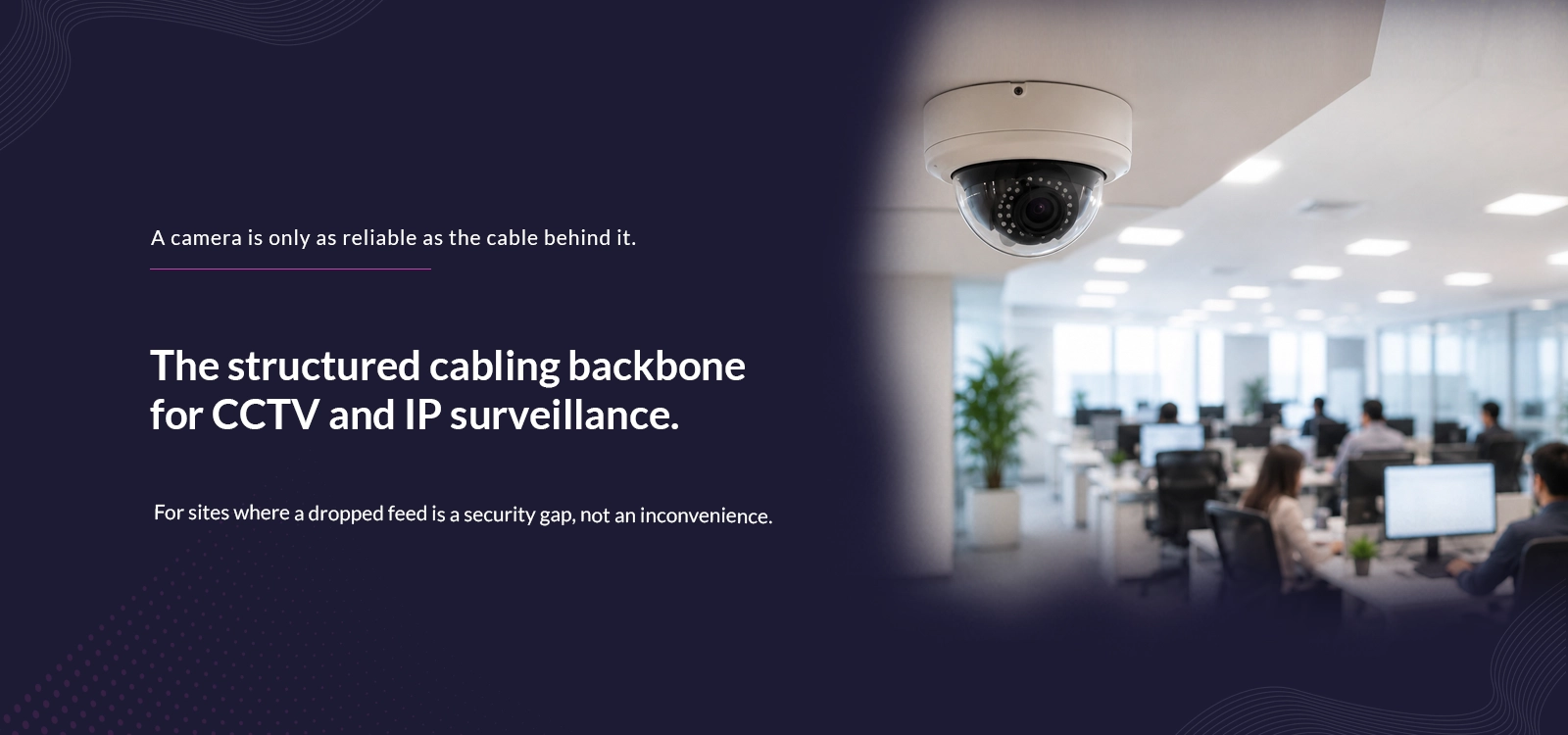

CCTV and Surveillance

Powered. Connected. Protected. Visible.

CCTV and Surveillance cabling is the structured backbone that powers cameras and carries their feeds to recorders and the control room: coax for analog, Cat6A and PoE for IP, and fibre for the long runs.

Built outdoor-ready with surge protection and grounding, on a network segment of its own and with every drop labelled, so a feed is there when it matters and a blind spot is never a cabling problem.

Cabling for Analog and IP Alike

Coax for existing analog estates, Cat6 and Cat6A for IP cameras, and fibre for the long runs. We cable what you have and what you are moving to, on one documented system.

PoE That Powers the Whole Estate

Power over Ethernet sized to the camera, from fixed domes to heated PTZ units, so every camera gets power and data over a single cable without voltage problems at the end of the run.

Built for Outdoor and Harsh Zones

Weatherproof, UV-resistant cabling with surge protection and proper grounding for perimeters, parking and rooftops, where heat, monsoon and lightning decide whether a camera survives.

A Camera Network, Kept Separate

Surveillance cabling and switching planned so cameras sit on their own segment, away from production traffic, which protects both bandwidth and security.

Surveillance Racks and Control Room Links

Centralised camera feeds in structured racks and patch panels, with stable links from the field to NVRs and the control room, so monitoring stays organised and serviceable.

Installed by Proactive, Not Subcontracted Away

Three decades of enterprise infrastructure delivery, certified engineers, and a 24/7 service desk. We design the surveillance cabling, install it, and document every drop.

CCTV and Surveillance Cabling: The Structured Backbone Behind Every Camera


CCTV and surveillance cabling is the structured cabling layer that powers cameras and carries their feeds from the field to the recorder and the control room. It covers the camera drops, the Power over Ethernet that runs them, the surveillance rack and patch panels, the links to NVRs and the control room, and the weatherproofing, segregation and grounding that keep footage flowing without gaps. Because IP cameras run on the same twisted-pair cabling as the network, it is built to the same TIA-568 and ISO/IEC 11801 standards as data cabling. 

A surveillance system is judged on one thing: was the footage there when it was needed. Cameras and recorders get the attention, but the cabling is what quietly decides reliability. A camera on an over-length run, an outdoor drop that lets water in, or a PoE link that sags under load does not fail loudly. It fails as a feed that drops at the wrong moment, and a blind spot no one noticed until it mattered. 

Analog or IP: Which Surveillance Cabling Fits 

Most estates run a mix, especially during a move from analog to IP. The cabling medium is chosen by camera type, distance and power, as set out below. 

Cabling  Camera type  Power and reach  Best use 
Coax (RG59 / RG6) Analog and HD-over-coax Separate power feed; long coax runs Existing analog estates and retrofits
Cat6 / Cat6A + PoE IP cameras PoE over the same cable; 100 m per run New and upgraded IP surveillance
Fibre (OM4 / OS2) IP cameras via media converters Local power; hundreds of metres to kilometres Long runs, perimeters, between buildings

PoE for Cameras: Matching Power to the Device 

IP cameras draw power over the same cable that carries their data, but not every camera needs the same wattage. Matching the PoE standard to the device avoids cameras that reboot, dim their infrared, or never power up on long runs. 

  • 802.3af (PoE): up to 15.4 W at the source, enough for fixed domes and bullet cameras. 
  • 802.3at (PoE+): up to 30 W, for pan-tilt-zoom (PTZ) cameras and stronger infrared. 
  • 802.3bt (PoE++): up to about 90 W, for heated and blower-equipped PTZ units and multi-sensor cameras. 

Power also has to be planned at the switch, not only per camera. A PoE switch has a total power budget shared across all its ports, so a rack of high-wattage PTZ cameras can exhaust it even when every individual link is within spec. We size switch PoE budgets to the full camera load, with headroom for the cameras still to come. 

Why the Cabling Decides Whether You Have Footage 

Right medium for each camera: coax, Cat6 and Cat6A, or fibre, chosen by camera type, distance and power. 

PoE sized to the device: the correct PoE class for each camera, so power holds up at the far end of the run. 

Distance respected: the 100-metre Ethernet limit honoured, with fibre or extenders used beyond it rather than over-length copper. 

Outdoor-rated and protected: weatherproof, UV-resistant cabling with surge protection and grounding for exposed runs. 

A separated camera network: surveillance traffic on its own segment, protecting bandwidth and security. 

Documented drops: every camera run labelled and recorded, so faults are found in minutes, not by walking the perimeter. 

The most common surveillance failures are cabling failures. Push an IP camera past 100 metres on copper, and the link becomes unreliable. Skip surge protection on a rooftop run, and the first storm takes the camera with it. Run an under-powered PoE class to a heated PTZ, and it browns out on the coldest night, exactly when it is needed. None of these are camera faults, and none show up at commissioning. 

Proactive designs surveillance cabling as part of the structured system, planning medium, power, distance, weatherproofing and segregation before the first camera drop is pulled. The cameras and recording platform are yours to choose; we make sure the infrastructure behind them never becomes the reason a feed is missing. 

CCTV Cabling Across India: Why the Site Decides the Design 

Surveillance cabling lives where the conditions are hardest. A perimeter run across a manufacturing campus is a different problem from cameras in an air-conditioned office, and a coastal site where salt air corrodes connectors is different again. 

Heat, monsoon, dust, lightning and long outdoor distances all shape what good surveillance cabling looks like in India, which is why outdoor-rated cable, surge protection, grounding and fibre for long perimeter runs are decisions made at design time, not patched in later. Because cameras ride the network, the camera segment is planned to sit behind proper network security rather than open on the production LAN. Proactive has installed CCTV and surveillance cabling across manufacturing, BFSI, healthcare, IT and ITeS and GCC sites in Delhi, Mumbai, Bengaluru, Pune and Hyderabad. 

Proactive Data Systems: The Partner That Designs, Installs, and Stays 

Choosing cameras is the visible decision. Cabling a surveillance estate so every feed is powered, in range, weatherproof and on the right network is the part that decides whether the system actually works. 

Proactive surveys the site, designs camera drops and runs for distance and power, selects outdoor-rated and surge-protected cabling where it is needed, terminates feeds into structured surveillance racks and patch panels, and documents every drop. Behind that work is over three decades of enterprise infrastructure delivery, certified engineers and an ISO 9001:2015 quality system. 

Surveillance cabling shares the same backbone as the rest of your estate. It works alongside Cabling Solutions, Racking Solutions, Cable Trays and Ladders, and DCIM Cabling Support, and connects to the Wi-Fi and switching the cameras depend on, so power, pathways and the network are planned together.  

From site survey and drop design through installation, weatherproofing and control room links, to the 24/7 service desk that answers when something needs attention, Proactive builds surveillance cabling that keeps every camera connected and every feed available.

Have a question? Check out the FAQs

Here are the most common, frequently asked questions.
In case you want to know more contact us at [email protected]

faq-img

What is CCTV and surveillance cabling?

CCTV and surveillance cabling is the structured cabling that powers cameras and carries their video feeds from the field to recorders and the control room. It covers camera drops, Power over Ethernet, surveillance racks and patch panels, links to NVRs, and the weatherproofing, grounding and network segregation that keep footage available.

What is the difference between analog and IP CCTV cabling?

Analog cameras typically run on coaxial cable (RG59 or RG6) with a separate power feed. IP cameras run on Ethernet cable (Cat6 or Cat6A) and are usually powered over the same cable by PoE. IP cabling is the standard for new and upgraded surveillance because it carries power and high-resolution video on one structured run.

What cable do IP cameras use?

IP cameras use twisted-pair Ethernet cable, most commonly Cat6 or Cat6A, which carries both the video feed and PoE power on a single run of up to 100 metres. For longer distances, fibre with a media converter is used at the camera or in the field.

What is PoE and why does it matter for CCTV?

Power over Ethernet delivers power and data to a camera over one cable, removing the need for a separate power run at each location. Matching the PoE class to the camera matters: 802.3af gives up to 15.4 W for fixed cameras, 802.3at up to 30 W for PTZ, and 802.3bt up to about 90 W for heated and multi-sensor units.

How far can a CCTV camera be from the switch?

An IP camera on copper Ethernet can sit up to 100 metres from the switch, the standard limit for a Cat6 or Cat6A run. Beyond that, the right approach is fibre with a media converter or a PoE extender, rather than stretching copper past its limit, which causes unreliable feeds and power problems.

When do you need fibre for surveillance cabling?

Fibre is used when cameras are beyond the 100-metre copper limit, on long perimeter runs, or in separate buildings. It carries the feed over hundreds of metres to kilometres and is immune to the electromagnetic interference common on industrial sites, with power provided locally or via a converter at the camera.

What cabling is needed for outdoor surveillance cameras?

Outdoor cameras need weatherproof, UV-resistant cable, sealed and protected connectors, and surge protection with proper grounding to survive heat, moisture and lightning. Runs are usually carried in conduit or protected pathways, and exposed copper links are surge-protected to stop storms from destroying cameras and switch ports.

Why should CCTV cameras be on a separate network?

Putting cameras on their own network segment, or VLAN, keeps high-volume video traffic off the production network and reduces the security risk of many internet-capable devices sharing the main LAN. It protects both bandwidth and security, and is planned into the cabling and switching design.

How much bandwidth and storage do IP cameras need?

It varies with resolution, frame rate and compression, but high-resolution IP cameras commonly stream a few megabits per second each, which adds up to significant continuous traffic and storage demand across an estate. That is why the cabling and switching are sized for the full camera count plus growth. Storage and recording sizing is set with your chosen recording platform; the cabling is built to carry the load reliably.

How many cameras can one PoE switch power?

It depends on the switch's total PoE power budget, not just its port count. A switch may have 24 PoE ports but a power budget that cannot run 24 high-wattage PTZ cameras at once. The right approach is to add up each camera's PoE draw, compare it to the switch budget, and leave headroom, rather than assuming every port can deliver maximum power at the same time.

Does Proactive supply cameras, or just the cabling?

Proactive designs and installs the structured cabling backbone for surveillance: camera drops, PoE, fibre, surveillance racks, patch panels and control room links. The cameras and recording or video management platform are yours to choose, and we build the infrastructure to integrate with them cleanly.

How is a CCTV cabling project delivered, and how long does it take?

Delivery runs through site survey, drop and route design, cable pulling and termination, weatherproofing and surge protection for outdoor runs, rack and patch panel build, and labelling. A single building is typically completed in days to a couple of weeks, while a multi-site or large campus rollout is phased over several weeks.

What determines the cost of a CCTV cabling project?

Cost is driven by the number of cameras and drops, the cable medium (copper, coax or fibre), the proportion of outdoor and surge-protected runs, the surveillance rack and switching, and site conditions such as distance, height and access. The cable is a modest share; design and installation quality are what keep feeds reliable over the system's life.

Contact Us

We value the opportunity to interact with you, Please feel free to get in touch with us.


Share a few details to get started.

We'll get back to you shortly.