
DCIM Cabling Support

Labelled. Mapped. Measured. Managed.

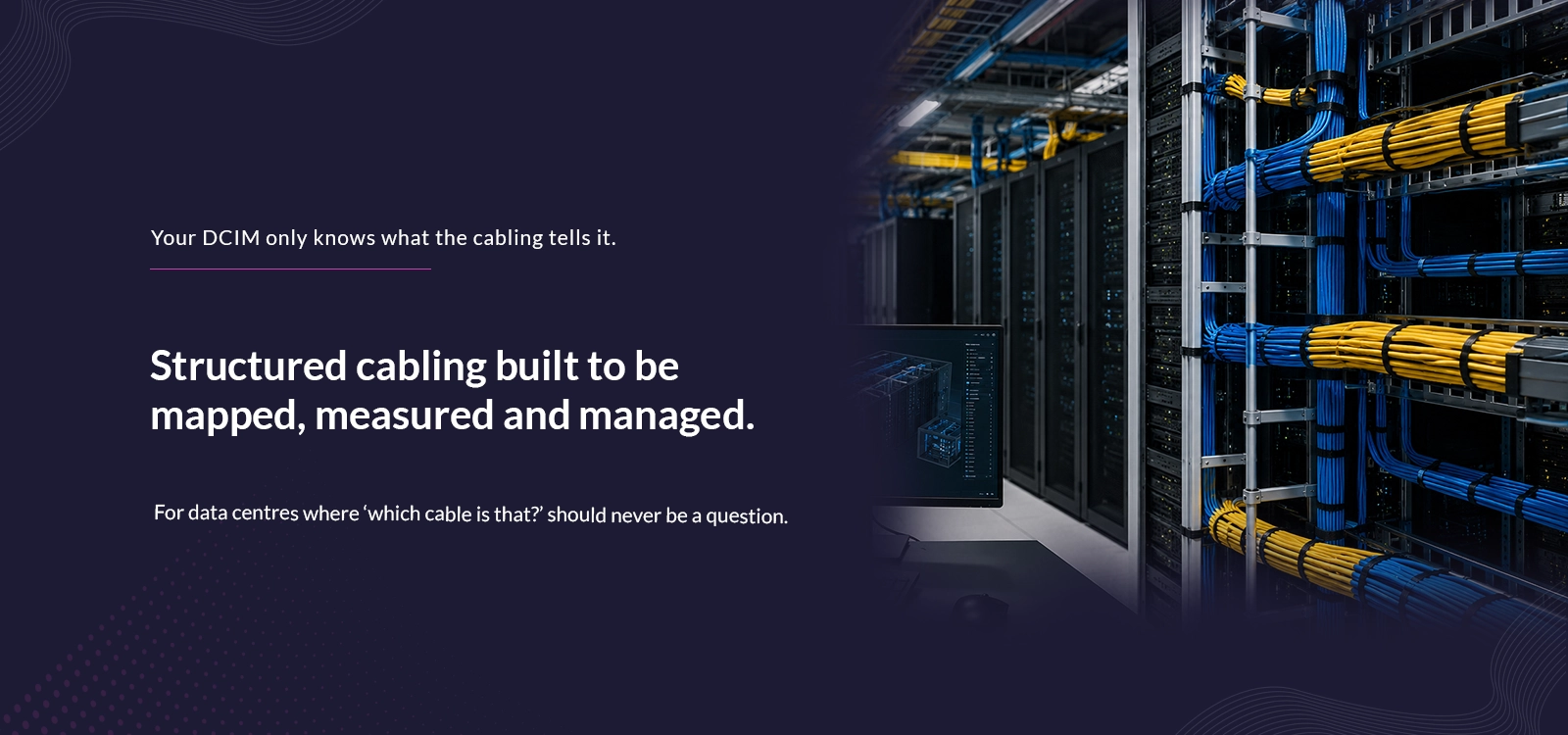
DCIM Cabling Support is structured cabling designed and documented so a DCIM platform can see and manage it: labelled to ANSI/TIA-606, mapped at port level, asset-tagged and colour-coded.

Because a DCIM platform is only as accurate as the physical layer beneath it, Proactive builds cabling and records that stay current through every move, add and change, ready for the tools you run on top.

Documented to ANSI/TIA-606

Every cable, port and panel labelled to the administration standard, so the physical layer has a single, traceable identity that a DCIM platform can read and trust.

Port-Level Mapping, End to End

Each device tied to its switch port and patch panel position, so connectivity is a record on a map rather than a trace done by hand with a torch.

Asset Tagging and Colour Coding

Standardised identifiers and colour schemes by service and zone, so equipment, cables and endpoints line up with the asset database and are quick to trace on the floor.

AIM-Ready Where You Need It

Layouts prepared for automated infrastructure management, the intelligent patching that senses connections live, where real-time accuracy is worth the investment.

Built for Moves, Adds and Changes

Cabling and records designed so every change is captured, keeping the documentation current instead of drifting out of date the week after handover.

Installed by Proactive, Not Subcontracted Away

Three decades of enterprise infrastructure delivery, certified engineers, and a 24/7 service desk. We design the physical layer, document it, and keep it accurate.

DCIM Cabling Support: Data Centre Cabling Documentation Built to Be Mapped, Measured, and Managed


DCIM cabling support is structured cabling designed and documented so a Data Center Infrastructure Management (DCIM) platform can see and manage it. DCIM software tracks power, cooling, space, assets and connectivity in real time, but it can only report what the physical layer feeds it. That depends on labelling to ANSI/TIA-606, port-level connectivity records, asset tags and colour coding, and, where it is warranted, automated infrastructure management, so every port, panel and patch is accounted for. 

A DCIM platform is a powerful tool sitting on top of a simple dependency: accurate physical-layer data. Feed it clean, labelled, mapped cabling, and it gives you real capacity planning, fast fault location and trustworthy change management. Feed it undocumented cabling, and it gives you confident-looking dashboards built on guesswork, which is worse than no dashboard at all. 

What DCIM Needs From the Cabling 

DCIM accuracy is built from six physical-layer ingredients: 

  • A labelling scheme to ANSI/TIA-606, so every cable, port and panel has a unique, traceable identity. 
  • Port-level connectivity records that map each device to its switch port and patch panel position. 
  • Asset tags and identifiers that tie cables and endpoints to the asset database. 
  • Colour coding by service or zone for fast, low-error visual tracing. 
  • As-built documentation kept current through every move, add and change. 
  • Automated infrastructure management (AIM), where live connection sensing is worth the investment. 

The Standards That Make Cabling Manageable 

DCIM-ready cabling is not a proprietary idea; it is structured cabling built to recognised administration and data-centre standards. The ones that matter most are below.

Standard What it governs
ANSI/TIA-606 Administration: labelling and documentation of cabling infrastructure, the backbone of DCIM accuracy
TIA-942 Data centre design, including cabling, cabinets and spaces
ISO/IEC 14763 Implementation and operation of cabling, including testing and administration
ISO/IEC 18598 Automated infrastructure management (AIM) systems

Why the Cabling Decides Whether DCIM Tells the Truth 

  • Labelled to standard: ANSI/TIA-606 identifiers on every cable, port and panel, so records and reality match. 
  • Mapped at port level: device-to-port-to-panel connectivity captured, not inferred. 
  • Tied to assets: cables and endpoints linked to the asset register the DCIM platform reads. 
  • Colour-coded by service: visual tracing that cuts error and time during changes. 
  • Kept live through changes: documentation updated with every move, add and change, not left to rot. 
  • AIM where it pays: automated sensing for environments where manual records cannot keep pace. 

The failure mode here is quiet and expensive. A DCIM rollout goes in, the dashboards look impressive, and the physical-layer data underneath is a year out of date within months because moves, adds, and changes were never captured. Capacity decisions get made on phantom free ports. A fault that should take minutes to locate takes hours because the map and the floor disagree. The platform is not at fault; the cabling discipline beneath it is. 

Proactive builds the physical layer DCIM depends on: labelled to standard, mapped at port level, asset-tagged and colour-coded, with documentation designed to stay current. Where live accuracy justifies it, we prepare the cabling for automated infrastructure management. The DCIM platform is yours to choose; we make sure the data it stands on is real. 

DCIM Cabling Across India: Why Documentation Is the Hard Part 

Most Indian data centre and enterprise environments do not start clean. They start with an operating facility, years of undocumented moves, and a DCIM ambition that runs straight into a physical layer no one fully trusts. 

Retrofitting accurate documentation into a live data centre, auditing what is actually connected, and imposing a labelling and change-management discipline that survives daily operations is the real work, and it is harder than greenfield. Proactive has delivered DCIM-ready cabling and documentation across enterprise and GCC data environments in Delhi, Mumbai, Bengaluru, Pune and Hyderabad, working to ANSI/TIA-606, TIA-942 and ISO/IEC 14763, so the physical layer is trustworthy before any DCIM platform is asked to rely on it. 

Proactive Data Systems: The Partner That Designs, Installs, and Stays 

Buying a DCIM platform is a software decision. Giving it a physical layer it can trust, then keeping that layer accurate as the data centre changes, is an infrastructure discipline that rewards experience. 

Proactive designs and installs structured cabling to ANSI/TIA-606 and TIA-942, captures port-level connectivity, applies asset tags and colour coding, prepares for automated infrastructure management where it is warranted, and hands over documentation built to stay current. Behind that work is over three decades of enterprise infrastructure delivery, certified engineers and an ISO 9001:2015 quality system. 

DCIM cabling support builds on the rest of the physical layer. It works alongside Cabling Solutions, Racking Solutions, Cable Trays and Ladders, and CCTV and Surveillance, and feeds directly into our Data Center solutions and Data Center Networking practices, so the physical layer and what runs on it are planned together. New to the topic? Start with Structured Cabling 101

From site survey and design through installation, labelling, port-level mapping and documentation, to the 24/7 service desk that answers when something needs attention, Proactive builds the accurate, manageable physical layer that lets a DCIM platform do its job. 

Have a question? Check out the FAQs

Here are the most common, frequently asked questions.
In case you want to know more contact us at [email protected]

faq-img

What is DCIM cabling support?

DCIM cabling support is structured cabling that is designed and documented so a Data Center Infrastructure Management platform can monitor and manage it. It covers labelling to ANSI/TIA-606, port-level connectivity mapping, asset tagging, colour coding, and as-built documentation kept current through changes, so the DCIM software has accurate physical-layer data to work from.

What is DCIM?

DCIM, or Data Center Infrastructure Management, is software that monitors and manages a data centre's power, cooling, space, assets and connectivity in real time. It gives operators a single view of capacity and dependencies, but its accuracy depends entirely on the quality of the underlying physical-layer data, much of which comes from the cabling and its documentation.

Why is structured cabling important for DCIM tools?

A DCIM platform can only report what the physical layer tells it. Clean, labelled, mapped cabling gives it accurate connectivity, capacity and asset data; undocumented cabling gives it confident dashboards built on guesswork. Good structured cabling and documentation are what make DCIM trustworthy rather than decorative.

What is port-level mapping?

Port-level mapping records exactly which device connects to which switch port and patch panel position, across the whole estate. It turns connectivity into a maintained record rather than something engineers trace by hand, which is what allows fast fault location, accurate capacity planning and reliable change management.

What standards should DCIM cabling comply with?

The key standards are ANSI/TIA-606 for labelling and administration, TIA-942 for data centre design, ISO/IEC 14763 for implementation and operation of cabling, and ISO/IEC 18598 for automated infrastructure management. Building to these standards is what makes the physical layer traceable, auditable and ready for DCIM.

What is ANSI/TIA-606?

ANSI/TIA-606 is the administration standard for telecommunications infrastructure. It defines how cables, ports, panels and spaces are labelled and documented so every element has a unique, consistent identifier. It is the foundation of DCIM accuracy, because a platform cannot manage what is not consistently identified.

What is automated infrastructure management (AIM), and do I need it?

AIM uses intelligent patch panels and connectors that sense connections automatically and report them to software in real time, following ISO/IEC 18598. It removes the risk of records drifting out of date between manual updates. It is worth the investment in high-change, high-density environments; in smaller or stable estates, disciplined ANSI/TIA-606 documentation may be enough.

What is the difference between DCIM and AIM?

DCIM (Data Center Infrastructure Management) is the management software that monitors power, cooling, space, assets and connectivity across the data centre. AIM (Automated Infrastructure Management) is the intelligent hardware layer, the smart patch panels and connectors that sense physical connections and feed that data to DCIM in real time. In short, DCIM is the brain, and AIM is one of the sensors that keeps the connectivity part of its picture accurate.

How does colour coding help in DCIM cabling?

Colour coding assigns cables to services or zones by colour, so an engineer can trace a connection at a glance and is far less likely to disturb the wrong cable during a change. It speeds up maintenance, reduces error, and reinforces the labelling and mapping the DCIM platform relies on.

How does good cabling documentation reduce downtime?

When records match reality, faults are located in minutes and changes are made without disturbing the wrong circuit. When they do not, every change carries risk and every fault becomes a search. Accurate, current physical-layer documentation is one of the cheapest ways to cut both change-related outages and mean time to repair.

Does Proactive provide the DCIM software, or the cabling?

Proactive provides the structured cabling and the physical-layer documentation that a DCIM platform consumes: labelling, port-level mapping, asset tagging, colour coding and AIM-ready layouts. The DCIM software itself is yours to choose, and we design and document the cabling to integrate cleanly with leading platforms such as Schneider EcoStruxure IT, Vertiv, Sunbird and Nlyte.

Can you document and label the cabling in an existing data centre?

Yes. A large part of DCIM cabling work is retrofitting accuracy into a live facility: auditing what is actually connected, applying an ANSI/TIA-606 labelling scheme, building port-level records, and putting a change-management discipline in place so the documentation stays current from then on.

How is DCIM cabling support delivered, and what drives the cost?

Delivery runs through survey and audit, labelling and documentation design, installation or remediation of cabling, port-level mapping and asset tagging, and optional AIM preparation. Cost is driven by the size of the estate, whether it is greenfield or a retrofit, the depth of documentation required, and whether automated infrastructure management is included.

Contact Us

We value the opportunity to interact with you, Please feel free to get in touch with us.


Share a few details to get started.

We'll get back to you shortly.