Updated: Jan 09, 2026
As Cisco transitions fully to the Cisco 360 Partner Program, the criteria used to recognise partners have become more explicit and outcome-driven. For enterprises in India, understanding Cisco Preferred Partner requirements is important not just for partner selection, but also for setting realistic expectations around delivery capability and accountability.
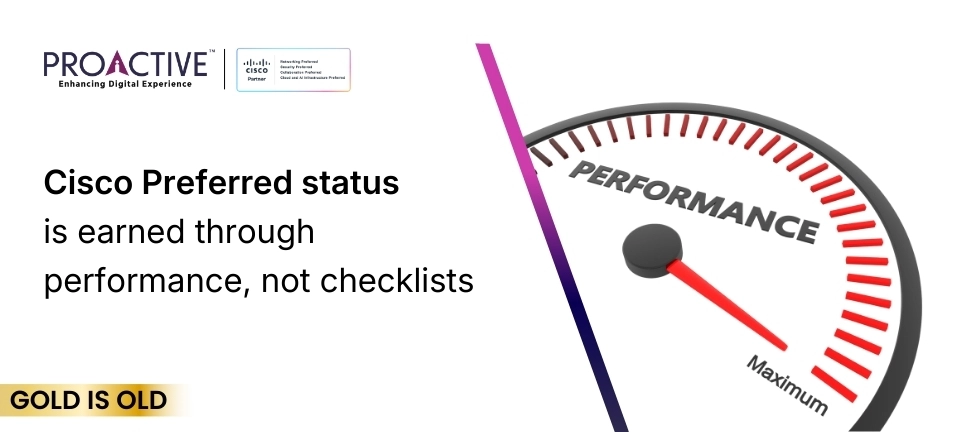
Unlike legacy partner tiers, Cisco Preferred Partner status is not awarded based on scale or history alone. It reflects current, portfolio-specific performance measured against defined benchmarks.
Under the Cisco 360 Partner Program, partner requirements have moved away from static qualification models. Cisco now evaluates partners based on how effectively they design, deploy, and operate solutions across the customer lifecycle.
This means Cisco Preferred Partner requirements are tied to demonstrable outcomes rather than one-time investments or certification counts.
Cisco assesses partners across several core areas when determining Cisco Preferred Partner status. These areas focus on execution quality and lifecycle ownership.
Partners are evaluated on technical capability and architectural depth, ensuring they can design solutions aligned to Cisco reference architectures and enterprise requirements. Delivery quality is another key requirement. Cisco looks at how consistently partners deploy solutions, manage complexity, and reduce operational risk across customer environments.
Customer adoption and lifecycle engagement form a critical part of the evaluation. Preferred status reflects a partner’s ability to drive usage, optimisation, and long-term value rather than limiting involvement to initial deployment.
Operational governance and support maturity are also considered. This includes how partners monitor environments, manage incidents, and maintain service continuity over time.
A defining feature of Cisco Preferred Partner requirements is that they are portfolio-specific.
A partner may meet Preferred requirements in Networking but not in Security or Collaboration. Cisco evaluates each portfolio independently to ensure recognition reflects actual delivery strength rather than assumed capability.
For enterprises, this makes it essential to verify that Preferred status applies to the relevant technology domain.
Cisco Preferred Partner status is not permanent. Under the Cisco 360 framework, partners are continuously assessed based on ongoing performance. Meeting requirements once does not guarantee retention of Preferred status if delivery quality or customer outcomes decline.
This continuous model ensures that Cisco Preferred Partner recognition remains current and meaningful for customers.
For Indian enterprises, Cisco Preferred Partner requirements introduce greater clarity into partner evaluation. Rather than relying on historical labels, enterprises can align partner selection with validated, portfolio-level capability. This is particularly relevant for large-scale, multi-site, or regulated environments where delivery consistency is critical.
Understanding these requirements also helps enterprises frame better RFPs and set clearer expectations during partner engagement.
Proactive Data Systems meets Cisco Preferred Partner requirements across multiple portfolios, including Networking, Security, Cloud & AI, and Collaboration.
This recognition reflects sustained delivery performance, lifecycle ownership, and operational governance aligned to Cisco’s evaluation framework, rather than legacy tier-based qualification.
Requirements are defined by portfolio and assessed through performance indicators related to delivery quality, customer adoption, and lifecycle engagement.
No. Each portfolio has its own evaluation criteria based on the nature of the technology and customer lifecycle. Preferred status must be earned independently for each portfolio.
No. Certifications are important, but they are only one input. Cisco Preferred Partner requirements place greater weight on real-world delivery outcomes and ongoing customer success.
No. Unlike Gold, Preferred status is continuously evaluated. Partners must sustain performance levels to retain recognition under the Cisco 360 Partner Program.
Cisco Preferred Partner requirements reflect Cisco’s shift toward performance-based partner evaluation. For Indian enterprises, understanding these requirements helps ensure partner selection is aligned with current capability, not historical reputation, and supports more reliable outcomes for Cisco-led initiatives.
We'll get back to you shortly.