Updated: 12 November 2026
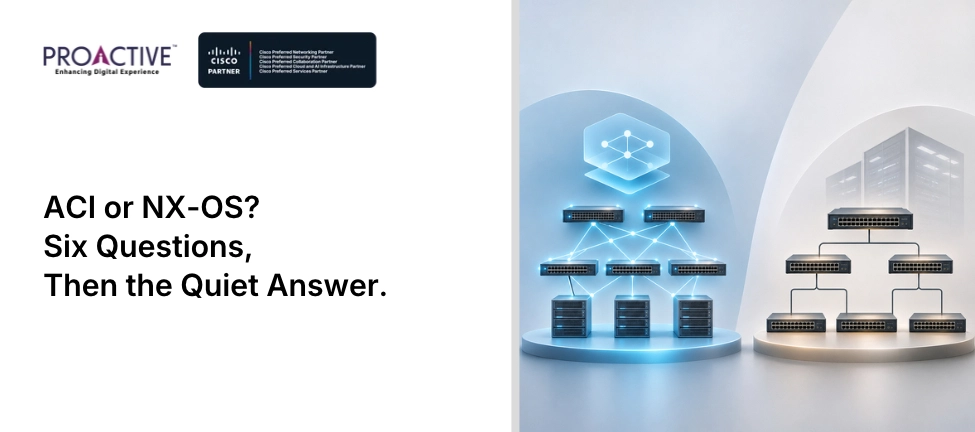
Choosing between Cisco ACI, an NX-OS VXLAN EVPN fabric, and an NX-OS fabric automated through Nexus Dashboard (the function formerly sold as NDFC) comes down to six questions: how many endpoints you have and how often they change, who will run the fabric, whether you need Layer 2 between sites, what your automation plan is, how large a blast radius you can tolerate, and whether an AI or GPU back-end fabric is in the plan. Proactive Data Systems, a Cisco Preferred Partner across all five architectures with 35 years in Indian enterprise infrastructure, puts these six to every customer before a Nexus bill of materials is drawn.
The counter-intuitive fact first: Cisco itself no longer says you must choose. Its Nexus One architecture, published in August 2026, connects ACI and NX-OS fabrics through standards-based VXLAN EVPN border gateways, with Nexus Dashboard as the common control point, and describes customers running ACI at one site and NX-OS at another as a normal state. That removes the religious war and leaves the engineering question, which is the harder one: which operating model fits the team you actually have.
How many endpoints, and how often do they change?
Who runs it, and can you hire them in India?
Do you need Layer 2 between sites at all?
What is the automation plan?
How big a blast radius can you live with?
Is an AI or GPU back-end fabric in the plan?
ACI pays for itself where thousands of endpoints move, scale and change policy weekly; a slow-changing data center of a few hundred workloads behind two spines and eight leaves is usually better served by an NX-OS VXLAN EVPN fabric, automated through Nexus Dashboard. Count the changes per month, not the endpoints.
The reason is what each model asks of you. ACI's policy model, with endpoint groups, contracts and tenants, is a different way of thinking about the network, and the return on learning it is proportional to how much the network changes. A fabric that is reconfigured twice a year does not earn that return; one that provisions and tears down workloads daily does. NX-OS VXLAN EVPN gives you a modern, standards-based fabric with the operating model your engineers already know, and Nexus Dashboard adds templated provisioning on top. Most Indian mid-market data centers Proactive sees sit in the second category and are better off admitting it.
ACI engineers are scarcer and dearer in the Indian market than NX-OS engineers, and a fabric that only one person on the team understands is a liability no feature offsets. Decide who will operate the fabric in year three before choosing what it runs.
This is not a judgement on ACI. It is a judgement on hiring. An NX-OS engineer with VXLAN EVPN skills can be found or trained from the large pool of CLI-fluent network staff in Delhi, Bengaluru or Pune; an ACI engineer who can troubleshoot a contract problem at 2 am is a narrower search. If you choose ACI, choose it with a plan: a partner who will run it with you, a training budget, and a second person who learns it in parallel. Proactive Data Systems runs both ACI and NX-OS fabrics for Indian customers from a 24x7 NOC with 100+ engineers, and even so, we ask prospects to name their in-house owner before we recommend ACI.
Most enterprises that ask for Layer 2 across sites want workload mobility or a legacy cluster that assumes a shared subnet; if neither applies, a Layer 3 interconnect is simpler, safer and cheaper, and the fabric choice stops mattering for the interconnect. Ask the application owners what actually requires it, and expect a short list.
Where Layer 2 extension is real, both paths handle it. ACI Multi-Site, with Advantage licensing, stretches policy and segments across data centers; NX-OS VXLAN EVPN Multi-Site does the same with standards-based border gateways. The newer option, ACI's own border gateway role introduced in 6.1, lets an ACI fabric peer with an NX-OS fabric or a third-party VXLAN EVPN fabric. That matters in India because mergers and multi-vendor estates are common: a Nexus fabric peering with an existing Arista or Juniper fabric is a design, not a failure, and Proactive has built them.
If you have no automation plan, Nexus Dashboard on NX-OS gives you templated provisioning without writing code; if you have an infrastructure-as-code practice, ACI and NX-OS both expose APIs that Ansible, Terraform and Cisco's Nexus-as-Code tooling can drive. Choose the fabric whose automation you will actually use, not the one with the longest API reference.
The uncomfortable truth is that most data center fabrics in India are still configured by hand, and the choice of fabric does not change that by itself. ACI's value assumes you will manage policy through its model or through code; used as a very expensive way to configure VLANs, it disappoints. NX-OS fabrics managed through Nexus Dashboard meet teams where they are: a template, a form, and a change window. Ask yourself which of the two your team will still be using in eighteen months, and be honest about it.
A single policy error in ACI can affect every workload that shares the contract, which is the price of centralised policy; a misconfiguration on one NX-OS leaf stays on that leaf, which is the price of distributed configuration. Neither is safer in the abstract. The question is which failure your operations process can catch.
ACI mitigates its risk with pre-change analysis in Nexus Dashboard's Premier tier, which models a change before it is pushed, and with role-based access that keeps the wrong hands off tenant policy. NX-OS mitigates its risk with the fact that most changes are local, and with the change management discipline your team already has for a CLI. Proactive's rule: if you cannot name the person who reviews every ACI contract change before it is committed, you are not ready for ACI's blast radius, whatever the licence tier.
If you expect to build an AI training or inference cluster in the next three years, the back-end fabric that feeds the GPUs is a separate design from the front-end fabric this article is about, and it leans toward NX-OS on Nexus 9000 at 400G and 800G or toward Nexus Hyperfabric AI, not toward ACI. Decide the front-end fabric on questions one to five, and keep the AI back-end as its own decision.
The reason to raise it now is cabling, optics and budget. An AI back-end fabric is lossless Ethernet tuned for RDMA traffic, with its own switches and its own operating model, and bolting it onto a front-end decision made for different reasons produces an expensive compromise. Indian enterprises are starting to size GPU clusters for in-house inference, and the honest advice is to design the two fabrics together and buy them separately. Proactive sizes both from the same site survey.
| S.No. | Question | Points to ACI | Points to NX-OS VXLAN EVPN with Nexus Dashboard |
|---|---|---|---|
| 1 | Endpoints and change rate | Thousands, changing weekly | Hundreds to low thousands, changing quarterly |
| 2 | Who runs it | Named ACI owner, training budget, partner on call | CLI-fluent team, broad Indian hiring pool |
| 3 | Layer 2 between sites | Real mobility need, policy stretched across sites | Layer 3 interconnect, or standards-based VXLAN EVPN Multi-Site |
| 4 | Automation | Policy managed through the model or through code | Templated provisioning, or code if you have the practice |
| 5 | Blast radius | Pre-change analysis and strict RBAC in place | Local changes, existing CLI change discipline |
| 6 | AI back-end fabric | Separate decision either way | Separate decision; usually NX-OS or Hyperfabric AI |
Licensing note: Essentials, Advantage and Premier tiers apply across Nexus Dashboard, ACI and NX-OS. ACI Multi-Site needs Advantage; pre-change analysis and flow analytics sit in Nexus Dashboard Premier; NX-OS Advantage adds data center interconnect overlays and tenant routed multicast. Map the features you will switch on to the tier before pricing.
Proactive Data Systems has built data center fabrics for Indian enterprises in BFSI, IT/ITES and manufacturing across 35 years, on Nexus and alongside other vendors' fabrics where the customer already had them. We hold Cisco's Preferred status in Cloud & AI, run both ACI and NX-OS estates from a 24x7 NOC, and will recommend the plainer fabric when the six questions point there, because an ACI deployment that stalls at tenant one is a worse outcome for us than an NX-OS fabric that runs quietly for a decade. More than 1,500 customers have taught us that the quiet one is usually the right one.
Send us your current data center topology, your endpoint count and your change calendar for the last quarter. We will return the six answers for your estate, the licence tier each one needs, and a view on whether the AI back-end belongs in the same conversation
Disclaimer: Cisco product names, architectures and licence tier contents are as published by Cisco in October 2026 and change with releases; confirm current details with Cisco or your partner before design or purchase. Arista and Juniper are trademarks of their respective owners.
We'll get back to you shortly.