We have been inside Indian enterprise infrastructure for 35 years. The legacy VPN nobody replaced. The ERP that predates cloud authentication. The vendor account that outlasted the engagement. We have seen all of it - because in many cases, we built it. Which is why, before we configure a single Duo policy, we do a credential audit. We have never done one that didn't find something that should not be there. Duo closes the gaps. We find them first.

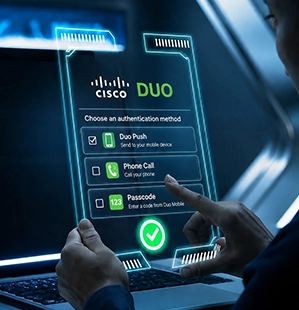
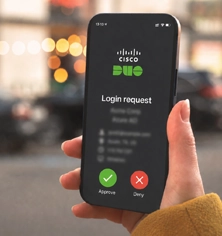
Cisco Duo integrates with the infrastructure you actually have. Legacy VPNs. Branch networks. OT environments. Systems that predate the cloud and will outlast the next migration project. We have deployed into all of it.
Three deployments. Three environments that would have broken a standard implementation. None of them did.
A Bengaluru-based GCC needed to secure remote access, privileged accounts, contractor access, and legacy applications while satisfying both parent company mandates and Indian regulatory requirements.
A Bengaluru-based lending technology platform needed to enforce MFA across production systems handling customer financial data while continuing to process nearly 8,000 loan applications per day dur...
A Hyderabad-based pharmaceutical manufacturer strengthened authentication controls across validated LIMS, MES, ERP, and remote access systems, without production disruption or revalidation of legac...
They use different language. They carry different penalties. They answer to different regulators.They are all asking the same question.
Can you prove who accessed your systems - and when?
The deployment window closed between January and April 2025. If you haven't deployed, you are not behind schedule.
MFA for all remote access is an explicit audit requirement. 180-day logs, stored in India, will be requested.
At least one dynamic factor. Factor independence required. Risk-based escalation for higher-value transactions.
The penalty for failing that standard after a breach is up to ₹250 crore per instance.
They go around it - through the application your policy never reached, the vendor account nobody deactivated, the push notification your exhausted employee approved at 2 AM. The technology didn't fail. The deployment did.
An attacker with your stolen password doesn't need to break your MFA. They send push approval requests to your phone at 2 AM, ten, twenty, thirty of them - until you approve one just to make it stop. That is MFA fatigue. It is the documented attack method behind the 2022 Uber breach and the 2023 MGM Resorts incident. It doesn't bypass MFA. It abuses the specific type - the standard push notification that treats user approval as proof of identity - that the majority of deployments rely on. Cisco Duo's Verified Push requires a real-time number match between your login screen and your phone. An attacker working remotely cannot complete it. The attack fails every time.
India's financial sector was built on SMS OTP. It is also the specific vulnerability behind ₹36,450 crore in financial cyber fraud losses reported on India's National Cyber Crime Reporting Portal as of February 2025. SIM-swap fraud - porting a victim's number to an attacker-controlled SIM to intercept OTPs - is the mechanism. The RBI Authentication Mechanisms Directions 2025, effective 1 April 2026, are unambiguous that SMS OTP is insufficient as the sole dynamic factor for higher-risk transactions. The framework points clearly toward what replaces it. If your authentication strategy still centres on SMS OTP, it is not a future proof strategy.
Attackers don't target your strongest application. They find the one your MFA policy doesn't reach. That application is never difficult to find. Microsoft 365 is protected. The Cisco VPN installed in 2016 is not. The core banking terminal authenticates with username and password. The ERP runs on-premises and hasn't been touched since the last migration project. The vendor accounts from an engagement that ended 18 months ago are still active. The gap is never in the application everyone is watching. It is always in the one nobody thought to check.
Cisco Duo is a purpose-built identity security platform that provides multi-factor authentication, device trust, zero trust network access, and single sign-on - from a single cloud-delivered platform, with a dedicated data centre in Mumbai for Indian tenants.
Cisco Duo is not a feature bundled into a productivity suite. It is a purpose-built identity security platform - MFA, device trust, zero trust access, and SSO - that sits in front of every application your organisation runs, regardless of vendor, age, or architecture. Cloud. On-premises. Legacy. OT. It does not ask your infrastructure to modernise before it can protect it.
Proactive deploys it. We configure it against what is actually there, not what the diagram says should be there.
See what a Duo deployment looks likeEvery access event is logged to a named individual. Every device is checked before it connects. Every privileged account is protected by MFA that cannot be defeated remotely. The logs are granular enough to satisfy RBI, CERT-In, and SEBI - without a premium tier upgrade to access them. And the enrolment experience is simple enough that branch staff in Nagpur and warehouse workers in Ahmedabad complete it in under three minutes. One platform. Everything it needs to cover, it covers.
Cisco Duo integrates with the infrastructure you actually have - the VPN from 2016, the on-premises Active Directory, the ERP nobody has touched since the last migration project. It does not require any of it to be rebuilt before it can protect it. Proactive brings 35 years of Indian enterprise infrastructure to every deployment. We know what BFSI core banking environments look like. We know what manufacturing OT stacks look like. We know what happens on Day 1 of an MFA rollout when branch employees receive enrolment emails and report them as phishing. We plan for that. The architecture matters more than the product. Getting the architecture right is what we do.
We start with a credential audit. Not a configuration. Not a scoping call. A credential audit. Before a single line of MFA policy is written, we map every account with access to your critical systems: VPN, remote access, core banking, privileged administrator, and third-party vendor. We find the stale accounts, the shared credentials, and the vendor access that nobody deactivated. That audit is itself a CERT-In deliverable. Then we deploy in priority order. Privileged access first - it carries the highest regulatory exposure and affects the fewest users. Remote access second. Employee access third. Customer-facing authentication as a parallel workstream. The evidence package - the seven documents that RBI and CERT-In examiners will ask for - is built alongside the deployment, not assembled the week before the audit.
Thirty-five years of Indian enterprise deployments means the gaps, the mistakes, the Day 1 surprises, and the audit findings are all ours. The content here reflects that. No global templates. No repurposed product sheets. Just what we have seen in environments like yours.
Tell us what you're running - the systems, the sector, the regulatory deadline that's closest. We'll tell you honestly what a Duo deployment looks like for you. If it isn't the right solution, we'll tell you that too.
We don't cold-call. If a conversation is useful, it will happen because you want it to.
We will be in touch within 1 business day.
We'll get back to you shortly.