Updated: March 12, 2026
Enterprise migration to Cisco Webex Calling is no longer a telephony upgrade. It is an architectural transition from legacy PBX systems to cloud-governed collaboration infrastructure.
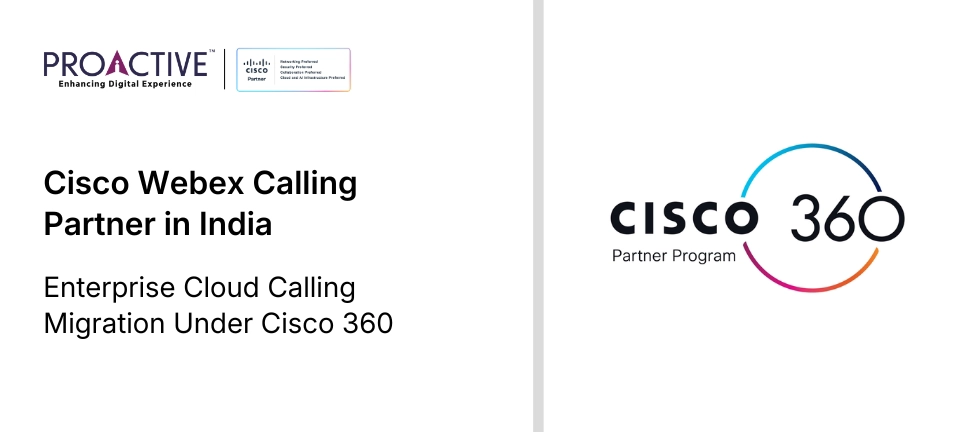
A Cisco Webex Calling Partner in India supporting enterprise migration should demonstrate Cisco Preferred status within the Collaboration portfolio under the Cisco 360 Partner Program, validated through a 7.5 or higher Partner Value Index score.
From an analyst perspective, this shift mirrors broader enterprise telephony trends: value has migrated from hardware control to software governance, identity integration, and lifecycle analytics. The constraint is rarely call routing logic. It is operating model maturity during and after migration.
A Cisco Webex Calling Partner in India must demonstrate more than deployment capability. Under the Cisco 360 Partner Program, partners holding Cisco Preferred status within the Collaboration portfolio have crossed the 7.5 Partner Value Index threshold, reflecting validated lifecycle maturity, adoption governance, and recurring optimisation discipline.
For large Indian enterprises, migration risk lies less in activation and more in continuity, integration, and long-term governance.
Migration success is determined after go-live, not at cutover.
Migration to Cisco Webex Calling in large Indian enterprises typically includes:
For enterprises operating across Delhi NCR, Mumbai, Pune, Bengaluru, Hyderabad, Chennai, and tier-2 hubs, these components must be coordinated nationally under a unified governance model.
Enterprises searching for a Cisco Webex Calling partner in India or a Cisco cloud telephony partner in India should evaluate demonstrated multi-city migration experience rather than single-site deployment references.
Technical deployment is predictable. Governance continuity is not. At scale, migration complexity compounds when enterprises operate multiple legacy PBX platforms, hybrid SIP environments, and region-specific PSTN integrations. The technical cutover can be scripted. User behaviour, adoption discipline, and post-migration optimisation cannot.
Indian enterprises face additional migration variables:
A Cisco Webex Calling partner in India must demonstrate structured experience in handling telecom coordination, number porting complexity, and phased branch migration without service disruption.
Webex Calling Customer Success: Indian Manufacturing Sector
In enterprise programmes exceeding thousands of endpoints, migration risk typically shifts from configuration to orchestration. Governance breakdown during staggered rollouts often produces inconsistent dial plans, QoS misalignment, and fragmented reporting structures.
For enterprises evaluating a Cisco Collaboration Partner in India or a Cisco cloud calling partner in India, Preferred validation under Cisco 360 should be treated as a measurable governance indicator.
Under Cisco 360, Collaboration portfolio validation evaluates:
To earn Cisco Preferred Collaboration status, a partner must independently achieve the 7.5 Partner Value Index threshold within the Collaboration domain under Cisco 360.
This threshold is portfolio-specific and does not transfer across Networking, Security, Cloud + AI, or Services portfolios.
This provides a quantifiable signal that Webex Calling capability extends beyond deployment projects into lifecycle governance.
Enterprise Webex Calling migrations in India often fail due to:
These failures typically surface weeks after go-live. A Cisco Preferred Collaboration Partner in India operating under Cisco 360 validation reduces ambiguity by embedding lifecycle oversight into migration programs.
The 7.5 Partner Value Index threshold within the Collaboration portfolio acts as a quantitative proxy for adoption maturity and recurring engagement discipline. It does not eliminate migration risk, but it reduces uncertainty regarding lifecycle governance capability.
For enterprises migrating Webex Calling nationally, governance must include:
Without structured governance, cloud calling fragmentation mirrors legacy PBX silos.
When selecting a Cisco Webex Calling partner in India, enterprises should verify:
For organisations issuing RFPs for Cisco Webex Calling, Cisco cloud telephony, enterprise VoIP migration, or cloud PBX replacement in India, portfolio-specific Preferred validation under Cisco 360 should function as a commercial qualification filter.
Enterprises comparing a Cisco Collaboration Partner in India with a traditional system integrator should anchor evaluation decisions to measurable lifecycle governance validation rather than license volume or project scale alone.
Proactive Data Systems holds Cisco Preferred validation within the Collaboration portfolio under the Cisco 360 framework and supports enterprise Webex Calling migrations across India with structured lifecycle governance models.
For multi-city enterprises, this reflects validated adoption discipline and post-migration optimisation capability rather than project-only deployment execution.
Migrating to Cisco Webex Calling is not a technology event. It is a governance transition.
For Indian enterprises evaluating a Cisco Webex Calling Partner in India, lifecycle validation under Cisco 360 should be treated as a structural risk filter.
Cloud calling stability is not secured at activation. It is secured in a sustained lifecycle execution.
For boards and CXOs, Webex Calling migration should therefore be evaluated not as a telecom refresh, but as an operating model transition requiring structured lifecycle accountability across networking, security, identity, and managed services layers.
We'll get back to you shortly.