Updated: 13 February 2026
Most organisations invested heavily in CRMs to create a single view of the customer. Many also moved voice to the cloud to gain scale and flexibility. Yet customers still repeat themselves on calls, agents still hunt for context, and managers still lack clean call trails.
This gap is not a technology failure. It is an integration failure.
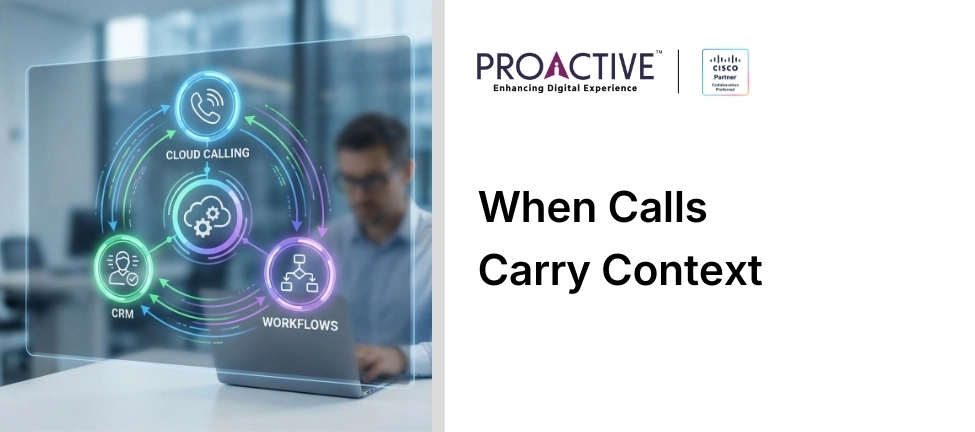
When cloud calling runs beside CRM instead of through it, customer experience suffers in quiet but costly ways. Cloud calling and CRM integration refers to linking voice interactions directly with customer records and workflows, so calls trigger actions, preserve context, and remain auditable. Calls lose context. Workflows break. Accountability fades.
The real question is not whether you have CRM and VoIP. It is whether they work together when a customer actually calls.
CRMs track intent, history, and ownership. Voice captures emotion, urgency, and resolution. When these two stay disconnected, teams operate blind during the most human moment of the customer journey.
An inbound call lands. The agent answers without context. The customer explains the issue again. Notes are added later, if at all. The CRM updates hours after the conversation ends.
You should pause here and ask yourself a blunt question. When a customer calls your business, does your system recognise them before your agent does?
Cloud calling turns voice into software. That shift makes integration possible at scale.
Modern cloud calling platforms integrate natively or through supported connectors with leading CRMs such as Salesforce and Microsoft Dynamics 365, as well as service platforms like ServiceNow. This allows voice events to interact directly with customer records instead of sitting outside core systems.
Instead of treating calls as isolated events, cloud calling allows voice to trigger workflows. Screen pops surface customer records as inbound calls arrive. Inbound and outbound calls update records in real time. Screen pops show customer records as calls arrive. Call outcomes update deal stages. Recordings attach to cases. Missed calls create tasks instead of excuses.
This is not about convenience. It is about closing the gap between what your customer says and what your systems remember.
Most integrations fail in predictable ways.
Call logs do not sync consistently. Agents log notes outside the CRM. Recordings sit in separate systems. Workflows trigger on emails but ignore calls. These problems grow under pressure. High call volumes, shift changes, and distributed teams expose weak links.
A support organisation in Noida serving enterprise customers across India faced this daily. Agents used cloud calling. CRM adoption looked strong on paper. Yet call outcomes rarely reflected in cases. Customer satisfaction slipped. The issue was not effort. It was design.
Many vendors sell connectors for platforms like Salesforce, Dynamics 365, and ServiceNow. Few design workflows.
A connector links systems. A workflow defines behaviour. When a call ends, what happens next? Does the case update? Does the owner change? Does a follow-up task appear? Does a recording attach automatically?
High-performing teams answer these questions upfront. They do not rely on manual discipline. Cloud calling integrated with CRM allows voice to become an event driver, not just a record. That is where customer experience improves.
Voice data is customer data. Regulators treat it that way.
Call recordings, retention policies, consent, and access control matter in regulated industries. When recordings live outside CRM workflows, audits become painful.
A BFSI services firm operating from Mumbai and Ahmedabad learned this during an internal audit. Call recordings existed. Proving linkage to customer cases took weeks. The problem was fragmentation, not non-compliance.
Integrated voice workflows ensure call evidence stays tied to customer records, a growing concern for Indian enterprises operating across cities, states, and regulatory environments. That matters when questions arise months later. If an auditor asked you to trace a customer call today, how confident would you feel?
Sales teams care about momentum. Support teams care about resolution. Both depend on context. Click-to-call from CRM reduces friction. Automatic call logging saves time. Real-time screen pops reduce awkward pauses. Follow-up workflows keep conversations moving.
These gains compound across teams. Fewer dropped threads. Clearer ownership. Better customer memory. This is how VoIP stops being an IT upgrade and starts affecting revenue and retention.
As volumes grow, cracks appear.
Multiple CRMs, regional processes, custom fields, and legacy habits complicate integration. Without ownership, integrations decay. This is where Proactive brings value beyond configuration. Whether the CRM is Salesforce, Microsoft Dynamics 365, or a service platform such as ServiceNow, Proactive focuses on how voice events flow through real business processes, not just whether systems connect. Proactive designs and runs cloud calling environments where CRM, workflows, and voice operate as one system. The focus stays on data integrity, workflow clarity, and day-two operations.
Cisco platforms provide the calling foundation. Proactive ensures voice events land where business decisions happen. That difference matters once the novelty wears off.
An inbound call arrives at a customer support centre in Pune. The agent sees the account, open cases, and past interactions before speaking. The call updates the case automatically. The recording attaches. A follow-up task triggers without manual effort.
Nothing dramatic. Just continuity. Customers notice this more than any script.
Organisations that link cloud calling with CRM see faster resolution, cleaner data, and fewer customer complaints rooted in repetition.
Voice stops leaking context. Workflows regain control.
If customer experience matters to your business, voice cannot sit outside your systems. Integration is no longer optional. Execution decides whether it becomes an asset or a liability.
Can Cloud Calling Integrate With Salesforce Or Microsoft Dynamics 365?
Yes. Modern cloud calling platforms integrate with leading CRMs such as Salesforce and Microsoft Dynamics 365, either natively or through supported connectors. The value comes not from the connection itself, but from how call events update records, trigger workflows, and preserve context without manual effort.
Do Calls Automatically Log Into CRM Records?
They can, if the integration is designed correctly. In strong implementations, inbound and outbound calls log automatically against leads, contacts, or cases, along with timestamps, outcomes, and ownership. When this fails, it is usually due to workflow gaps rather than platform limits.
Can Call Recordings Be Stored Against CRM Cases?
Yes, call recordings can attach to CRM records, subject to policy and consent rules. This is critical for quality reviews, dispute resolution, and audits. Problems arise when recordings sit in separate systems without a reliable link to customer records.
Why Do CRM And VoIP Integrations Often Break After Go-Live?
Most break due to ownership drift. CRM changes, new fields appear, teams change processes, but calling workflows stay frozen. Without ongoing governance, data sync degrades quietly until teams stop trusting the system.
Who Owns CRM And Cloud Calling Integration, IT Or Business Teams?
Both. IT owns architecture, security, and reliability. Business teams own workflows, outcomes, and data quality. Integrations fail when one side assumes the other is responsible.
Is CRM And Cloud Calling Integration Important For Audits?
Yes. In regulated environments, auditors often ask how customer calls link to cases, decisions, and outcomes. Integrated workflows make this traceable. Fragmented systems turn audits into reconstruction exercises.

Proactive Collaboration Team
We'll get back to you shortly.