Updated: 25 March 2026
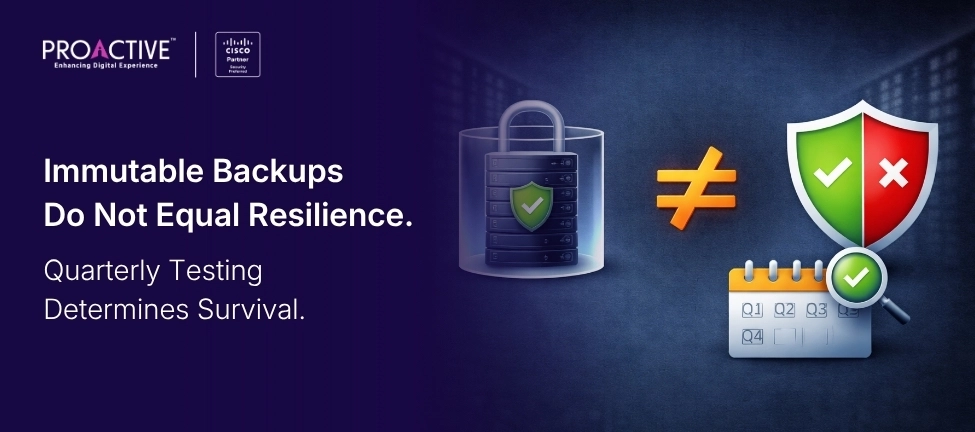
Immutable backups reduce ransomware blast radius. They do not guarantee recoverability.
Quarterly validation of restore integrity, access control, and failover sequencing determines operational survival.
Across Indian enterprises, ransomware recovery strategy discussions often begin and end with immutable backups. For CISOs searching for an immutable backups ransomware recovery framework, this is where risk concentration begins. The assumption is simple: if backups cannot be altered, recovery is assured. That assumption is flawed.
Immutability prevents deletion or modification of stored data. It does not validate restoration speed, dependency mapping, identity integrity, or business continuity sequencing. Boards in BFSI, IT/ITeS, manufacturing, and healthcare sectors increasingly recognise that recovery failure is a governance lapse, not a technical anomaly. An effective cyber resilience model requires quarterly validation. Anything less converts backup into a compliance checkbox.
Sector: Large Indian manufacturing enterprise
Backup posture: Immutable object storage with 30-day retention
Incident: Ransomware encryption across ERP and production systems
Backup integrity: Confirmed intact
Time to full operational restore: 96 hours
Revenue impact during downtime: Estimated INR 18 crore
Post-incident analysis revealed:
Identity infrastructure was not restored in the correct sequence
Backup catalogue indexing was outdated
Network segmentation rules blocked recovery traffic
Application dependencies were undocumented
Backups were intact. Recovery architecture was not rehearsed.
Immutable storage protects against deletion and tampering. It does not protect against contaminated recovery logic.
Advanced ransomware campaigns typically follow this sequence:
Initial access and privilege escalation
Lateral movement and domain dominance
Snapshot poisoning during dwell time
Backup catalogue reconnaissance
Coordinated encryption and extortion
If the attacker dwell time exceeds the snapshot interval frequency, backups may capture already-compromised states.
Example modelling:
Snapshot frequency: Every 12 hours
Undetected dwell time: 36 hours
Result: Three consecutive restore points potentially contaminated
In this scenario, immutability preserves corrupted data with perfect integrity.
Identity systems are the primary target.
If Active Directory or equivalent identity infrastructure is compromised:
Backup console credentials may be exposed
Restore orchestration can be manipulated
Recovered workloads can be re-encrypted post-restore
Immutable storage without identity isolation is partial control.
Quarterly Recovery Confidence Model
Quarterly restore testing for ransomware recovery must test four measurable dimensions. This forms the core of an immutable backups quarterly testing framework.
| Dimension | Target Benchmark | Board Risk if Below Threshold |
|---|---|---|
| Tier-1 Workload Test Coverage | ≥ 70% tested quarterly | Recovery assumptions unverified |
| Measured RTO Variance | ≤ 20% deviation from stated RTO | Financial planning distortion |
| Identity Rebuild Time | < 6 hours for privileged core | Extended operational paralysis |
| Snapshot Clean Validation | Independent malware scan of restore set | Reinfection risk |
Recovery Confidence Index (RCI) Model:
RCI = (Coverage Score × 0.30) + (RTO Accuracy × 0.25) + (Identity Isolation Score × 0.25) + (Clean Snapshot Validation × 0.20)
Where each component is scored 0–1 based on tested evidence.
An RCI below 0.75 indicates structural recovery risk.
This converts resilience from architecture belief into a measurable governance signal.
Detection latency directly influences snapshot integrity. If Mean Time to Detect exceeds snapshot interval cadence, the probability of restore contamination increases materially.
Quarterly validation must therefore simulate both encrypted-state restore and contaminated-snapshot recovery scenarios.
Boards should require evidence of:
Documented restore drill outcomes within the last 90 days
Measured Recovery Time Objective versus tested performance
Identity infrastructure rebuild validation
Backup console access segregation
Independent audit of immutable storage configuration
If these cannot be produced within one board cycle, resilience remains unproven.
Under the Digital Personal Data Protection Act, 2023, Indian enterprises must implement reasonable security safeguards to prevent personal data breaches. Where ransomware disrupts access to personal data, regulators may evaluate whether backup and restore testing formed part of those safeguards. Where ransomware leads to personal data unavailability or compromise, the inability to restore in a timely manner may weaken claims of proportionate safeguards.
Sector regulators in BFSI and critical infrastructure increasingly evaluate operational continuity as part of cybersecurity oversight. Recovery capability is therefore both a statutory and supervisory concern.
Architecture Translation: Backup vs Resilience Framework
| Component | Backup-Centric Model | Resilience-Centric Model |
|---|---|---|
| Storage | Immutable object store | Immutable + tested restore orchestration |
| Identity | Shared admin accounts | Segregated privileged rebuild process |
| Monitoring | Backup job success alerts | Restore rehearsal telemetry |
| Governance | Annual audit | Quarterly validation evidence |
| Board Visibility | Storage metrics | Operational recovery dashboard |
A resilience-centric model treats restore capability as a structural control layer.
Proactive is a Cisco Preferred Security Partner supporting Indian enterprises in designing ransomware recovery architecture, identity-centric controls, and quarterly restore validation models. In resilience design, emphasis lies on identity-centric enforcement, segmented recovery networks, and verifiable quarterly restore governance.
Forensic Restore Walkthrough: 72-Hour Simulation Model
A recovery strategy must withstand operational sequencing pressure.
| Time | Event | Control Failure | Required Recovery Action |
|---|---|---|---|
| T+0 | Encryption detected | Privileged account misuse | Immediate network isolation |
| T+2h | Backup console login attempt | Shared credential exposure | |
| T+6h | Snapshot selected | 12-hour interval gap | Malware validation of restore set |
| T+12h | Restore initiated | Identity dependency conflict | Clean-room AD rebuild |
| T+24h | Tier-1 app partial recovery | Undocumented dependencies | Manual sequencing correction |
| T+48h | External disclosure risk | Delayed customer comms | Legal + board escalation |
Restore integrity is determined by orchestration discipline, not storage durability.
If your board asks the following, can you answer with evidence?
When was the last full Tier-1 restore drill executed?
What percentage of revenue-critical workloads are tested quarterly?
What is our measured Recovery Time Objective variance?
How long does it take to rebuild core identity infrastructure in isolation?
What is the financial exposure per hour of operational downtime?
If responses rely on architecture diagrams rather than drill results, resilience remains theoretical.
"Immutable" means unalterable.
It does not mean recoverable.
It does not mean isolated.
It does not mean rehearsed.
Immutability preserves state. It does not validate operational continuity.
A resilient model requires structural separation.
Dedicated recovery VLAN isolated from production
Separate identity forest for restore validation
Offline credential vault for backup console access
Snapshot malware scanning sandbox
Controlled workload reintroduction protocol
Without clean-room validation, restored systems may reintroduce latent compromise.
Boards evaluate downtime in financial terms.
Downtime Exposure Formula:
Hourly Revenue × Operational Dependency Factor × Contractual Penalty Multiplier
Illustrative example:
Rs 3 crore per hour × 0.6 dependency factor × 1.2 contractual multiplier = Rs 2.16 crore effective exposure per hour
A 48-hour restore delay under this model results in a potential impact exceeding Rs 100 crore before regulatory or reputational cost is considered.
Financial modelling converts recovery testing from a technical exercise into capital protection.
Immutable backups reduce ransomware risk. They do not eliminate ransomware recovery failure. Recovery failure is rarely a storage problem. It is a sequencing problem, an identity problem, or a governance problem.
If you have not tested full restore capability within the last 90 days, you do not have cyber resilience. You have storage. CISOs who validate restore capability quarterly convert resilience from assumption into measurable control evidence. Boards should demand proof.
Immutable backups reduce risk. They do not eliminate it.
Recovery failure is rarely a storage problem. It is a sequencing problem, an identity problem, or a governance problem. CISOs who test restore capability quarterly convert resilience from assumption to evidence. Boards should demand proof, not architecture diagrams.

Alok Sah Head, Cybersecurity, Proactive Data Systems
We'll get back to you shortly.