Updated: 26 February 2026
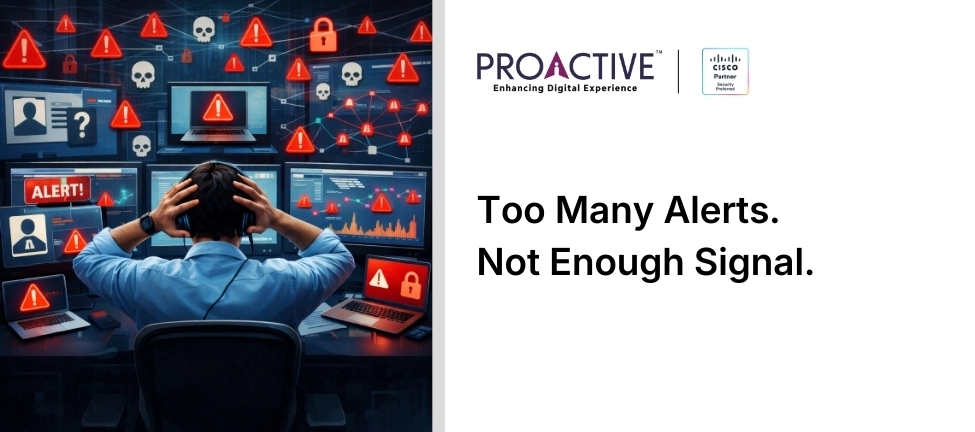
Security Operations Centres in Indian enterprises often run more tools than they can operationalise. If alerts outnumber analysts and telemetry remains uncorrelated, detection slows, and compliance risk increases. Consolidate around identity, endpoint, network, and cloud telemetry with measurable outcomes.
SOC tool sprawl refers to the uncontrolled expansion of security products across endpoint, network, email, cloud, vulnerability management, and threat intelligence platforms without unified correlation, workflow integration, or measurable detection improvement.
In many Indian enterprises, the SOC stack grows through incremental procurement decisions. Each new risk results in another product. Integration lags behind acquisition.
The result is alert volume without clarity.
SOC consolidation is the structured rationalisation of security tools, telemetry sources, detection logic, and analyst workflows to reduce alert duplication, improve cross-domain correlation, and produce measurable improvement in mean time to detect and respond.
SOC consolidation does not mean removing every tool. It means:
Defining core telemetry domains, identity, endpoint, network, cloud
Eliminating redundant alert sources
Standardising severity scoring
Aligning detection use cases to business risk
Integrating investigation workflows into a unified view
In practical terms, SOC consolidation replaces tool accumulation with outcome-driven detection architecture.
A financial services firm in Mumbai deployed separate tools for EDR, NDR, email security, cloud monitoring, and SIEM ingestion. Analysts manually pivoted between consoles to investigate a single incident. Mean time to detect exceeded four hours. Mean time to respond stretched further.
The board did not ask how many tools were deployed. It asked why detection was slow and why alert noise remained high despite investment. Tool count does not equal detection maturity.
Operational consequences of tool sprawl include:
Duplicate alerts triggered by the same activity across different platforms
Conflicting severity classifications for identical events
Manual correlation between identity misuse and endpoint compromise
Limited visibility into east-west network movement
Analyst fatigue leading to missed escalation
Increased compliance risk due to fragmented log review
From a risk perspective, tool sprawl increases the probability of delayed containment and weakens regulatory defensibility. If you cannot produce a unified incident timeline within minutes, your SOC lacks coherence.
Multiple point solutions with minimal integration
Manual alert triage across consoles
No defined detection engineering programme
Limited KPI measurement beyond alert count
Risk profile: High alert noise, low detection precision.
Logs centralised into SIEM
Basic correlation rules configured
Some automation scripts for response
KPIs tracked inconsistently
Risk profile: Moderate visibility but slow root cause clarity.
Identity, endpoint, network, and cloud telemetry correlated
Defined detection use cases mapped to business risk
Measured MTTD and MTTR targets
Alert reduction through rule tuning and automation
Regular validation through purple team exercises
Risk profile: Reduced noise, improved precision, faster containment.
If your SOC cannot state its MTTD, MTTR, and alert-to-incident conversion ratio, maturity remains low.
SOC consolidation does not mean removing all tools. It means rationalising around core telemetry pillars.
1. Identity Telemetry
Identity logs from directory services, MFA systems, and privileged access must feed central detection. Many breaches begin with credential misuse.
2. Endpoint Detection And Response
Endpoint visibility must integrate with identity events. Correlate login anomalies with endpoint process behaviour.
3. Network And East-West Traffic
Internal traffic visibility reduces blind spots. Segment and monitor lateral movement indicators.
4. Cloud And SaaS Activity
SaaS logs and cloud control plane activity must integrate into central detection workflows.
If these four domains do not correlate within one platform or workflow, analysts operate in fragments.
SOC Consolidation Diagnostic Table
Use this table to assess whether your SOC stack produces clarity or noise.
| Contol Area | Diagnostic Qustion | Yes/No |
|---|---|---|
| Telemetry Integration | Are identity, endpoint, network, and cloud correlated in one investigation view? | |
| Alert Reduction | Has alert volume reduced after rule tuning in the last 6 months? | |
| Detection Use Case | Are detection rules mapped to define business risks? | |
| KPI Measurement | Do you track MTTD and MTTR monthly? | |
| Automation | Are repetitive response tasks automated? | |
| Analyst Efficiency | Can an analyst reconstruct a full attack timeline within 15 minutes? |
If more than three answers are No, your SOC requires consolidation.
XDR vs SIEM vs SOAR: What Changes Operationally
| Capability | Traditional SIEM | XDR | SOAR |
|---|---|---|---|
| Data Ingestion | Log aggregation focused | Native multi-domain telemetry | Dependent on integrated tools |
| Correlation | Rule-based,maual tuning | Built-in cross-domain correlation | Workflow automation layer |
| Analyst Workflow | Console pivoting common | Unified investigation view | Automated playbooks |
| Outcome focus | Log storage and alerting | Detection precision and context | Response orchestration |
SIEM centralises logs. XDR correlates multi-domain signals. SOAR automates response workflows. Consolidation requires alignment between these functions, not blind replacement.
Inventory all SOC tools and log sources
Map alerts to business risks
Identify duplicate detection logic
Define baseline KPIs for MTTD and MTTR
Target outcome: Clear visibility into redundancy and detection gaps.
Consolidate identity, endpoint, and network signals into unified workflows
Retire redundant alert sources
Tune detection rules to reduce false positives
Implement automation for repetitive triage tasks
Target outcome: Reduced alert volume and improved signal precision.
Conduct red-team or purple-team simulation
Measure detection time improvement
Refine correlation logic based on findings
Align reporting dashboards with board-level metrics
Target outcome: Measurable improvement in detection speed and analyst efficiency.
Effective SOC consolidation integrates identity enforcement, secure access telemetry, endpoint detection, network segmentation signals, and cloud control plane activity into one coherent detection model.
A consolidated architecture should:
Ingest telemetry from identity providers, MFA systems, endpoint agents, firewalls, and cloud platforms
Correlate signals across domains without manual console pivoting
Map detection use cases to defined business risks such as fraud, data exfiltration, and ransomware
Standardise severity scoring across alert sources
Provide unified investigation timelines with contextual enrichment
For enterprises across Delhi NCR, Mumbai, Pune, Bengaluru, and Hyderabad, distributed branch networks increase telemetry complexity. Architecture must standardise logging formats and time synchronisation across all sites to avoid fragmented investigations.
For organisations deploying Cisco XDR, Cisco Secure Access, Cisco Duo, and Cisco ISE, consolidation becomes effective when identity events, remote access telemetry, segmentation policy logs, and endpoint detections feed a unified investigation workflow.
Consolidation succeeds when configuration discipline, detection engineering, and KPI governance align with business risk rather than product features.
Within 90 days, you should demonstrate:
Reduced duplicate alerts across identity, endpoint, and network domains
Unified cross-domain investigation view for analysts
Measured improvement in MTTD and MTTR
Clear KPI dashboard aligned to business risk and board reporting
Defined ownership of detection engineering and rule tuning
Track measurable indicators:
Percentage reduction in total alert volume
Alert-to-incident conversion ratio
Average analyst investigation time per incident
Time required to produce a complete attack timeline
If your SOC cannot demonstrate quantitative improvement, consolidation remains cosmetic.
Proactive Data Systems works with enterprises across India to rationalise SOC architecture, integrate identity and network telemetry, and align detection engineering with measurable outcomes.
As a Cisco Preferred Security Partner, Proactive deploys and operationalises Cisco XDR, Cisco Secure Access, Cisco Duo, and Cisco ISE within a consolidation framework that reduces noise and improves truth in detection.
We assess your tool stack, identify redundancy, define a consolidation roadmap, and validate improvements through controlled simulation. If you want clarity instead of console overload, request a focused SOC Consolidation Assessment.

Amitabh Mishra AGM, Cybersecurity, Proactive Data Systems
We'll get back to you shortly.