Updated: 17 February 2026
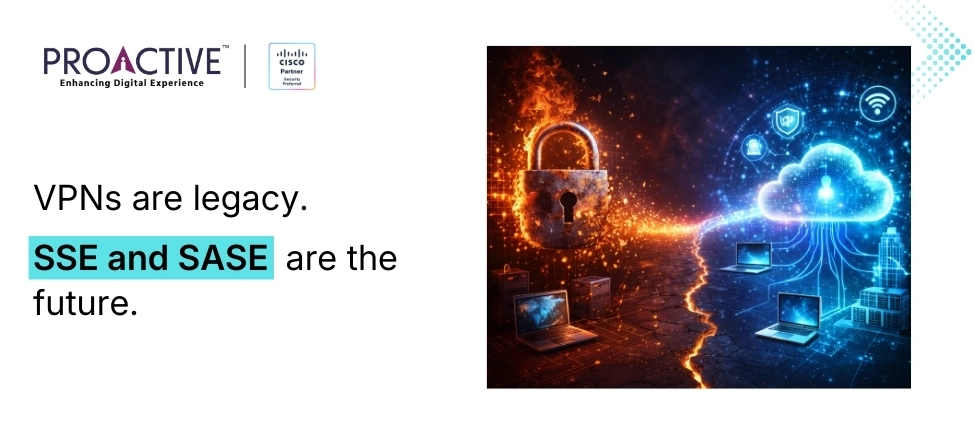
SSE secures user-to-app access, while SASE adds the network layer through SD-WAN. This blog helps you choose the model that fits your architecture, workforce, and compliance needs.
SSE and SASE get used interchangeably, but they are not the same. One focuses on securing access. The other adds the network layer to it. This distinction isn’t academic. It shapes how you design, implement, and manage secure access across your workforce, sites, and multi-cloud environments.
If you choose the wrong model, you risk tool sprawl, policy gaps, or unnecessary complexity. Worse, you might end up with a solution that adds latency or breaks compliance reporting. Choosing between SSE and SASE is not just a product decision; it’s an architectural one.
SSE (Security Service Edge) refers to a cloud-delivered security framework that integrates:
Secure Web Gateway (SWG): Real-time inspection of web traffic to block malicious URLs, enforce acceptable use, and control data transfers
Cloud Access Security Broker (CASB): Visibility and control over SaaS usage, enforcing data loss prevention and shadow IT discovery
Zero Trust Network Access (ZTNA): Access policies based on user identity, device posture, and session risk rather than IP or network location
SASE (Secure Access Service Edge) includes all the above plus SD-WAN, enabling intelligent routing of traffic between branch offices, data centres, and cloud services, with security built into the fabric.
Key Differences That Affect Architecture and Operations
| Feature | SSE (Security Service Edge) | SASE (Secure Access + SD-WAN) |
|---|---|---|
| Core Components | SWG, CASB, ZTNA | SSE + SD-WAN |
| Focus | Secure remote and SaaS access | Secure site-to-site and cloud access |
| Includes Routing Control? | No | Yes |
| Deployment Model | Cloud-native | Hybrid (hardware + cloud) |
| Ideal For | Cloud-first organisations, remote workforces | Multi-site networks, MPLS replacement |
| Management Layer | SSE portal, often API integrated | SSE portal, often API integrated |
| Common Vendors | Cisco, Zscaler, Netskope | Cisco, Palo Alto, Fortinet |
If your business runs on SaaS, supports a distributed workforce, and needs secure remote access to apps like Salesforce, Office 365, or internal portals, SSE delivers all necessary controls without touching your network fabric.
Typical high-intent use cases include:
Secure remote workforce access using ZTNA instead of VPN
Data loss prevention for SaaS apps via inline CASB policies
DNS-layer protection through Secure Web Gateway to block threats early
Cloud security posture management (CSPM) for visibility across sanctioned and unsanctioned apps
For example, Proactive deployed Cisco SSE for a fast-scaling fintech in Indore, enabling risk-based access and application-layer control across 1,100 endpoints, with zero change to their WAN. Incident response improved with centralised logging via SecureX. Licensing was modular, and rollout took under two weeks.
Enterprises with branch-heavy footprints, MPLS cost pressure, or the need for WAN optimisation benefit more from full SASE. SASE blends SD-WAN with the security stack of SSE to optimise both performance and protection.
High-intent SASE adoption signals include:
Modernising MPLS networks with SD-WAN
Unified network and security policy enforcement across sites
WAN cost reduction without losing control or visibility
Granular routing policies integrated with identity-based access
In one deployment, Proactive helped a logistics player in Gurgaon replace MPLS routers with Cisco Meraki SD-WAN and layered Cisco Secure Access on top. The result: real-time traffic steering, threat inspection, and compliance-grade logging. User experience improved, bandwidth costs dropped, and IT gained full-stack visibility.
Cisco provides a full spectrum of secure access solutions:
Cisco Umbrella: SWG with DNS-layer security, malware blocking
Cloudlock: CASB for app visibility, file sharing control
Secure Access: ZTNA with adaptive policy enforcement
Duo Security: MFA and device trust for identity-driven access
SecureX: Centralised visibility, SIEM/SOAR integrations
Cisco SD-WAN: Meraki or Viptela for site routing and network fabric control
What makes this stack effective is its ability to unify policy, visibility, and enforcement across user, device, app, and network.
Cisco tools need strategic implementation. You need a partner that aligns SSE or SASE with business objectives, compliance mandates, and India-specific infrastructure realities.
Proactive, a Cisco Preferred Security Partner, conducts architecture reviews, policy design, and phased rollouts. We handle:
Integration with Azure AD, Okta, and on-prem directories
DLP rule design mapped to data classification frameworks
Logging setup for CERT-In and RBI reporting readiness
Zero-trust access frameworks aligned to SEBI/ISO 27001
We’ve delivered both SSE and full SASE in manufacturing, BPO, fintech, and healthcare. We don’t just enable access. We make it observable, enforceable, and measurable.
SSE and SASE both solve secure access. The difference lies in scope. SSE is modular and fast to deploy. SASE is broader, touching routing, and is better suited for enterprises consolidating WAN and security.
Proactive helps you assess:
User-to-app risk vectors
Network topology maturity
SaaS and IaaS adoption
Compliance and audit needs
Get a clear answer. Book a no-obligation architecture walkthrough with Proactive.
SSE or SASE? The right choice secures your users, protects your data, and respects your network. Let Proactive guide the architecture that fits.
Proactive Cybersecurity Team
We'll get back to you shortly.