
Updated: 14 August 2025
You moved meetings to the cloud. Voice still sits on a branch PBX, a gateway that no one wants to touch, and a help desk that learns each site by trial. Do you keep running Webex Calling on your own, or do you bring in an operator to run it as a service? The right answer depends on the scale you plan to reach, the controls you must prove, and the hours your team can cover.
DIY looks simple on paper because Control Hub centralises policy, routing, numbers, devices, and analytics. In practice, you own a full stack.
If you run DIY, you must write and follow runbooks. You must staff nights and weekends. You must keep documentation current when sites expand in Delhi NCR, Bengaluru, Pune, Mumbai, and Hyderabad.
DIY fits when you run a single site, or two, with a steady headcount and low change volume. You can template the build, schedule monthly windows, and keep a small roster. DIY is daunting when you add sites every quarter, when audit demands grow, or when leaders expect near-zero disruption. It also fails when your team cannot sustain 24×7 alert triage and carrier escalations. The risk is not features missing; the risk is operational drag that slows hiring, sales, and support.
You keep the policy. You stay in Control Hub with full visibility. You approve changes. An operator runs the roster, the runbooks, and the escalations.
Policy, priorities, exceptions, admin access, and the monthly scorecard review.
Alert triage, incident response, routine MACD, firmware windows, and RCAs with timers.
A standard dial plan across cities. A change desk that treats voice like a programme with tests and rollback. A reporting rhythm that ends guesswork.
Webex Calling has reached more than 15 million users across 150-plus markets, which signals maturity and feature depth. Source: Cisco, Spring Summer 2024 release.
You must respect toll bypass controls. Keep PSTN and VoIP domains separate for calls that leave the enterprise. Map emergency rules to each location. Pick Cloud Connected PSTN where eligible, pick Local Gateway when premises trunks or local breakout make sense. Document exceptions and revisit them at each service review. Add branch survivability so basic calling continues during a link event.
Answer these in a room with your IT lead, finance, and operations.
Sites in the next 12 months, one to two, DIY with strong templates. Three to ten, consider a managed layer. More than ten, add an operator now.
Change volume per month, low, DIY cadence works. Medium to high, managed change desk with CAB, UAT, and backout.
Coverage for 24x7, if you cannot staff nights and weekends, shift alert triage and incidents.
Audit pressure from clients or regulators, if you need recording, exports, or strict RBAC, insist on documented runbooks and monthly reviews.
Pick a one-page scorecard and hold to it.
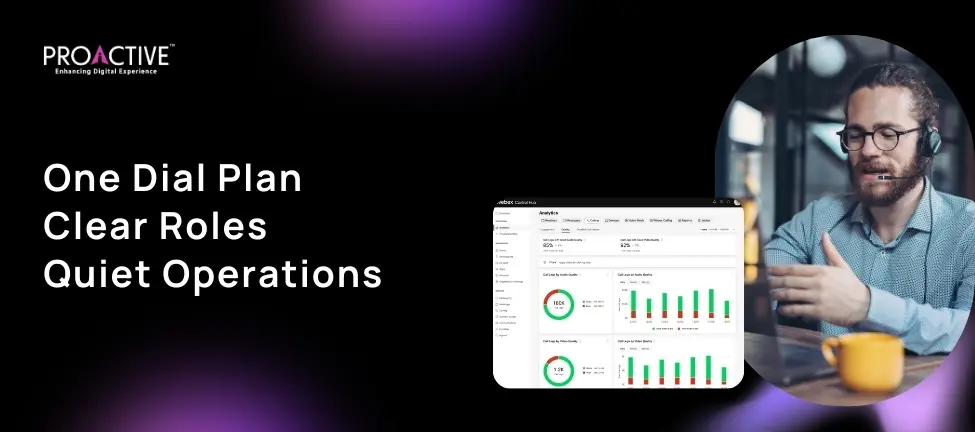
Control Hub provides the telemetry. You set thresholds, alerts, and owners. Validate each cutover with before and after data.
You do not need a portal; you need an operator. Proactive standardises dial plans for India, runs change with real tests and rollback, and closes incidents with evidence and RCA. We run 24x7, coordinate TAC and carriers, and document every step. You keep policy and oversight. We keep the roster, the runbooks, and the response timers.
Start with one pilot site and a fixed change window. Write the dial plan, map PSTN per location, and define alerts. Run the pilot, review the scorecard, and scale in waves. Voice should behave like a utility, predictable and quiet.
Request a Cloud Calling Readiness Review or a Webex Calling Design Workshop. Write to [email protected].

Proactive Collaboration Team
We'll get back to you shortly.
