Updated: 30 June 2026
"AI factory" sounds like a phrase invented to sell GPUs. Strip the marketing away, though, and there is a real and useful idea underneath, one worth understanding before you approve a budget line that has it written on top. This guide gives you the substance in a few minutes, in language you can repeat in a board meeting without wincing.
An AI factory is infrastructure purpose-built to produce artificial intelligence at scale, rather than to store and serve data. NVIDIA, which popularised the term, frames it as infrastructure that "manufactures intelligence", measured in the tokens an AI model generates. Where a traditional data center runs your applications, an AI factory exists to train and run AI models as its primary job.
That single shift, AI as the main output rather than one more application, is what changes the engineering underneath. Everything else in the building exists to keep the GPUs productive.
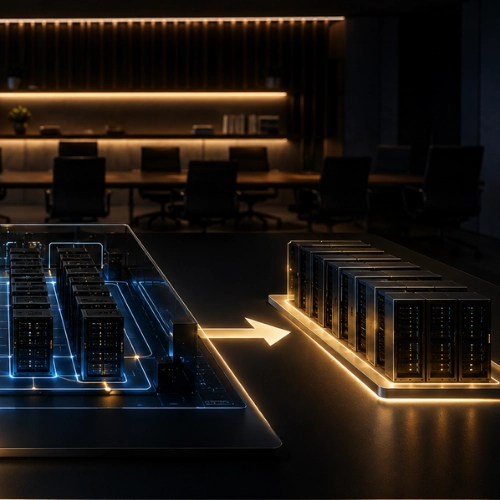
They differ in purpose, and so in almost every design choice that follows. A traditional data center is built around general-purpose CPUs running databases and business applications. An AI factory is built around GPUs running model training and inference, with storage, networking, power and cooling all sized to keep those GPUs fed and running. One is measured in uptime and transactions; the other in tokens produced per rupee of cost.
| Dimension | Traditional Data Center | AI Factory |
|---|---|---|
| Primary output | Applications, transactions, stored data | AI tokens (predictions, generated output) |
| Core hardware | General-purpose CPU servers | GPU-accelerated servers |
| Networking | North-south, moderate bandwidth | Low-latency east-west fabric between GPUs |
| Power & cooling | ~5–10 kW racks, air-cooled | 25–40 kW racks, often liquid-cooled |
| Success metric | Uptime, throughput | Tokens per second, cost per token |
| Best for | Business applications, virtualization | Training and running AI models at scale |
The practical takeaway: you cannot make a data center AI-ready simply by adding GPUs to a spare rack. The power, cooling and networking have to change with them.
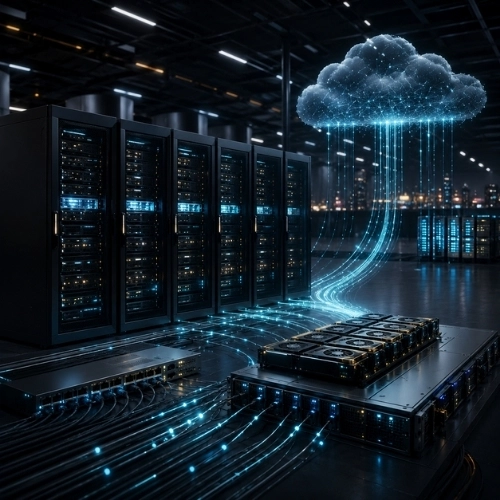
Four layers, engineered as one system. GPU-accelerated compute does the work. High-throughput storage feeds the GPUs fast enough that they are not left waiting. A low-latency east-west network lets the GPUs work together as a cluster rather than as isolated machines. And dense power and cooling carries the heat, with rack densities climbing toward 25 to 40 kW, past the point air cooling alone can manage and into liquid cooling.
Get one layer wrong and the most expensive layer suffers for it. A GPU cluster starved by slow storage, or throttled by an ordinary network, is costly idle metal. The design discipline is in the balance, not in any single component.
Not necessarily, and that is the honest answer few vendors give. You need AI-factory infrastructure when you run sustained AI training or inference at meaningful scale, especially on data that must stay inside your control. If your AI use is occasional, experimental or light, public cloud or GPU-as-a-Service is usually the better economic fit, and renting beats building.
The question is not "is AI important". It is "are my AI workloads steady and sensitive enough to justify owning the infrastructure". For regulated data and production-grade, always-on models, the answer increasingly tips toward building, often on-premises or as sovereign AI so the data never leaves your boundary. Where do your workloads sit on that line today, and where will they sit in a year?
Understanding the term is the easy part. Sizing the GPUs to your models, building storage and networking that will not starve them, and confirming your facility can power and cool the result, that is the work that turns a budget line into a system that earns its cost.
Proactive Data Systems designs, builds and runs AI infrastructure for Indian enterprises, on-premises, hybrid and sovereign. We are a Cisco Preferred Cloud and AI Partner, Dell Platinum Partner and NetApp Preferred Partner, with 35 years in enterprise IT, more than 1,500 organisations served, and a 24/7 service desk in India. If you are weighing whether an AI factory is right for your workloads, ask us for an AI-readiness assessment, and we will tell you honestly whether to build or to rent. Write to [email protected].

Muhammad Shariq General Manager, Data Center, Proactive Data Systems
We'll get back to you shortly.