Updated: 01 July 2026
The boards have approved the AI. The data centers underneath them are mostly not ready for it. That is the quiet gap behind every stalled AI programme: an ambition signed off at the top, running on infrastructure that was never built to carry it. "AI-ready" is not a slogan. It is a specific, buildable standard, and this guide sets out exactly what it means, what it costs, and how to reach it without rebuilding from scratch.
It is written for the CIO or CTO who has to turn an AI mandate into infrastructure that actually works in production, in India, under Indian rules. Read it as the map; each section links to the detail beneath it.
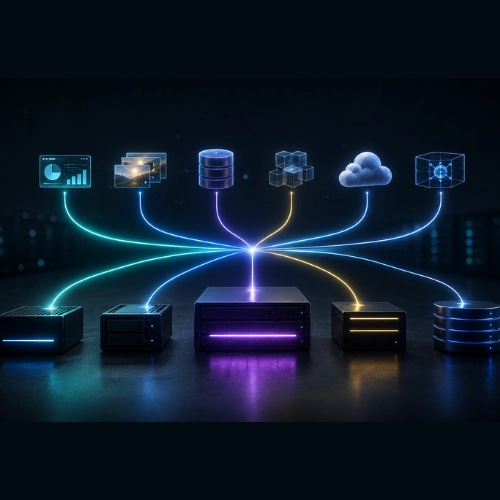
An AI-ready data center, often called an AI factory, is infrastructure built to train and run AI models as its primary workload, rather than to store and serve data. It pairs GPU-accelerated compute with storage fast enough to feed the GPUs, low-latency networking between them, and the power and cooling density dense AI racks demand. The defining shift is that AI is the main output, not one more application, and the whole facility is engineered to keep the GPUs productive. That single change, AI as the primary workload, is why you cannot reach AI-readiness by adding a GPU to a spare rack.
A traditional data center runs business applications on general-purpose CPUs and is measured in uptime and transactions. An AI-ready data center runs models on GPUs and is measured in tokens produced and cost per token. The consequences cascade: far higher power per rack, liquid cooling where air no longer suffices, and a low-latency east-west network so GPUs work as a cluster rather than as isolated machines. The difference is in kind, not degree.
Four layers, engineered as one system. Get one wrong and the most expensive layer, the GPUs, sits idle waiting for it. The table is the architecture in brief.
| Layer | What It Does | Why AI Needs More Of It | Built On |
|---|---|---|---|
| GPU compute | Trains and runs the models | The workhorse; everything else exists to keep it busy | NVIDIA-accelerated Dell, HPE, Cisco, Lenovo |
| Storag | Feeds data to the GPUs | Slow storage starves expensive GPUs | All-flash and high-throughput NetApp, Dell, Hitachi, HPE |
| Networking | Connects GPUs into a cluster | Training and inference depend on low-latency east-west traffic | Spine-and-leaf on Cisco, Dell, HPE |
| Power & cooling | Carries the heat | AI racks now reach 25–40 kW, past air-cooling limits | High-density power; increasingly liquid cooling |
The discipline is balance. A fast GPU cluster fed by slow storage, or throttled by an ordinary network, is costly idle metal. Build the four together, or do not build at all.
In stages, starting with the facility, not the GPUs. Making a data center AI-ready usually means adding GPU compute, upgrading to higher-throughput storage and higher-bandwidth east-west networking, and confirming that power and cooling can carry the much higher density, often with liquid cooling. The most common and most expensive mistake is buying the GPUs before checking the building can power and cool them. Survey the facility first, design the upgrade in phases, and you add AI capability without a forklift rebuild.
It depends on how steady and how sensitive the workload is. Bursty, experimental work suits the cloud, which you can spin up in hours and pay for by the hour. Steady, high-utilisation production tends to cost less on owned infrastructure once the hardware is busy enough to amortise. And workloads touching regulated data often belong in a sovereign or private deployment that keeps the data in-country and inside your boundary. Most enterprises end up hybrid, placing each workload where its usage and its risk fit. The full cost logic and the broader decision are covered in the companion pieces on on-prem versus cloud AI.
You size from the model outward, not the catalogue inward. The models you intend to train or serve, and the concurrency they must handle, set the GPU count. The GPU count sets the storage throughput and network bandwidth needed to keep them fed. All of it sets the power and cooling envelope, which the facility must be confirmed able to carry. Size from a vendor's reference rack instead, and you tend to over-buy the hardware and under-build the facility, the worst of both.
It makes where your AI data lives a design decision. India's Digital Personal Data Protection Rules were notified in November 2025, with the substantive obligations taking effect from 13 May 2027. A model that trains or runs on personal data inherits that data's obligations, so if you cannot show where your AI pipeline's data sits and who accessed it, you have an infrastructure gap, not a paperwork one. For sensitive workloads, residency-by-design, on-premises or sovereign, is the prudent posture, because the rules can tighten and certain data may be required to stay in India.
Often because the pilot infrastructure was never built to become a product. A demo on one borrowed GPU proves the idea, not the system; production needs a sized cluster, a live data pipeline, low-latency networking, governance and a defensible cost per token, none of which existed at pilot scale. Designing for production from the start, rather than discovering the gap after the demo succeeds, is what turns an AI-ready data center from a budget line into a working capability.
Three things, and they reinforce each other. First, momentum: a national AI mission and heavy private investment are pulling AI infrastructure into the mainstream faster than most roadmaps assumed. Second, the physical reality: power costs and cooling design vary by state, and dense GPU racks test facilities not built for them, so the engineering has to be local. Third, the rules: DPDP and sector regulations make residency a first-class design constraint, not an afterthought. An AI-ready data center built for India is built around all three, not a global template dropped in.
An AI-ready data center is a systems problem spanning GPUs, storage, networking, facilities, governance and compliance. Assembling that breadth under deadline is hard, which is why the build partner matters as much as the design, and why a lifecycle partner beats a box-seller when the pilot finally has to run in production.
Proactive Data Systems designs, builds and runs AI-ready data centers for Indian enterprises, on-premises, hybrid and sovereign. We are a Cisco Preferred Cloud and AI Partner, Dell Platinum Partner and NetApp Preferred Partner, with 35 years in enterprise IT, more than 1,500 organisations served, and a 24/7 service desk in India. We size the GPUs to your models, build the storage and fabric to feed them, confirm the facility can carry them, and add AI-readiness in stages rather than a rebuild.
Bring us your AI roadmap and your current environment, and we will map the path to an AI-ready data center. Ask us for an AI-readiness assessment.
Disclaimer: This guide provides general information on AI infrastructure and references to India's data-protection framework. It is not legal, financial or compliance advice. Costs, specifications and regulations vary and change. Confirm your specific obligations with qualified advisers and build a model on your own requirements before committing budget.

Sandeep Chandrashekar Peshwe Regional Head, Pune, Proactive Data Systems
We'll get back to you shortly.