Updated: 23 October 2026
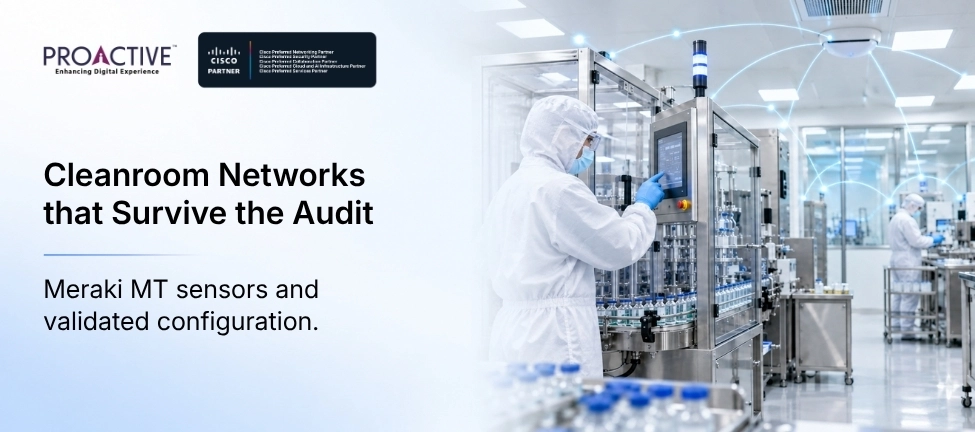
Managed networks for Indian pharma and cleanroom engineering cover cleanroom environmental monitoring via Meraki MT sensors, batch record system availability, GxP-scoped network segmentation, and audit-ready configuration control aligned to Schedule M (Indian D&C Rules), 21 CFR Part 11 and ALCOA+ data integrity principles. Delivered on Cisco Meraki by a Cisco Penta-Preferred Partner under the Cisco 360 Partner Program.
Written for Pharma IT Heads, Heads of Quality Assurance, Cleanroom Engineering leads, Validation leads and CISOs in Indian pharma manufacturing, contract development and manufacturing (CDMO), biosimilar and vaccine facilities.
An FDA inspector, an EU Notified Body auditor or a Schedule M inspector walks into your plant and, before touching a batch record, asks a question that decides the tone of the entire visit.
Show me the configuration change history for your batch record system network for the last twelve months, with attribution.
If the answer is a spreadsheet somebody exported the night before, the audit becomes adversarial. If the answer is a version-controlled log with named reviewers, dated changes, and a documented rollback path for every entry, the audit becomes procedural. The difference is not the batch data. The difference is whether the network operating around the batch data is run as a validated system or as a best-effort utility.
Pharma networks are a category of their own because they sit inside a validation and audit regime that has no equivalent in retail, BFSI or discrete manufacturing. Managed networks in pharma exist to make the audit procedural.
Four regulatory frames converge on any Indian pharma manufacturing site:
Schedule M of the Drugs and Cosmetics Rules 1945, revised in 2023 and progressively mandatory across Indian pharma manufacturers through late 2024 and into 2025, with extensions for smaller units. It sets minimum GMP requirements for premises, plant, equipment, personnel, sanitation, quality control and data integrity. The revised Schedule M has notably strengthened language on computerised systems, data integrity and change control.
21 CFR Part 11 (US FDA) for any facility exporting to or filed with the FDA. It requires electronic records to be reliable, trustworthy, attributable, and equivalent to paper records for enforcement purposes. Electronic signatures require identity verification and audit trail linkage.
EU Annex 11 for facilities filing with EU regulators. Substantially aligned with Part 11, with additional emphasis on validation lifecycle and risk-based approaches.
ALCOA+ data integrity principles (Attributable, Legible, Contemporaneous, Original, Accurate, plus Complete, Consistent, Enduring, Available). Applied by every serious pharma auditor, whether Schedule M, FDA, EU or WHO-GMP.
The network is not neutral to any of these. It carries the batch data. It hosts the systems that generate the electronic records. It sits between the cleanroom sensors and the systems that log their readings. A network change without an audit trail is an ALCOA+ violation waiting to be discovered.
The revised Schedule M raised the bar on computerised system control. Beyond validation itself, the practical impact on network operations is fourfold.
Change control that captures attribution. Every configuration change to a network device supporting a validated system must be attributable to a named individual, dated, reviewed, and reversible. "Somebody adjusted the switch VLAN over the weekend" fails the standard immediately.
Segregation between GxP and non-GxP systems. Networks serving batch record systems, laboratory information management systems (LIMS), manufacturing execution systems (MES) and environmental monitoring systems must be segregated from general corporate traffic, guest Wi-Fi and OT that is not GxP-scoped.
Environmental monitoring with continuous data availability. Cleanroom temperature, humidity, differential pressure and particle count data must be captured continuously, stored with integrity, and retrievable for the entire retention period (typically five to seven years depending on product and market).
Audit-ready evidence on demand. The inspector does not schedule the question. The evidence has to be produced within the visit, not "sent over next week".
A managed network with the right operating discipline produces all four by default.
The ALCOA+ principles are usually discussed in the context of laboratory data. They apply equally to the network change log.
Attributable. The change was made by a named individual, not a shared account, not a generic service account. The reviewer is also named.
Legible. The change record is readable, not a cryptic diff, and includes the reason for the change.
Contemporaneous. The change was logged at the time of change, not reconstructed later.
Original. The primary record is preserved, not overwritten. Version history is intact.
Accurate. The record reflects what actually changed, verifiable against configuration state.
Complete. All parts of the change are recorded, including any dependent changes.
Consistent. Recorded in a consistent format across all changes, all sites, all systems.
Enduring. Retained for the applicable retention period, not lost when the person or the vendor leaves.
Available. Retrievable on demand, not requiring an eight-hour data extraction exercise.
Managed contracts on Meraki networks in pharma bake ALCOA+ into the change control workflow: every proposed change ships with a change record before it lands, reviewer sign-off is captured in the ticket, the Meraki configuration versioning preserves before-and-after state, and the entire history is exportable for audit review.
Meraki MT sensors have become a common choice for cleanroom environmental monitoring on new-build and refurbished Indian pharma sites, because the sensors self-configure on the Meraki dashboard, integrate with the same operations team as the network, and produce continuous data at the level of granularity the ALCOA+ framework expects.
Deployed in a cleanroom, MT sensors typically cover:
Temperature. 2-8°C for cold-chain storage, 15-25°C for controlled ambient rooms, targeted set points for specific processes (crystallisation, freeze-drying, tabletting).
Humidity. Percentage relative humidity within specification for the room class and process.
Differential pressure. Between cleanroom zones of different classification (ISO 5, 6, 7, 8) to ensure air flow moves from cleaner to less clean and not the reverse.
Door open events. Cleanroom airlock discipline; unexpected door open events are a batch-risk signal.
Water leak detection. Utility corridors, chilled water, WFI (Water for Injection) systems.
Under a managed contract, the MT sensor coverage plan is designed against the cleanroom qualification documentation, alerts are routed to the QA function and the maintenance team simultaneously, thresholds are set with QA sign-off (not IT), and calibration schedules are tracked. Historical data is exportable in formats that fit into batch review documentation.
The auditor looks for four things. Continuous coverage without gaps. Alert response evidence when a threshold was breached. Data integrity: the readings written by the sensor match the readings retrieved from the system. And validation: the sensor deployment was itself validated against the site's URS.
The batch record system is the beating heart of a modern Indian pharma facility. When it is up, batches move. When it wobbles, the site pays in three directions at once.
Batch delay or discard. A batch in mid-manufacture when the electronic batch record (eBR) system is unreachable may run into hold states, rework, or, in a worst case discard, depending on the batch value and the stage. For high-value biologics or speciality pharmaceuticals, a discarded batch can cost tens of lakhs to over a crore.
Data integrity exposure. A batch record system that goes down during a run creates a data gap. The gap has to be reconstructed, documented, deviations filed, and root-cause analysed. ALCOA+ "Contemporaneous" gets tested.
Audit exposure. Repeated availability incidents against the eBR or LIMS become a pattern the auditor notices. A pattern raises the risk category of the facility, which cascades into more frequent inspections and slower filings.
A managed network protects the batch record system's availability by treating the network path to that system as critical infrastructure: redundancy in the path, monitoring at the level of application reachability (not just device status), change control that never touches the path during a manufacturing run, and 24x7 coverage for continuous-process sites.
The single most valuable segmentation decision in a pharma facility is between the GxP-scoped network and everything else.
GxP-scoped: the batch record system, LIMS, MES, EBR (electronic batch record), environmental monitoring systems, validated instruments, and the network segments carrying their traffic.
Non-GxP: corporate IT (email, ERP financial modules, general productivity), guest Wi-Fi, OT that is not part of the validated system inventory, and administrative systems.
The Meraki architecture applies this cleanly through VLANs, firewall zones between them, and Auto-VPN policy that keeps GxP traffic on defined paths. Under a managed contract, the segmentation is designed once, applied through templates, and audited every quarter. Any temporary rule that touches the GxP scope requires QA sign-off, not just IT sign-off.
The value at audit is precise. When the inspector asks "show me the network devices in scope for computerised system validation", the answer is a defined list generated from the segmentation, not a hunt across the whole estate.
Beyond the cleanroom itself, Indian pharma networks carry environmental monitoring for cold-chain warehousing, vaccine distribution hubs, biologic storage and clinical trial material handling.
MT sensor coverage extends here to freezer arrays (typically 2-8°C for standard cold chain, -20°C for extended storage, and specialised sensors for -70°C ultra-cold), transit staging (for material moving between production and distribution), and stability chambers (for accelerated and long-term stability studies).
Under a managed contract, alerts on temperature excursions in cold chain go to QA, maintenance and the on-call manager simultaneously; response protocols are documented, and every excursion (even those within tolerance) is logged for cumulative review. The regulator does not just want the excursions logged; the regulator wants the response evidence.
Three commercial models, chosen with QA and validation lifecycle in mind.
CapEx suits established sites with stable qualification and validation state. Hardware bought, capitalised, and integrated into the site's validated inventory. Refresh planned inside the qualification review cycle.
OPEX suits new builds, expansion sites, and CDMOs adding capacity. Per-site subscription pricing simplifies the capital case. Refresh handled inside the term. Validation status has to be considered in the OPEX contract because hardware changes trigger revalidation; the contract should specify the process for equipment substitution during the term.
Managed-Only suits sites with a recently qualified Meraki estate that want to hand operations to a specialist while keeping the asset and validation records untouched.
Multi-site pharma enterprises often mix: OPEX for a new biologics facility being commissioned, CapEx at the flagship formulations plant where validation is settled, Managed-Only at older API sites where the estate is stable.
Two days at your primary manufacturing site, with your Head of IT, Head of Quality Assurance, Validation lead and Cleanroom Engineering lead. We take a snapshot of the network estate serving the GxP scope, map it against ALCOA+ and the current Schedule M provisions, run the MT sensor coverage against your cleanroom qualification documentation, and hand you a written finding by end of week. If the estate is well-run, we say so. If we can help you tighten audit posture, we quote the fix.
Disclaimer: Regulatory references (Schedule M, 21 CFR Part 11, EU Annex 11, ALCOA+) in this piece are drawn from currently published guidance and are for operational orientation, not regulatory advice. Compliance status for any specific facility depends on site validation, URS documentation, QMS integration and inspection outcome. A qualified Regulatory Affairs professional, QA consultant or validation lead is the definitive voice on GxP scope and compliance posture.

Alok Sah Head, Cybersecurity, Proactive Data Systems
We'll get back to you shortly.