Updated: 19 June 2026

India now hosts more than 1,700 global capability centres, over half the world's total, employing close to two million people (IBEF). Each one is a piece of a global enterprise, expected to look, behave and report like every other site that enterprise runs, from Dublin to Dallas. And each one sits on the Indian ground, with Indian power, Indian last-mile connectivity and Indian regulation. The network is where those two facts collide, and where "global standard" most often quietly slips.
A GCC network has a harder brief than an ordinary office. It must match the parent company's architecture closely enough to be managed from a global operations centre, secured to a global posture, and integrated into a global backbone, while being built fast, run locally around the clock, and made compliant with Indian law. Get it right, and the India campus is indistinguishable from any other corporate site, only larger and busier. Get it wrong and global IT inherits a site that needs special handling forever. Here is how to build it to standard.
Three pressures at once that an ordinary campus never faces together. The first is conformance: the network must mirror the global enterprise's reference architecture, not a locally improvised design, so that global IT can manage and trust it. The second is speed: GCCs scale quickly, taking large floors and filling thousands of seats on timelines that leave little room for a leisurely build. The third is duality: the site answers to two compliance regimes, the parent's global frameworks and India's own laws, simultaneously.
Most local network projects optimise for one of these and neglect the rest. A fast fit-out that ignores the global standard produces a site that global IT cannot absorb. A faithful copy of the global design that ignores Indian power, connectivity and regulation produces a campus that does not work where it stands. The GCC brief is to satisfy all three, which is why it rewards a builder who understands both the global enterprise world and the Indian one. Does your India campus look, to your global NOC, like just another site, or like an exception they have learned to work around?
It means the India campus is built on the same architecture, vendor and security model as the rest of the enterprise, so it slots into the global estate rather than sitting beside it. For the large share of global enterprises standardised on Cisco, that means a campus built on Catalyst switching, an SD-Access fabric with identity-based segmentation through ISE, and Catalyst SD-WAN tying the site into the global backbone, managed through the same controllers and observed with the same telemetry the parent uses everywhere else.
The value of that conformance is operational, not cosmetic. When the India campus runs the same design as Frankfurt and Singapore, the global team can manage it with the same tools and runbooks, apply policy centrally, and trust that a control proven elsewhere works here too. A GCC that diverges from the standard, different switches, a bespoke security model, and a one-off management approach become a permanent tax on global operations. Standardisation is what lets a CIO treat the India site as part of the whole rather than a project that never quite closes.
By making speed a property of standardisation, not a trade against it. The GCCs that fit out quickly do so because they apply a known reference design rather than engineering each floor from scratch, pre-stage and pre-configure equipment before it reaches the site, and use zero-touch provisioning so switches and routers configure themselves centrally on power-up. Repetition, not haste, is what compresses the timeline.
The corner that must never be cut for speed is security and compliance. A campus rushed into service with flat networking and segmentation "to follow later" creates an exposure that is far slower to fix than it would have been to build correctly. The discipline is to bake the global security posture into the standard design itself, so that deploying fast and deploying compliant are the same act. A fit-out done this way is quick because the design is settled, the kit is staged, and the process is repeatable, not because anything important was skipped. How fast can you open a new floor today without a security exception trailing behind it?
By designing for the stricter union of the two, not the easier of them. A GCC typically inherits global frameworks from its parent, ISO 27001, SOC 2, and for European parents, the demands of GDPR, alongside India's Digital Personal Data Protection regime. These overlap heavily, and the network controls that satisfy one tend to satisfy the others, because they all ask for access control, segmentation, monitoring and the ability to contain a breach.
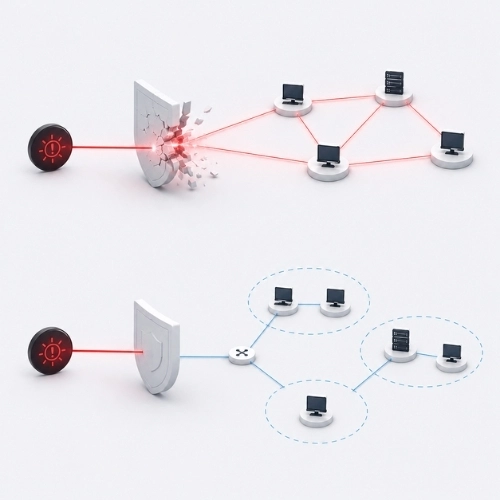
Identity-based segmentation is the shared answer. It restricts which systems and users can reach sensitive data, produces the access logs these frameworks expect, and confines an intrusion so a breach stays small, which matters for India's DPDP rules and their penalties as much as for the parent's audit. Data residency adds an Indian wrinkle worth designing for early: where regulated data must stay in India, the architecture has to keep it there and prove it. Built once to the stricter standard, the India campus passes the parent's audit and the Indian regulator's test with the same controls, rather than maintaining two overlapping compliance stories.
It looks like local hands working toward global consistency, around the clock. A GCC often runs in a follow-the-sun model, so the India campus may be carrying production for the whole enterprise while headquarters sleeps, which makes 24x7 operational coverage a requirement rather than a nicety. The network must be observable and supportable both from the global operations centre and from someone who can be on site in Bengaluru or Hyderabad when hardware fails at 3 a.m.
This is where many GCC builds disappoint after a strong start. The fit-out completes, the global team takes over remote management, and then a local fault has no local owner, because day-2 operations were never arranged. The campus needs a support model that pairs the global tooling and standards with genuine Indian presence: spares stocked in India, engineers who can reach the site, and integration into the enterprise's incident and change processes so a local fix is recorded globally. A GCC network is only as good as the second year of running it, not the first month of building it.
The art of a GCC build is knowing which decisions belong to the global standard and which to Indian reality. The split usually looks like this
| Element | Standardise To Global | Localise To India |
|---|---|---|
| Architecture and security model | Mirror the enterprise design (Catalyst, SD-Access, ISE) | — |
| Management and monitoring | Global controllers, tooling and policy | Local engineers for hands-on day-2 work |
| Connectivity | Global SD-WAN and backbone policy | Local leased-line and ILL providers, redundant last mile |
| Compliance | Global frameworks (ISO 27001, SOC 2, GDPR) | India DPDP and data-residency requirements |
| Facilities and power | — | Indian power, UPS, cooling, the physical fit-out |
| Support | Global SLAs and processes | 24x7 local presence and spares in India |
The principle is to standardise the design and the policy, and localise the delivery and the physical realities. A CIO who keeps that line clear gets a campus that is globally consistent where consistency matters and locally grounded where the ground demands it. Blur the line, by localising the architecture or by ignoring Indian facilities, and the site becomes either an exception or a liability.
A GCC is not an island; its value is in working closely with the rest of the enterprise, which puts weight on how the campus joins the global network. Catalyst SD-WAN links the India site into the corporate backbone over a mix of international leased lines and internet transport, applying the same central policy as every other site and steering collaboration traffic, the video calls and shared applications that connect India to headquarters, down the best available path. Where the enterprise has moved toward a cloud-delivered security edge, the India campus should plug into it the same way the rest of the estate does.
Latency and resilience are the practical concerns. Teams in India collaborating in real time with colleagues abroad feel every avoidable delay, and a single international link is a single point of failure for a site the whole enterprise may depend on during its working day. The connectivity design, redundant paths, sensible transport choices, and quality treatment for collaboration are what make the India campus feel like part of the enterprise rather than a remote outpost reached over a fragile pipe.
The recurring gap in GCC builds is a partner who can hold both ends at once: fluent in the global enterprise's architecture and standards, and grounded in Indian fit-outs, connectivity, regulation and day-2 operations. Global system integrators often understand the standard but not the Indian ground; local vendors often deliver the fit-out but not to the global design. The GCC needs both in one team.
Proactive Data Systems has spent 35 years building and running networks for Indian enterprises and the India sites of global ones, across more than 1,500 customers, as a Cisco Preferred Partner in Networking, Security, Collaboration, Cloud and AI, and Services. We build GCC campuses to the parent's Cisco standard, segmented and compliant with both global frameworks and India's DPDP, fit them out fast through pre-staging and standard designs, connect them into the global backbone, and run day-2 operations from a 24x7 NOC in India with CCIE-led design and spares held locally. Global standard, delivered and operated on Indian ground.
Setting up or scaling a GCC campus in India? Ask Proactive to build it to your global standard and run it locally. The India site should be your easiest campus to manage, not your exception.

Kunal Hans CTO, Proactive Data Systems
We'll get back to you shortly.