Updated: 10 July 2026
Servers get bought two ways: by habit, whatever we bought last time, and by price, whatever is cheapest this quarter. Both ignore the only questions that decide whether the purchase pays off: what the workload actually needs, how much power and heat it will draw, and how long it has to last. Choose the form factor, the sizing or the source carelessly, and you pay for it every month for the next five years. This guide matches the three main server types, rack, blade and GPU, to the workloads, power envelopes and refresh cycles they suit, so you buy for the work ahead rather than the quote in front of you.
By starting from the workload and its future, not the price list. Three questions frame the decision: what does the workload demand in compute, memory and acceleration; what power and cooling envelope can your facility provide; and how long must this server serve before the next refresh? The form factor, rack, blade or GPU, follows from those answers.
Buying on headline price alone tends to produce a server that is wrong for the workload, expensive to power, or stranded without support, none of which shows up on the quote but all of which shows up in the running cost.
Three matters for the enterprise.
Most enterprises run a mix of the first three, each where it fits.
The table sets the three side by side on the factors that decide the choice.
| Factor | Rack Server | Blade Server | GPU Server |
|---|---|---|---|
| Best for | General workloads, virtualisation, mixed estates | Density, consolidation, shared infrastructure | AI, machine learning, accelerated workloads |
| Density | Moderate | High | High, but power-limited |
| Power & cooling | Standard | Higher per rack; shared | Very high; often needs liquid cooling |
| Flexibility | High; mix and scale freely | Tied to the chassis | Specialised |
| Trade-off | Floor space and cabling at scale | Chassis investment; vendor lock | Facility must power and cool it |
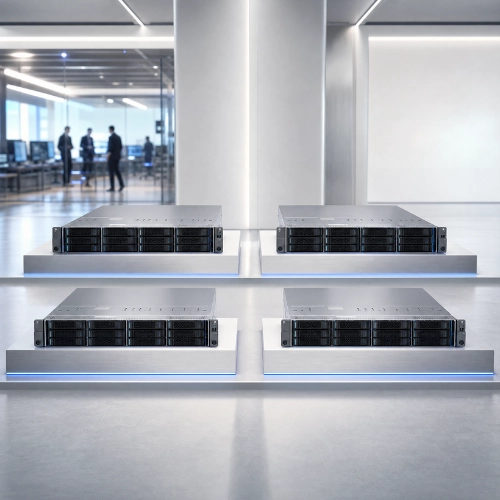
When you want flexibility and your workloads are varied. Rack servers are the sensible default for most enterprise estates: easy to mix, scale and refresh independently, and well suited to virtualisation, databases and general applications. A rack server is usually the right server for virtualisation in a mixed estate, because you can size each one to its role and add more without committing to a shared chassis. The trade-off is that at large scale, racks consume more floor space and cabling than a denser design, but for most enterprises the flexibility outweighs that.
When density and consolidation matter more than per-unit flexibility. Blade servers pack more compute into less space by sharing power, cooling and networking across a chassis, which suits consolidated estates and environments where rack space is at a premium. The trade-offs are a higher up-front investment in the chassis and a degree of lock-in to that vendor's blade ecosystem. For an estate that will fill the chassis and values the density, blades pay off; for a smaller or more varied estate, the rack server's flexibility is usually the better fit.
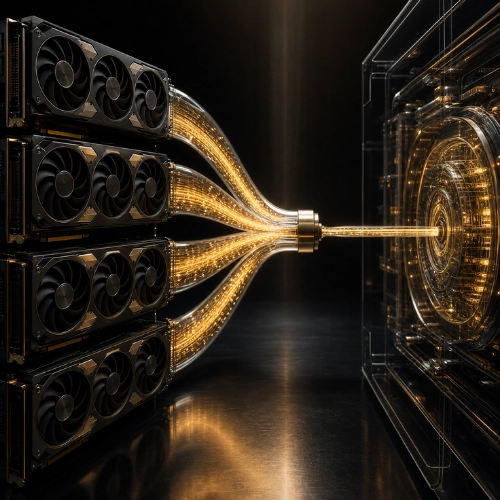
When the workload is AI, machine learning or another parallel task that accelerators do far faster than CPUs. GPU servers deliver the performance these workloads need, but they belong to the AI conversation as much as the compute one, because they draw far more power and heat than a standard server. A GPU server dropped into a facility that cannot power or cool it is a stranded purchase, so the facility check comes before the order. If you are building AI infrastructure, size the GPU servers to the models you will run and design the power and cooling around them, rather than treating a GPU server as an ordinary box with a card added.
Three factors decide the true cost and are routinely underestimated. Power and cooling: a server's draw, multiplied across the estate and the year, is a real operating cost, and dense or GPU servers can exceed what a facility was designed for. Refresh cycle: a server bought for the lowest price today but retired or unsupported in two years costs more than one specified to serve its full life. And source: in the Indian market, the gap between genuine, fully warranted OEM hardware and grey-market stock with no support path is the difference between a quote that looks cheap and a server that becomes a liability the day a component fails. Specifying for power, lifespan and genuine supply is how a partner-grade purchase beats a marketplace listing.
Diagnose, then specify. Establish what each workload genuinely needs in compute, memory and acceleration, and resist both over-provisioning headroom you will never use and under-provisioning that forces a refresh in two years. Match the form factor to the workload and the facility, and write an RFQ that specifies the workloads, the performance and capacity targets, the power envelope, the support level and genuine OEM supply, so the quotes you receive are comparable and the lowest one is not hiding an omission. That discipline keeps you from buying the wrong server well.
The form-factor decision compounds over the life of the server, which is why it deserves more thought than the price comparison that usually drives it. Matching the server to the workload, the power envelope and the refresh cycle, and sourcing it genuine and supported, is where a multi-OEM partner adds more than a single-vendor reseller or a marketplace listing.
Proactive Data Systems specifies, supplies and supports enterprise servers for Indian organisations across Cisco UCS, Dell PowerEdge, HPE ProLiant, Lenovo and IBM, rack, blade and GPU. We are a Cisco Preferred Cloud and AI Partner, Dell Platinum Partner and NetApp Preferred Partner, with 35 years in enterprise IT, more than 1,500 organisations served, and a 24/7 service desk in India, supplying genuine, fully warranted hardware with local support. To specify the right servers for your workloads, you can ask Proactive for a compute assessment.
Disclaimer: This guide is general guidance, not a quote. Server prices vary by configuration, support tier, power and source, and change over time. Obtain a formal quotation for your specific requirement, and confirm genuine OEM supply and warranty, before purchasing.

Dharmendra Gangaram Chourasia Regional Manager, Mumbai, Proactive Data Systems
We'll get back to you shortly.