Updated: 16 June 2026
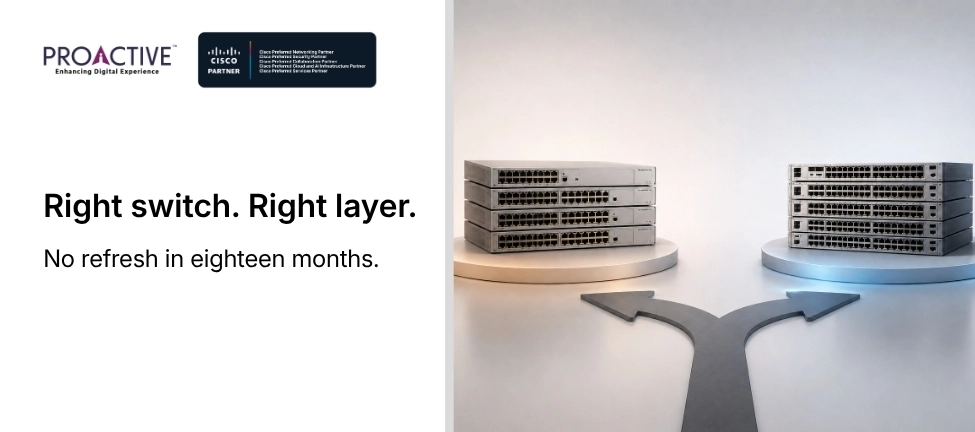
The Catalyst 9300 and 9500 are not rivals on a spec sheet. They are designed for different layers of your network, and confusing them costs money twice: once when you buy the wrong platform, and again when you replace it. This guide gives Indian network architects a direct, technically grounded comparison of both platforms across access, distribution, and core deployments. Read this before the purchase order, not after.
The call came from a plant IT manager in Manesar. Three manufacturing facilities. 9300s at the distribution layer because, as he put it, the spec sheet looked more than adequate. Eighteen months later, shift-change traffic spikes were saturating uplinks daily, latency was spiking across the production floor, and the network needed a full distribution refresh. The switches were not faulty. They were placed in a role they were never designed to carry.
This is the most common network architecture mistake Proactive Data Systems sees across Indian enterprise campuses, and it is almost always preventable.
The Cisco Catalyst 9300 series is a fixed-configuration, stackable access layer platform. Its strengths are well-matched to what access layers actually demand: high port density, IEEE 802.3bt PoE++ for high-draw endpoints, Cisco StackWise-480 for resilient multi-switch stacking, and native UADP 2.0 ASIC support for programmability and security features including Cisco DNA and Security Group Tags.
The 9300 handles downlink aggregation, PoE endpoint power delivery — IP phones, access points, cameras, industrial IoT sensors — and traffic classification well. In a manufacturing environment, the PoE++ capability at the access layer is not a luxury. Plants running IP-based surveillance, industrial wireless APs, and VoIP across shift floors will draw on that power budget heavily.
What the 9300 is not is a high-throughput transit platform. Its uplink module architecture means you are typically working with 4 x 10G or, at best, a limited 25G uplink pool per stack. Stack throughput on a fully populated 9300 stack tops out at 480 Gbps (Cisco Catalyst 9300 Series Datasheet) — sufficient for aggregating access traffic, not sufficient for serving as the convergence point for multiple access stacks simultaneously under peak load.
The Manesar deployment made every individually defensible decision. Each 9300 stack was well within its own port capacity. The problem was aggregate uplink saturation at the distribution layer when all three production floors peaked simultaneously at shift change. The platform could not carry the transit load it had been assigned.
The Cisco Catalyst 9500 series is a modular-ready, high-performance distribution and core platform. The architectural distinction matters: the 9500 is built for throughput, redundancy, and scale at layers where access traffic converges.
The 9500H variant delivers switching capacity up to 25.6 Tbps (Cisco Catalyst 9500H Series Datasheet) with 400G uplink support. The platform supports Stackwise Virtual for chassis-level redundancy without the cost of a true modular chassis. UADP 3.0 provides deeper programmability, more granular QoS policy enforcement, and enhanced telemetry, all of which matter at distribution, where you are enforcing policy for aggregated traffic across multiple access stacks.
For Indian enterprises running large campuses — GCC facilities in Bengaluru or Hyderabad, BFSI data centres in Mumbai, multi-building manufacturing parks in Pune or NCR — the 9500 at distribution gives you the throughput headroom and redundancy model the layer actually requires. A 9500 pair in Stackwise Virtual configuration eliminates the single points of failure that a 9300 stack at distribution cannot address with equal resilience.
The 9500 also delivers where SD-Access fabric deployments are concerned. If your architecture roadmap includes Cisco SD-Access with a fabric border node or distribution-layer policy enforcement, the 9500 is the correct choice. The 9300 can participate in an SD-Access fabric as an access node. It cannot serve as a fabric border or intermediate node without significant design compromises.
Where They Meet: The Comparison That Actually Matters
| Parameter | Catalyst 9300 | Catalyst 9500 |
|---|---|---|
| Intended Layer | Access | Distribution / Core |
| Switching Capacity | Up to 480 Gbps (stack) | Up to 25.6 Tbps |
| Uplink Options | 4 x 10G / limited 25G | 100G / 400G native |
| Stacking Technology | StackWise-480 | StackWise Virtual (VSS) |
| PoE Support | Yes, 802.3bt PoE++ | Limited (not a PoE platform) |
| SD-Access Role | Access node | Border / distribution node |
| UADP Generation | UADP 2.0 | UADP 3.0 |
| Typical India Use Case | Campus floor, branch, plant access | Multi-building campus, DC distribution |
| Price Point | INR entry point appropriate for access | Significantly higher; warranted at core/distribution |
This table is not a ranking. It is a map. Neither platform is superior; they serve different architectural layers, and the correct purchase decision is a function of where in your network the switch will operate.
Juniper EX series, particularly the EX4300 and EX4650, are technically capable platforms worth serious evaluation, particularly where an organisation already runs Junos at the WAN or data centre edge and values operational consistency across vendors.
HPE Aruba CX 6300 and 8400 series have matured considerably. For organisations already committed to Aruba for wireless infrastructure, the fabric integration story is coherent, and the argument for consolidation is real.
Extreme Networks ExtremeXOS platforms remain strong in education and mid-market segments; less so in the high-density enterprise and manufacturing contexts where Indian customers increasingly operate.
The Proactive position: for Indian enterprises with existing Cisco DNA Centre deployments, SD-Access roadmaps, or significant Cisco Security investment, the operational integration argument for 9300/9500 is substantive, not a vendor preference. Integrated telemetry, Security Group Tag enforcement, and native DNA Centre integration at both access and distribution layers do not have precise equivalents in competing platforms today. For greenfield deployments without that installed base, all three alternatives deserve evaluation on their own terms.
The question is not which switch is better. The question is what layer you are designing for, and what that layer will demand in 36 months.
Three questions determine the answer.
Where does your traffic converge?
If a switch is aggregating uplinks from multiple access stacks, it is a distribution device. Put a 9500 there.
What are your peak traffic scenarios?
Shift-change patterns in manufacturing, trading-hour bursts in BFSI, and campus-wide wireless peaks during all-hands events are concentrated, predictable loads that will expose undersized transit platforms. Model the peak, not the average.
What is your SD-Access roadmap?
If you are planning SD-Access within 24 months, your distribution layer selection today determines your fabric border architecture. Do not design yourself into a retrofit.
Proactive Data Systems has been designing campus and enterprise networks since 1991. As a Cisco Preferred Networking Partner, one of the very few partners preferred across all five Cisco portfolios, including Networking, Security, Collaboration, Cloud and AI, and Services, Proactive has deployed both platforms across manufacturing plants, GCC campuses, and BFSI branch networks across India.
Both errors appear in the field. 9500s purchased for access layer deployments where the port density and PoE budget would have been fully served at a lower cost. 9300s placed at distribution, where the platform was asked to carry far more than it was designed to sustain.
The Manesar situation was avoidable. The specification review that preceded it was technically accurate for individual switches. It did not account for aggregate layer behaviour under realistic peak load. That is not a switch problem. It is a design problem.
A correct architecture review before a purchase order is less expensive than a network refresh 18 months later.
Your network architecture does not forgive decisions made to fit a budget template rather than a technical requirement. If you are planning a campus switching refresh, Proactive will review your current topology, model your peak traffic scenarios, and specify the correct platform for each layer — before the purchase order, not after it.
Contact Proactive Data Systems to schedule a network architecture review. Write to [email protected].

Proactive Enterprise Networking Team
We'll get back to you shortly.