Updated: 26 June 2026
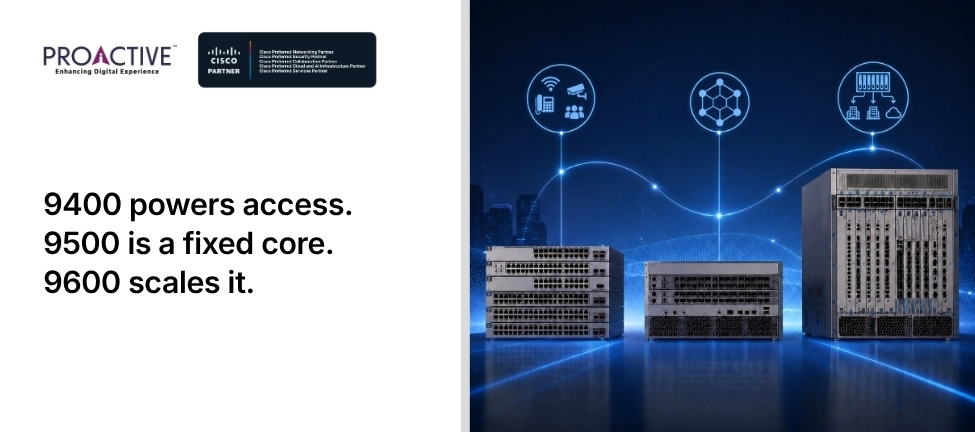
These are the heavyweight switches in the Catalyst 9000 range, the ones you reach for when a stack of fixed switches is no longer enough. They also cause the most expensive confusion, because two of the three target the core and the names give no hint of the differences that matter. Choosing between them on price or model number, rather than role, is how a large campus ends up with the wrong chassis at its centre.
The decision is more straightforward than the spec sheets suggest, and it comes down to two questions: does this switch need to power devices, and does it need redundancy built into the chassis? Answer those and the right platform usually picks itself. Here is what each one is for, and how to choose.
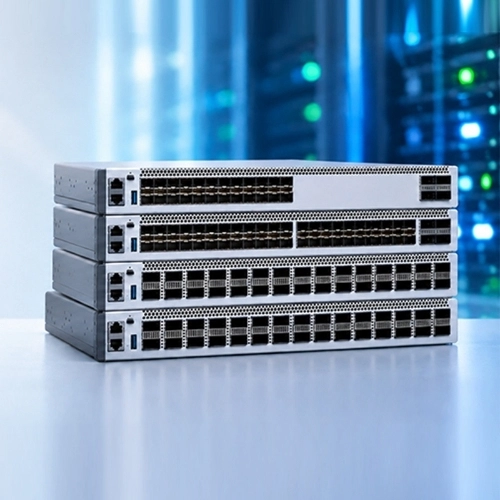
They occupy different roles and form factors. The Catalyst 9400 is a modular chassis for the access and distribution layers, with high-density Power over Ethernet to run devices. The Catalyst 9500 is a fixed switch for core, aggregation and distribution, with high-speed fibre and no PoE. The Catalyst 9600 is a modular chassis for the campus core, with the highest density and in-chassis redundancy, and no PoE (Cisco Catalyst 9600 architecture).
The full comparison shows where each belongs:
| Catalyst 9400 | Catalyst 9500 | Catalyst 9600 | |
|---|---|---|---|
| Form factor | Modular chassis (4/7/10-slot) | Fixed, 1RU | Modular chassis (6-slot) |
| Primary role | Access and building distribution | Core, aggregation, distribution | Core and large campus aggregation |
| Power over Ethernet | Yes, PoE+/UPOE/UPOE+ to 90W | No | No |
| Ports | Line cards: copper/PoE plus fibre | High-density fibre, 10/25/40/100G | Line cards: 10/25/40/100/400G fibre |
| Supervisor redundancy | Dual supervisors in chassis | None in box; StackWise Virtual | Dual supervisors in chassis |
| Scale | High-density access | High-speed, compact | Highest density and throughput, up to 400G |
| Best for | Large closets needing PoE and redundancy | Core or aggregation without chassis complexity | The largest campus cores with room to grow |
High-density access and building distribution, with power and redundancy. The 9400 is a modular chassis, available in four, seven and ten-slot sizes, that you fill with line cards to suit the site. Crucially, among these three it is the one with Power over Ethernet, supporting PoE+, UPOE and UPOE+ up to 90 watts, so it powers the access points, phones, cameras and building systems an access layer connects (Cisco Catalyst 9000 FAQ).
It also brings chassis-level resilience that a stack of fixed switches cannot match. A 9400 chassis holds two supervisor engines, so it supports in-service software upgrades and stateful switchover, keeping the access or distribution layer running through a supervisor failure or an upgrade. You choose a 9400 when a wiring closet or a building needs high-density PoE and the reliability of a redundant chassis rather than a stack.
Core and aggregation, without the complexity of a chassis. The 9500 is a fixed one-rack-unit switch built for high-speed fibre, 10, 25, 40 and 100 gigabit, with deep buffers and the routing scale a backbone needs, and no Power over Ethernet, because it connects switches rather than endpoints. It is the compact, cost-effective way to build a core or aggregation layer when you do not need a modular chassis.
Its redundancy works differently from the chassis switches. Instead of two supervisors in one box, the 9500 uses StackWise Virtual, which makes two physical switches act as one logical core over standard high-speed uplinks. You get a resilient core from two fixed units rather than one redundant chassis. The 9500 suits cores and aggregation points where high-speed switching matters but the scale and chassis redundancy of a 9600 would be more than the design needs.
The largest campus cores, with maximum scale and built-in redundancy. The 9600 is a six-slot modular chassis, with two slots dedicated to redundant supervisors and the rest for line cards, delivering high-density 100-gigabit and, with the newer supervisor, 400-gigabit interfaces (Cisco Catalyst 9600 architecture). Like the 9400 it has dual supervisors for stateful switchover and in-service upgrades, but it is aimed at the core, with no PoE.
It is the modern successor to the large chassis switches that sat at the heart of big campuses for years, and the platform you choose when the core must aggregate a very large network, carry the highest throughput, and grow over time through line-card upgrades rather than replacement. If your core needs chassis redundancy and headroom that a fixed 9500 cannot provide, the 9600 is the answer.
This is the decision most large-campus designs actually wrestle with, because both can sit at the core. The question is scale, redundancy and growth. The 9500 gives you a high-speed core in a compact fixed form, with redundancy through a pair of switches in StackWise Virtual, at lower cost and complexity. The 9600 gives you a modular chassis with in-box supervisor redundancy, far higher port density and scale, 400-gigabit capability, and the ability to grow by adding or upgrading line cards.
Choose the 9500 when a fixed, high-speed core meets your scale and you value simplicity and cost. Choose the 9600 when the core is large enough to justify a chassis, when you want supervisor redundancy and in-service upgrades within a single system, or when you need the density and the room to grow that only a modular platform offers. Buying a 9600 for a core a 9500 would serve wastes money; outgrowing a 9500 you should have built as a 9600 means rebuilding the core. How big is the network this core must carry, today and in five years?
Two questions settle most designs. First, does the switch need to power devices? If yes, it is an access or distribution role and the answer is the 9400, the only one of the three with PoE. Second, if it is a core or aggregation switch with no PoE, does it need a modular chassis with in-box redundancy and high scale, or will a fixed high-speed switch do? Chassis and scale point to the 9600; a compact fixed core points to the 9500.
Put plainly: 9400 for modular access and distribution with power; 9500 for a fixed core or aggregation layer; 9600 for the largest modular cores. The mistake to avoid is treating these as a simple ladder where a higher number is always better. They are different tools for different layers and scales, and the right campus often uses more than one.
Choosing core and distribution platforms for a large campus is a high-stakes design decision, the kind where an over-specified chassis wastes budget and an under-specified one becomes next year's bottleneck. It rewards experience with real campus designs rather than a reading of the data sheets.
Proactive Data Systems, a Cisco Preferred Networking Partner with 35 years of experience and more than 1,500 customers, designs campus cores and distribution layers sized to the network they actually serve, the 9400 where you need modular PoE access, the 9500 for a compact core, the 9600 where scale and chassis redundancy justify it. If you are weighing these platforms for a large campus, ask us to size the core against your real traffic and growth before you commit to a chassis.

Proactive Enterprise Networking Team
We'll get back to you shortly.