Updated: 13 August 2026
The Catalyst 9200 is where budgets get tight, and where the cheapest choice can quietly cost you the most. It is Cisco's entry enterprise access switch, the one procurement reaches for when the 9300 looks dear, and it splits into two lines that look almost identical on a price list and behave very differently on a network: the 9200 and the cheaper 9200L. Buy the wrong one to save a little now, and you inherit limits that force a replacement later.
So the real 9200 price question is not "what does it cost" but "which one, and what does the quote leave out". This guide decodes the 9200 versus 9200L decision, shows where the 9200L's lower price starts to bite, and breaks down the licence, optics and tax that turn a budget switch into a real number. Treat every figure as indicative, not a quote.
There is no single published price. Cisco prices through partners, not a public list, so the cost of a 9200 depends on the model, whether it is a 9200 or a 9200L, the licence tier and term, the uplinks and optics, the support and the discount, before 18 per cent GST. As the budget tier below the 9300, the 9200 is cheaper hardware, but it carries the same mandatory subscription, so the box alone still understates the spend.
The marketplace figures for a 9200 are as unreliable as for any Cisco switch, because they mix new, used and grey-market stock and quote a bare unit without the licence Cisco requires. A price far below the rest usually means used or grey hardware with no valid warranty or transferable licence. Build the budget as a stack, and start by choosing between the two families correctly.
The 9200 is modular and scales further; the 9200L is fixed and cheaper. Both are enterprise access switches with stacking and Power over Ethernet, but the 9200 has field-replaceable uplink modules and fans, higher stacking bandwidth and larger capacity, while the 9200L fixes those to cut cost (Cisco Catalyst 9200 data sheet):
| Catalyst 9200 | Catalyst 9200L | |
|---|---|---|
| Uplinks | Modular, field-replaceable (1/10/25/40G) | Fixed (4x1G, 4x10G or multi-gig) |
| Stacking | StackWise-160, up to 8 switches | StackWise-80, up to 8 (9200L only) |
| Virtual networks (VRF) | Up to 4 | 1 |
| Capacity (lookup tables) | Larger | Smaller |
| Field-replaceable fans | Yes | No |
| Stacks with 9200 / 9300 | Interoperates as designed | No, 9200L stacks only with 9200L |
| Best for | Access needing headroom and more scale | Cost-sensitive, simple, fixed access |
There is also a compact C9200CX line for very small or space-constrained sites. The suffix rules are the same as the rest of the family: the port letter shows power (T is data-only, P is PoE+), and -A is Network Advantage, -E is Network Essentials.
Exactly where a growing or more demanding network needs room, which is why the savings can be false economy. Five limits matter. The fixed uplinks cannot be upgraded, so a 9200L bought with 1G uplinks stays on 1G, while a modular 9200 can move to 10G or 25G later. StackWise-80 gives half the stack bandwidth of the 9200's StackWise-160, which shows on a busy stack. A single virtual network, against the 9200's four, limits how far you can segment traffic, and segmentation is increasingly a security and compliance requirement, not a luxury. The smaller lookup tables set a lower ceiling on the addresses and routes the switch can hold. And the absence of field-replaceable fans means a fan failure is a whole-unit swap rather than a part swap.
None of this makes the 9200L a bad switch. For a small, stable, cost-sensitive site that will never need modular uplinks, deeper segmentation or high stack throughput, it is the right, economical choice. The mistake is buying it into a role that will outgrow it, then paying twice when it hits the ceiling. The honest test: will this site's needs change in the life of the switch? If yes, the modular 9200 usually earns its higher price. If no, the 9200L saves you money cleanly.
Match the model to the site, then read the budget from the family. These are indicative hardware bands only, before licensing, optics, support and GST, and they vary with configuration and discount, so use them to size, not to quote:
| SKU Family | Example SKUs | What It Is | Indicative Hardware Band (Rs.) |
|---|---|---|---|
| 9200CX (compact) | C9200CX-12P, C9200CX-8P | Compact, fanless, small or space-tight sites | ~Rs.0.6–2 lakh |
| 9200L (fixed uplinks) | C9200L-24T/48T, C9200L-24P/48P | Budget access, fixed uplinks, data or PoE+ | ~Rs.1–4 lakh |
| 9200 (modular uplinks) | C9200-24T/48T, C9200-24P/48P | Modular uplinks, field-replaceable, data or PoE+ | ~Rs.2.5–6 lakh |
| 9200 multi-gig | C9200-24PXG/48PXG | Multi-gigabit access for Wi-Fi 6 and beyond | ~Rs.5–9 lakh |
The 9200 sits well below the 9300 on hardware, which is its point. But the next section is where budgets for a "cheap" switch go wrong.
Because the mandatory subscription applies regardless of how cheap the box is. Every Catalyst 9200 carries a perpetual network licence, embedded in the SKU, plus a required Cisco DNA or Catalyst software subscription in a three, five or seven-year term (Cisco Catalyst 9200 ordering guide). Many 9200 deployments use the Essentials tier, which is cheaper than Advantage, but the subscription is still a real, recurring line, and on a low-cost switch, it is a larger proportion of the total than it is on a 9300.
So, a "budget" 9200 is less of a bargain than the hardware price suggests once the subscription is counted, and the renewal must be planned from the start. A quote that shows a low box price and a thin or missing licence line is not cheaper; it is understating the cost you will carry for years. Budget the licence at the tier your features actually need, for the full life of the switch.
The subscription earns part of its cost back if you read the quote. The Cisco DNA and Catalyst subscription includes embedded software support with 24x7 TAC access and software and security updates for the term. That already covers the software half of what a separate SmartNet contract used to provide, so you should not pay twice for TAC and updates.
You still need a hardware-replacement arrangement at the service level your sites require, and on a 9200L, remember that a fan failure means a whole-unit replacement, which makes that hardware cover more important, not less. Ask your partner to show what the subscription includes and to quote only the incremental hardware support on top.
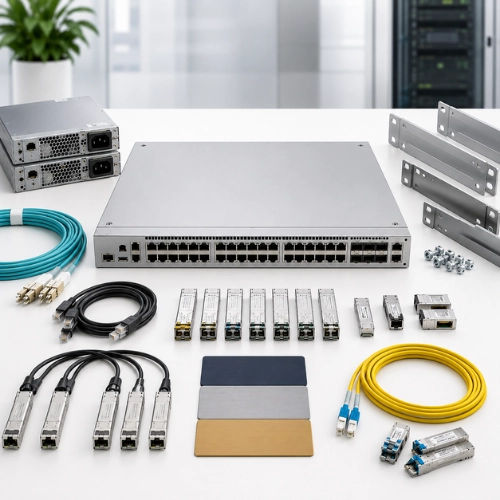
Two more line families and one set of levers. Beyond the box and the licence, budget for uplink optics where the model uses them, a 9200L with fixed uplinks needs the matching transceivers, redundant power where uptime matters, and stacking cables where you are stacking. And build in the India factors: GST at 18 per cent under HSN 8517 62 90, and, unlike routers, switches can attract basic customs duty, which flows into the landed price. Government and PSU buyers add GeM's rules.
The discount, meanwhile, is negotiated, not fixed. The levers that move a 9200 quote are order volume, whether the deal is registered with Cisco, the partner's tier, the subscription term, and any trade-in of old equipment against the new. Because the 9200 is often bought in quantity for access across many floors or sites, volume and deal registration matter more here than on a one-off core switch. The cheapest headline is rarely the best value once the licence tier, optics and non-duplicated support are correct.
A 9200 budget turns on two things a price search cannot give you: the right choice between 9200 and 9200L for each site, and the full stack of licence, optics, support and tax on top of the box. Get both right, and the budget holds; get the model wrong, and you pay again when the 9200L hits a limit.
Proactive Data Systems, a Cisco Preferred Networking Partner with 35 years of experience and more than 1,500 customers, sizes each access site to the right 9200 or 9200L, builds a complete, transparent bill of quantities with the licence, optics, non-duplicated support and GST, and registers the deal to secure the best price on volume access buys. If you are pricing a 9200 rollout, send us the site list or the quote you have, and we will show you the real cost and flag where the cheaper model would bite.
Disclaimer: This article is general budgeting guidance, not a price quote or tax advice. Cisco does not publish street pricing; actual prices depend on model, configuration, licensing, partner discount and current terms, and GST and duty rates can change. Obtain a formal quote from an authorised partner and confirm current tax treatment before budgeting or purchasing.

Deepak Sinha Senior Presales Manager, Enterprise Networking
We'll get back to you shortly.