Updated: 04 May 2026
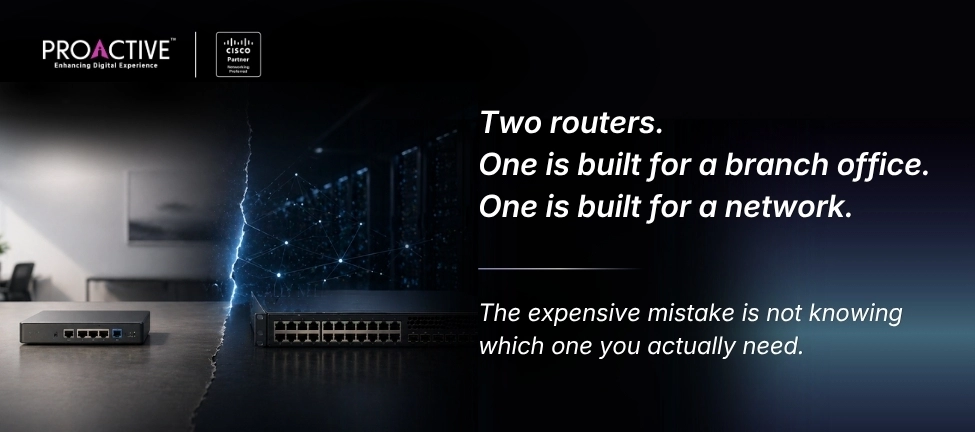
Two routers. Different silicon, different architectures, different price points. This guide tells Indian IT managers exactly which one fits their network -- and which one they will regret.
Proactive Data Systems Engineering Team | Cisco 360 Preferred Partner, India | Last reviewed: April 2026
ISR 4000 End-of-Sale status verified against Cisco Product Bulletins, April 2026.
Catalyst 8000 series confirmed as active replacement platform.
Up Front
The ISR 1100-4P and ISR 1100-8P are the correct branch routers for Indian offices up to 50 users running Cisco SD-WAN, dual-WAN failover, and standard routing. They are actively supported, purpose-built for this role, and the most cost-effective Cisco branch router available today.
The ISR 4331, ISR 4351, and ISR 4451 are the correct platforms for regional aggregation hubs, sites running PVDM4 voice gateway, DMVPN over MPLS, or hardware service modules. Their replacement in new deployments is the Cisco Catalyst 8300 and 8500.
The ISR 4221, ISR 4321, ISR 4331, ISR 4351, ISR 4431, and ISR 4451 have all reached End-of-Sale. If a vendor is quoting any of these models today, verify the End-of-Software-Maintenance date before signing the PO.
The ISR 1100 has no NIM or SM module slots. If your deployment requires a voice DSP, a hardware IDS/IPS module, or serial WAN interfaces (T1/E1), the ISR 1100 cannot deliver them. No workaround exists.
Cisco ISR 1100 vs ISR 4000 is the branch router comparison that shows up on Indian IT manager's desks every week -- usually in the form of two vendor quotes and a question about why one is significantly more expensive than the other. For anyone researching a Cisco branch router for India, the answer is not about price. It is about architecture.
The short answer: they are not competing products. The ISR 1100 is a fixed-configuration branch router designed for simplicity, SD-WAN, and lean deployments. The ISR 4000 is a modular multi-service platform designed for aggregation, high-density WAN, and service-rich environments. Buying one when you need the other is an architecture error that costs more to fix than the money saved at the point of purchase.
This guide draws the line. What the two platforms can and cannot do, which Indian deployment scenarios belong to which router, and the lifecycle question that must be asked before any ISR 4000 PO is raised.
The price difference between an ISR 1100 and an ISR 4000 is not arbitrary. It reflects genuine architectural differences. Here is what changes.
| ISR 1100 Series | ISR 4000 Series | |
|---|---|---|
| Architecture | Fixed configuration -- no service modules | Modular -- NIM, SM, ISC slots for service expansion |
| WAN ports | 2 x GE WAN (1100-4P) or 2 x GE + 2 x ADSL/VDSL (1100-8P) | Multiple NIM slots: up to 8 WAN ports depending on model |
| LAN ports | 4 x GE LAN (1100-4P) or 8 x GE LAN (1100-8P) | Varies by model; ISR 4331 has 3 x GE, ISR 4451 has 4 x GE |
| Max throughput | Up to 1 Gbps | Up to 2 Gbps (ISR 4451) with performance licence |
| Service modules | None -- fixed feature set | Yes -- PVDM4 (voice DSP), NIM-SSD, SM-X for compute |
| Integrated Wi-Fi | Yes -- select models (ISR 1100W, 1100X) | No -- external AP required |
| SD-WAN support | Full Cisco SD-WAN (Viptela) -- primary use case | Full Cisco SD-WAN -- also supports DMVPN, MPLS |
| Voice gateway | Limited PSTN gateway capability | Full PVDM4 DSP support, CUBE voice gateway |
| USB console | Yes | Yes |
| Lifecycle status | Active -- current recommended branch platform | Several models End-of-Sale. Verify before ordering. |
| India price range* | Lower -- accessible for branch and SMB | Higher -- 2x to 4x ISR 1100 depending on model and modules |
* India pricing is indicative, based on Cisco list price with standard partner discount as observed in Proactive Data Systems quotations and India enterprise procurement engagements, 2023-2026. Actual pricing varies by volume, contract, and modules specified. Contact Proactive for a current quote.
The ISR 4000's service module slots are not features you pay for and leave empty. They are the reason the platform exists. If your deployment does not need them, you are buying the wrong router.
Question 1 -- How many users, and what services will the router run?
User count is the starting point, not the answer. The ISR 1100 comfortably handles 25 to 50 users at a branch. The ISR 4331 (entry ISR 4000) handles up to 100 users; the ISR 4451 handles 250 and above. But user count alone does not determine the right router. Service density does. This is the distinction that most ISR 4K vs ISR 1100 comparisons miss entirely.
A 30-user branch in Chennai running SD-WAN, basic firewall, and DHCP needs an ISR 1100. A 30-user regional office in Pune running voice gateway services, SIP trunks for 20 phones, DMVPN over MPLS, and an integrated WAN optimisation module needs an ISR 4000. The user count is the same. The service load is not.
| Service Requirement | ISR 1100 | ISR 4000 |
|---|---|---|
| Dual WAN, broadband failover | Yes | Yes |
| Cisco SD-WAN (Viptela) | Yes -- primary use case | Yes |
| DMVPN over MPLS | Limited | Yes -- full support |
| Voice gateway (PSTN/SIP) | Basic only | Full PVDM4, CUBE |
| Integrated Wi-Fi (no separate AP) | Yes (W/X models) | No |
| Hardware firewall module (IDS/IPS) | No | Yes -- NIM-based |
| High-density serial WAN (T1/E1) | No | Yes -- NIM-T1/E1 |
| Application visibility (NBAR2) | Yes | Yes |
| Multi-tenant VRF | Yes | Yes -- more scalable |
Question 2 -- Is this a standalone branch or part of a hub-and-spoke network?
This is the question that changes the answer for Indian enterprise IT teams more than any other.
A standalone branch office in Delhi NCR -- 40 users, internet access, Webex calling, VPN back to HQ -- is exactly the ISR 1100's natural environment. It is simple, predictable, and the ISR 1100 handles it with capacity to spare.
A regional aggregation hub in Mumbai that terminates MPLS circuits from 12 branch offices, runs CUBE for a 200-seat contact centre, and needs sub-second failover between dual MPLS providers is a different problem entirely. That is an ISR 4000 problem. Putting an ISR 1100 at a hub site because it is cheaper is not a cost saving. It is a design flaw that will surface at the worst possible moment.
Most Indian enterprises building hub-and-spoke WAN architectures use the ISR 4331 or ISR 4351 at regional aggregation points in Mumbai, Bangalore, and Delhi NCR, and the ISR 1100 at spoke sites -- smaller offices, retail locations, warehouses. That split is not accidental. It is what the platforms are built for. (Proactive Data Systems deployment observations, India enterprise WAN deployments, 2023-2026.)
For MPLS-heavy environments in India
BSNL, Tata Communications, and Airtel MPLS circuits in India frequently deliver variable QoS marking. The ISR 4000's hardware QoS engine handles re-marking and queuing at scale. The ISR 1100 handles basic QoS but is not designed for the policy complexity that a 20-site MPLS network demands. If your WAN team is managing SLAs across multiple ISPs from a central NOC, the aggregation site needs ISR 4000.
Question 3 -- What is the ISR 4000 model's lifecycle status?
This is the question most vendors will not raise unprompted.
As of April 2026, the Cisco ISR 4221, ISR 4321, ISR 4331, ISR 4351, ISR 4431, and ISR 4451 have all reached End-of-Sale. New orders for these models are not accepted. The recommended replacement for new deployments is the Cisco Catalyst 8000 series. (Source: Cisco Product Bulletins, verified April 2026.)
For Indian enterprises evaluating branch infrastructure that will be in service for five to seven years -- which is the typical refresh cycle for a 50-site Indian enterprise -- buying End-of-Sale ISR 4000 hardware today means reaching end of support before the hardware is due for replacement. That creates a security and compliance exposure, not just a support gap.
Before any ISR 4000 PO: verify the exact model number against Cisco's Product Bulletin page. The replacement platform for ISR 4000 in most architectures is the Cisco Catalyst 8000 series (Cat 8200, Cat 8300, Cat 8500). If a vendor is quoting ISR 4000 and has not raised the lifecycle question, raise it yourself.
Lifecycle check -- run this before signing
On any existing ISR 4000: run 'show version' to confirm the model number, then cross-reference at cisco.com/go/eos. For new procurement: ask your Cisco partner for the Product Bulletin reference for the specific ISR 4000 SKU being quoted. Proactive Data Systems provides lifecycle advisory as part of every routing infrastructure engagement.
The ISR 1100 is the right platform for any Bangalore GCC regional office, Mumbai BFSI branch, Delhi NCR enterprise spoke site, or standalone retail location where the primary requirement is SD-WAN, dual-WAN failover, and clean routing to a central hub. It is cost-effective, actively supported, and purpose-built for exactly the kind of lean branch deployments that make up the majority of India's enterprise WAN.
The ISR 4000 (or its replacement, the Catalyst 8000) is the right platform where multiple services must run concurrently on a single device, where MPLS circuit aggregation demands hardware-level QoS, or where the site is a regional hub terminating circuits from multiple spoke locations.
| Environment | Right Router | Reason |
|---|---|---|
| Bangalore GCC: 40-user regional office, SD-WAN, Webex calling | ISR 1100 | Lean branch profile, SD-WAN native, no service modules required |
| Mumbai BFSI: branch office, 25 users, dual ISP, basic VPN | ISR 1100 | Dual WAN built-in, simple policy, CapEx controlled |
| Delhi NCR hub: terminates 15 MPLS branches, CUBE voice gateway | ISR 4000 / Cat 8000 | Service module density, hardware QoS, PVDM4 for voice DSP |
| Pune manufacturing: OT/IT WAN, serial E1, MPLS + broadband | ISR 4000 / Cat 8000 | NIM-E1 serial WAN, hardware crypto, multi-VRF for OT segment |
| Hyderabad GCC: 50-user office, broadband, Cisco Umbrella, no voice gateway | ISR 1100 | Fixed service set, SD-WAN, Umbrella integration, no module need |
| Retail chain: 80 stores, standardised config, ZTP deployment | ISR 1100 | Zero-touch provisioning, SD-WAN template deployment at scale, Wi-Fi models available |
| Regional bank: 200-branch MPLS, contact centre integration, 24x7 NOC | ISR 4000 / Cat 8000 | Service density, CUBE, MPLS aggregation, lifecycle must be verified |
Note on retail chain scenario: ISR 1100 ZTP deployment at scale across Indian retail chains reflects Proactive Data Systems field deployments, India retail enterprise environments, 2023-2026.
If the ISR 4000 is the platform you need architecturally, but lifecycle concerns are a blocker, the answer is the Cisco Catalyst 8000 series. This is Cisco's current-generation multi-service routing platform, and it is the direct successor to the ISR 4000 for new deployments.
| Platform | ISR 4000 Equivalent | Target Environment | Status |
|---|---|---|---|
| Catalyst 8200 | ISR 4221 / 4321 | Small branch, up to 50 users | Active |
| Catalyst 8300 | ISR 4331 / 4351 | Mid-size branch, up to 200 users | Active |
| Catalyst 8500 | ISR 4431 / 4451 | Aggregation, hub site, 200+ users | Active |
| ISR 1100 | No ISR 4000 equivalent | Lean branch, SD-WAN, up to 50 users | Active |
For Indian enterprises currently running ISR 4000 hardware approaching end of support, the migration path to Catalyst 8000 is documented, the configuration syntax is largely compatible, and the SD-WAN integration is native. The transition does not require a network redesign. It requires a hardware refresh with a clear lifecycle horizon.
A typical migration scenario in India: a Mumbai aggregation hub running an ISR 4351 -- terminating MPLS circuits from 15 branch offices, running CUBE for a contact centre, dual Tata Communications and Airtel MPLS links -- migrates to a Catalyst 8300. The IOS-XE configuration is carried across with minor syntax changes. SD-WAN policy migrates through vManage templates. The NIM slots are compatible with most existing WAN interface modules. The hub stays operational through a rolling upgrade, and the branch ISR 1100 spoke sites require no changes.
IOS-XE version compatibility note: the Catalyst 8000 series requires IOS-XE 17.x. ISR 4000 deployments running IOS-XE 16.x need a software upgrade path review before migration. Run 'show version' on existing ISR 4000 hardware to confirm the current IOS-XE version, then consult the Cisco Catalyst 8000 migration guide for the specific compatibility matrix.
IOS-XE is the operating system on both platforms. Command syntax is consistent. The differences are in feature availability and module-specific configuration.
! Bootstrap config for SD-WAN ZTP on ISR 1100
! Device contacts vBond after getting DHCP from WAN
sdwan
vbond <vbond-ip> port 12346
!
interface GigabitEthernet0/0/0
description WAN-Primary
ip address dhcp
ip nat outside
no shutdown
!
interface GigabitEthernet0/0/1
description WAN-Secondary-Failover
ip address dhcp
ip nat outside
no shutdown
! Track primary WAN reachability
ip sla 1
icmp-echo 8.8.8.8 source-interface GigabitEthernet0/0/0
frequency 10
ip sla schedule 1 life forever start-time now
!
track 1 ip sla 1 reachability
!
ip route 0.0.0.0 0.0.0.0 <primary-gw> track 1
ip route 0.0.0.0 0.0.0.0 <secondary-gw> 10
show version
show platform
show module ! ISR 4000 -- shows installed NIMs and SMs
show diag ! Detailed hardware inventory
Proactive Data Systems holds Cisco Preferred Partner status across Networking, Security, Collaboration, Cloud and AI, and Services under the Cisco 360 programme. We have deployed ISR 1100, ISR 4000, and Catalyst 8000 series routers across Indian enterprise environments -- GCCs, BFSI, manufacturing, and multi-site retail. If you have two router quotes and a question about which one belongs in your network, a 30-minute call with our engineering team is faster than reading another datasheet.
Source: Cisco ISR 1100 Series Datasheet (cisco.com); Cisco ISR 4000 Series Datasheet (cisco.com); Cisco Catalyst 8000 Series Datasheet; End-of-Sale and End-of-Life announcements (cisco.com/go/eos). Deployment observations: Proactive Data Systems, India enterprise routing deployments, 2023-2026.

Kunal Hans CTO, Proactive Data Systems
We'll get back to you shortly.