Updated: 26 June 2026
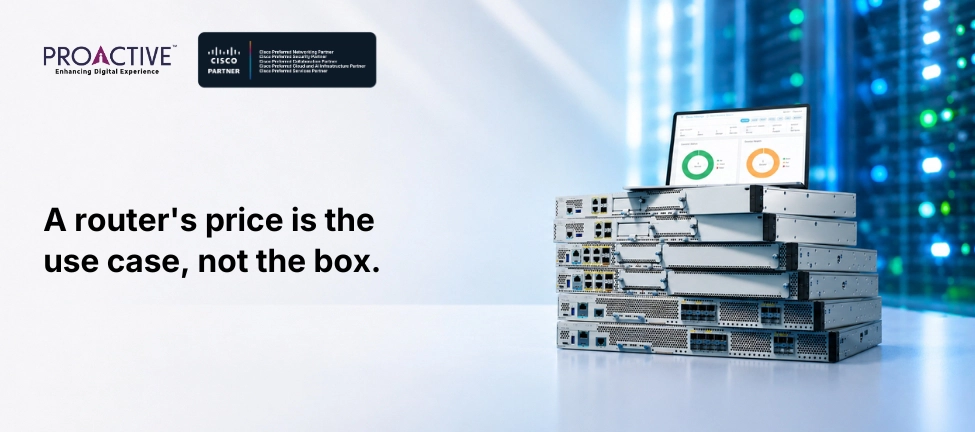
"Cisco router price list" suggests a tidy table where you find your model and read off a number. Cisco routing does not work that way, and a procurement team that budgets from a single sticker is usually wrong before it starts. The price of a Cisco router is set as much by the throughput you license and the subscription you attach as by the box itself, so the only useful price guide is one organised by what the router has to do.
This guide gives budget ranges by use case, from a small branch to a regional aggregation hub, and then explains the lines that sit on top of the hardware, the throughput licence, the subscription, the modules and the support, which is where router budgets most often go astray. Treat the ranges as indicative, not as a quote, and build from the use case outwards.
Not a reliable public one. Cisco prices through partners rather than a street list, and the figures floating around marketplaces mix new, used and grey-market stock at numbers you cannot budget against. What is consistent is the structure: a router's cost is the platform, plus the throughput and feature licence, plus the term subscription, plus any interface modules, plus support, plus GST. Change the throughput tier on the same box, and the price moves substantially.
There is one piece of good news specific to India. Routers enter duty-free under the Information Technology Agreement, so they carry no basic customs duty, unlike switches, which can attract it. That removes one variable from the router budget that complicates the switch budget. GST at 18 per cent still applies. With that framing, here are the ranges by use case.
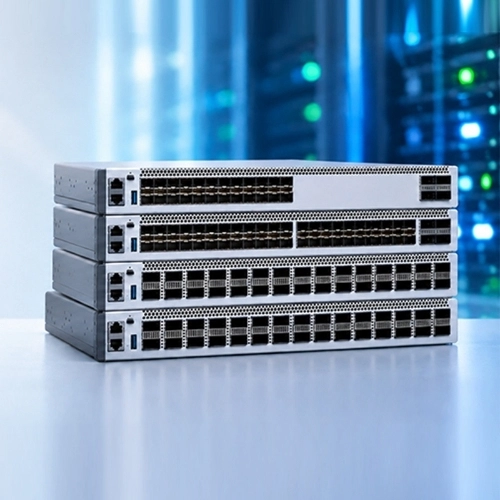
The Catalyst 8000 family maps cleanly to branch size and WAN role. The bands below are indicative hardware figures only, before licensing, support and GST, and they vary with configuration and discount, so use them to size the budget, not to quote:
| Use Case | Typical Platform | Indicative Hardware Band (Rs., indicative) |
|---|---|---|
| Small branch / small office | Catalyst 8200 / 8200L | ~Rs.1–4 lakh |
| Mid-size branch | Catalyst 8300 (lower) | ~Rs.3–8 lakh |
| Large branch / regional headend | Catalyst 8300 (higher) / 8500L | ~Rs.7–15 lakh |
| Aggregation / hub / data-centre edge | Catalyst 8500 | ~Rs.15 lakh to Rs.65 lakh+ |
| Cloud / virtual | Catalyst 8000V | Software, by instance and throughput |
The spread within a tier is real: a high-performance aggregation router with dense 100-gigabit interfaces sits at the top of the 8500 band, while an entry 8500L sits near the bottom. Identify the use case first, then the platform, then refine within the band using the factors below.
Four things, and together they often add as much as the hardware. The throughput licence sets how much traffic the router is permitted to forward, the subscription unlocks the software features and SD-WAN, the interface modules provide the actual connectivity, and the support contract keeps it current. A router quote that shows only the chassis is showing you a fraction of the cost.
The most important of these, and the least understood, is the throughput licence, because it can change the price of an identical box dramatically.
Cisco licenses a Catalyst 8000 router by the IPsec and SD-WAN throughput it must carry, not just by the model (Cisco DNA for SD-WAN and routing ordering guide). The same physical 8300 licensed for 250 Mbps and licensed for a multi-gigabit tier are very different prices, because you are buying performance, not only hardware. Higher bandwidth tiers are also tied to the higher feature tiers, so a high-throughput site pulls the licensing up on two axes at once.
The practical consequence for procurement is that you must know the throughput each site needs before you can budget the router, because under-licensing throttles the branch and over-licensing wastes money. Two quotes for the same model can differ widely simply because one assumed a higher throughput tier. Always state the required throughput in your enquiry so the comparison is fair.
Like Cisco switches, routers split licensing into a perpetual network stack and a term-based subscription of three, five or seven years that delivers SD-WAN, automation and orchestration (Cisco DNA for SD-WAN and routing ordering guide). The tier matters: DNA or Catalyst Essentials, Advantage and Premier unlock progressively more, and some platforms, such as the 8500, require Advantage as a minimum. For an SD-WAN deployment, the subscription is mandatory and recurring, so it belongs in both the upfront budget and the renewal plan.
If you are building an SD-WAN, the controllers, the SD-WAN Manager, Controller and Validator, are part of the subscription and are typically cloud-hosted, so they are an operating cost rather than a box you rack. Factor the whole SD-WAN subscription, not just the routers, into the programme budget.
A Catalyst 8000 router is a platform you populate. The base unit comes with some ports, but the connectivity a branch actually needs, additional Ethernet, a leased-line interface, fibre SFPs, or a cellular module for 4G or 5G backup, comes as interface modules ordered separately. For a resilient branch with a cellular failover path, the cellular module is not optional, and it is a real line item.
These modules are easy to forget when budgeting from a chassis price, and their absence shows up as a branch that cannot connect the way the design intended. List the interfaces each site needs alongside the platform, so the router arrives able to do its job.
Two factors shape the Indian router budget, and one is in your favour. GST at 18 per cent applies to the hardware under HSN 8517 62 90 and should be built into the figure rather than discovered at the end. On the other hand, routers are covered by the Information Technology Agreement and enter India duty-free, so unlike switches, they carry no basic customs duty, which keeps the landed price closer to the quoted price. For government and PSU buyers, procurement through GeM adds its own bid rules to the budget.
Net, a router budget has one fewer nasty surprise than a switch budget, because the customs-duty variable is removed, but the licensing and throughput variables more than make up for it in complexity. Account for all of them, and the approved budget matches the invoice.
Specify the use case and the throughput, then ask for a complete bill of quantities. A reliable router quote states the platform, the required throughput tier, the network and subscription licence tiers and term, every interface module and optic, the support level and term, and GST shown separately. The single most important input you can give is the throughput each site must carry, because without it no two quotes are comparable.
The quickest route to a number you can trust is to give a partner your site list with branch sizes, WAN links and throughput needs, and have them build the BoQ per use case. A marketplace figure describes a bare box; your budget needs the configured router.
Pricing a router estate well is a use-case exercise: match each site to the right platform and throughput, attach the correct licence and modules, and the budget becomes predictable instead of a guess against a marketplace number.
Proactive Data Systems, a Cisco Preferred Networking Partner with 35 years of experience and more than 1,500 customers, builds router and SD-WAN budgets by use case, sizing platform, throughput, licensing, modules and support to each branch and hub, so the estate budget you approve is the one you pay. If you are pricing a Cisco router rollout, send us your site list, and we will build the ranges into a real BoQ.
Disclaimer: This article is general budgeting guidance, not a price quote or tax advice. Cisco does not publish street pricing; actual prices depend on configuration, throughput licensing, partner discount and current terms, and tax and duty rules can change. Obtain a formal quote from an authorised partner and confirm current tax treatment before budgeting or purchasing.

Proactive Enterprise Networking Team
We'll get back to you shortly.