Updated: 25 May 2026
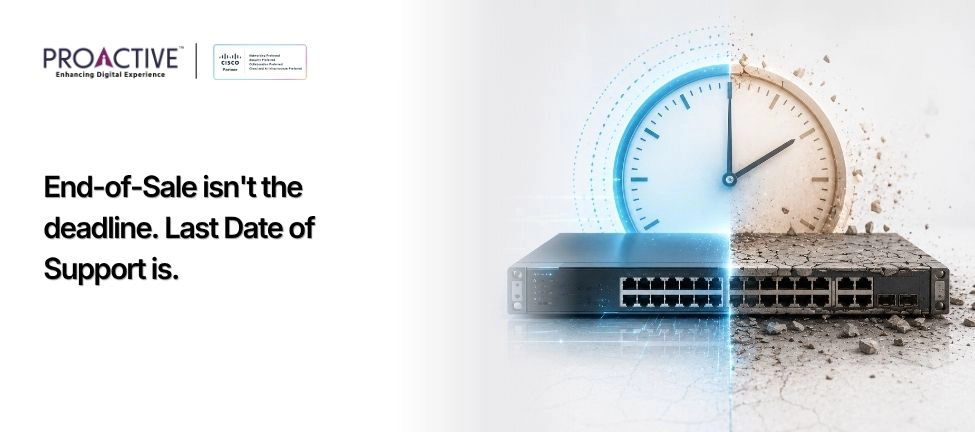
Cisco retires every switch through five published milestones, ending at Last Date of Support (LDoS), the date all software updates and security patches stop for good. End-of-Sale is not the deadline; LDoS is. Plan a refresh by inventorying your install base, mapping each device to its LDoS date, and phasing replacements across two to three budget cycles.
A Catalyst switch does not slow down when it reaches end-of-life. It keeps forwarding traffic, the lights stay green, and nobody raises a ticket. That is precisely the risk. The kit that still works is the kit that has quietly stopped receiving security patches, and in many Indian networks, series such as the Catalyst 2960-X and 3650/3850 have already passed End-of-Sale.
Cisco's End-of-Life Policy moves every product through five milestones. Knowing them is the difference between a planned refresh and a scramble.
| Milestone | What It Means |
|---|---|
| End-of-Life (EoL) | Cisco announces the product will be withdrawn — the clock starts |
| End-of-Sale (EoS) | The last day you can buy the product from Cisco |
| End of New Service Attach (EoNSA) | No new support contracts can be attached |
| End of Service Contract Renewal (EoSCR) | Existing support contracts can no longer be renewed |
| Last Date of Support (LDoS) |
All software, bug fixes and security patches stop — permanently |
Cisco announces End-of-Life roughly a year before End-of-Sale, then allows around five years before LDoS. That notice period is your planning window. Most organisations let it expire unused.
The common mistake is treating End-of-Sale as the date to act. It is not. A switch bought the day before EoS is fully supported for years afterwards. The date that matters is Last Date of Support. After LDoS, Cisco issues no security patches, even for critical vulnerabilities, and the device cannot be brought back under a support contract. Plan backwards from LDoS, not from End-of-Sale.
Three costs, and none of them appear on an invoice.
Security: an end-of-life software image accumulates an average of 218 new vulnerabilities in the six months after support ends, and flaws in end-of-life systems are four times more likely to be weaponised by attackers.
Compliance: unsupported infrastructure fails the audits that BFSI, healthcare and manufacturing customers increasingly require of their suppliers.
Operations: spares dry up, replacement units drift to the grey market, and a failed switch with no RMA path becomes an unplanned outage. Keeping the hardware costs nothing. Trusting it does.
A refresh handled well spans two to three budget cycles. Five steps:
Inventory the install base. List every Cisco device, its model and its software version. A Cisco partner can pull this directly from your network and Cisco's records.
Map each device to its LDoS date. Cisco publishes every milestone on its End-of-Life page. This turns a vague worry into a dated schedule.
Prioritise by risk, not age. A switch carrying production or OT traffic, or one already past LDoS, moves ahead of a lightly loaded access switch with three years left.
Phase the budget. Group replacements into waves aligned to LDoS dates and capital cycles, so no single year carries the whole cost.
Standardise the target platform. Decide the replacement once, Catalyst 9300/9350 for campus, so each wave is a repeatable deployment, not a fresh design.
The organisations that handle end-of-life well are not the ones with the newest hardware. They are the ones that treat Cisco's milestone notices as a schedule, not a surprise.
Proactive Data Systems has planned and delivered Cisco network refreshes across India for over 35 years, and holds Cisco Preferred Partner status under the Cisco 360 Partner Program for Networking.
Request a network lifecycle audit. We map your entire Cisco install base against its End-of-Life milestones and hand you a dated, risk-ranked refresh plan.

Proactive Editorial
We'll get back to you shortly.