Updated: 16 November 2026
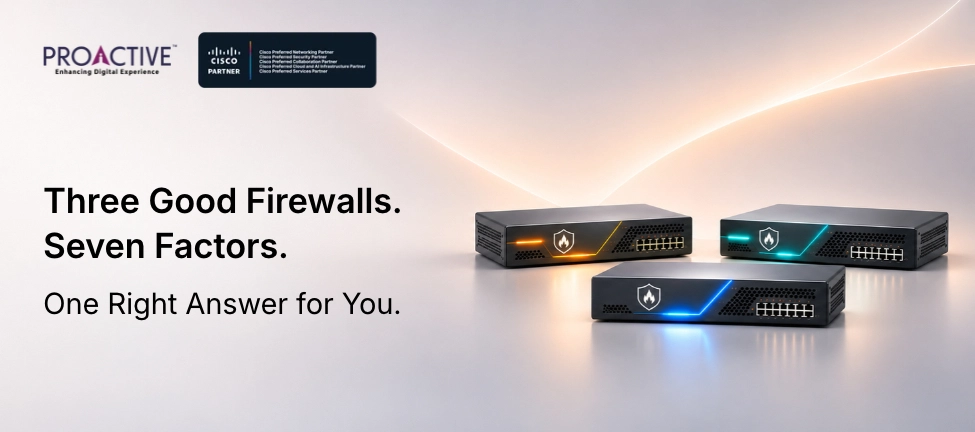
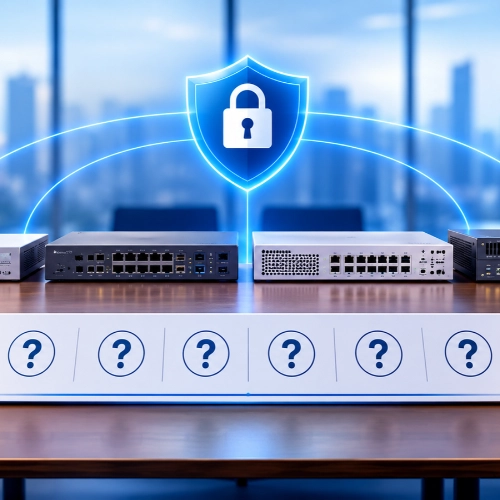
Choosing between Cisco Secure Firewall, Palo Alto Networks and Fortinet FortiGate for an Indian enterprise comes down to seven factors: five-year cost rather than list price, how many management consoles you end up running, threat intelligence and update cadence, integration with what you already own, support depth in India, the availability of skills in the Indian market, and an honest reading of where each one wins.
Proactive Data Systems, a Cisco Preferred Partner across all five architectures with 35 years in Indian enterprise infrastructure, sells Cisco and Palo Alto and has evaluated all three against Indian tenders, and this is the comparison we give a CIO who asks which one to buy.
Which firewall is best? The one your team will configure correctly and patch on time, and that answer is less evasive than it sounds. All three vendors make firewalls that stop the same attacks when run well. The differences that decide an Indian enterprise purchase are operational and commercial: what it costs over five years, how it fits the estate, who answers the phone in Bengaluru, and who you can hire in Pune to run it. Those seven factors follow, with a table at the end and a paragraph on where each product loses, including ours.
Five-year cost, not list price
How many consoles you will run
Threat intelligence and update cadence
Integration with what you already own
Support depth in India
Skills in the Indian market
Where each one wins
Fortinet is often the lowest five-year cost of the three for a like-for-like feature set, Palo Alto is often the highest, and Cisco sits between them, with the gap narrowing sharply when Cisco bundles are negotiated against an existing Cisco estate; those are directional observations from Indian tenders Proactive has seen, not published figures, and the basis for any such claim should be stated in your own comparison. Ask every bidder for a five-year total including hardware, subscriptions, support and GST, on the same throughput and feature assumptions.
The structure of the cost differs more than the total. Palo Alto's subscriptions for threat prevention, URL filtering, DNS security and the rest are modular and add up quickly if you take them all. Fortinet's bundles tend to be simpler and cheaper, which is part of its appeal to the Indian mid-market. Cisco's Threat Defense licensing is tiered and the hardware is competitively priced, but the management plane adds a line the other two sometimes fold in. The only honest comparison is the five-year table, with inspection features switched on, on the same traffic profile.
Each vendor will manage its own firewalls from one place; the question is whether that place becomes your second or third security console. Palo Alto manages through Panorama on-premises or, increasingly, through Strata Cloud Manager in the cloud; Fortinet through FortiManager and FortiCloud, with the Security Fabric pulling other Fortinet products into the same view; Cisco through Firewall Management Centre on-premises or cloud-delivered inside Security Cloud Control.
The practical implication is that the console question is really the estate question. A Fortinet firewall in a Fortinet estate, a Palo Alto firewall alongside Cortex and Prisma, or a Cisco firewall alongside ISE, Duo and Meraki each gives you one console for more than the firewall. The same firewall dropped into a different vendor's estate gives you one more console to staff and one more place where a policy mismatch can hide. Count consoles before you count features.
All three run large, credible research operations, Cisco Talos, Palo Alto's Unit 42 and Fortinet's FortiGuard Labs, and all three push signature and reputation updates on a cadence measured in hours; none of the three is meaningfully behind on this factor for an Indian enterprise. What differs is what the intelligence is attached to and how it reaches you.
Talos feeds Cisco's Threat Defense, Umbrella and Secure Endpoint from one research base, which matters if you already own those. Unit 42 is the research engine behind Palo Alto's threat prevention and Cortex, and its published incident reporting is the most widely read of the three. FortiGuard feeds every Fortinet product in the fabric at once. The honest conclusion is that this factor rarely decides an Indian purchase on its own, and a buyer who is told it should is being sold a differentiator that does not exist.
Integration with your existing estate is the factor that most often decides the purchase in practice, and it should. A Cisco estate with ISE for access control and Duo for identity gets Secure Firewall integration that is native: identity-aware policy, TrustSec tags carried into firewall rules, pxGrid threat response. A Fortinet estate gets the same inside the Security Fabric. A Palo Alto estate gets it across Strata, Prisma and Cortex.
Cross-vendor integration exists for all three, through standard identity sources, syslog and APIs, and it works. It also lags, costs engineer time to maintain, and breaks on upgrades more often than the native path. Proactive's position is the second-vendor one: you do not have to rip out a working estate to run a different firewall where it wins, and multi-vendor security stacks are normal in India. The cost is the integration debt, and it should be on the five-year table as a line, not as a footnote.
All three vendors have technical support operations in India, with Cisco's TAC long established in Bengaluru, Palo Alto expanding its Bengaluru office for regional support, and Fortinet having built out Indian technical support; the differences a buyer will feel are in escalation paths and partner depth, not in whether someone picks up. Ask each bidder to describe, step by step, how a P1 case reaches a senior engineer at 2 am IST.
The practical variables are the partner's own bench and the OEM's back-to-back arrangement. A regulated Indian buyer will ask for OEM-direct call logging, on-site spares within hours and a seven-year support horizon, and the vendor and partner together must meet them. Proactive Data Systems runs a 24x7 NOC in India with 100+ engineers and holds Cisco's advanced customer-experience specialisation, so for Cisco we answer that question ourselves. For Palo Alto, we answer it as a partner with the vendor's Bengaluru support behind us. For Fortinet, ask the Fortinet partner the same question and expect the same quality of answer.
Fortinet and Cisco firewall skills are the easiest to hire in the Indian market, in Proactive's recruiting experience, because both have large installed bases and broad certification tracks; Palo Alto skills are prized and scarcer, and command a premium. This is an observation from hiring, not a published statistic, and your own HR team can test it in a week with three job postings.
The reason it matters is the same reason it matters for any platform: a firewall is only as good as the person who maintains its rule base. A Palo Alto firewall run by a team that does not know it is less secure than a Fortinet firewall run by a team that does. If you choose the product with the scarcer skills, budget for training or for a partner who holds them, and write that line into the five-year table too.
Proactive sells all three, so weigh this section with that in mind. Cisco Secure Firewall wins in a Cisco estate, where ISE, Duo, Meraki and Talos make the firewall part of one policy system, and in regulated deployments where Cisco's Indian TAC depth and partner ecosystem matter. Palo Alto wins where application-level visibility, the most mature single-pass inspection engine of the three and tight coupling with Cortex and Prisma are the priority, and where budget follows security rather than the other way round. Fortinet wins on cost, on simplicity, and in estates already on the Security Fabric, which is why it dominates the Indian mid-market.
| S.No | Factor | Cisco Secure Firewall | Palo Alto Networks | Fortinet FortiGate |
|---|---|---|---|---|
| 1 | Five-year cost | Mid; narrows against an existing Cisco estate | Often highest for a like-for-like set | Often lowest for a like-for-like set |
| 2 | Management | FMC on premises or cloud-delivered via Security Cloud Control | Panorama, moving to Strata Cloud Manager | FortiManager, FortiCloud, Security Fabric |
| 3 | Threat intelligence | Talos; shared with Umbrella and Secure Endpoint | Unit 42; shared with Cortex and Prisma | FortiGuard Labs; shared across the fabric |
| 4 | Native integration | ISE, Duo, Meraki, TrustSec, pxGrid | Cortex, Prisma, Strata | Security Fabric |
| 5 | India support | Long-established TAC in Bengaluru; deep partner base | Expanding Bengaluru support; growing partner base | Established Indian support; large partner base |
| 6 | Skills availability | Broad | Scarcer, premium | Broad |
| 7 | Best fit | Cisco-centric, regulated, identity-led policy | Security-first budget, Cortex or Prisma estates | Cost-led, mid-market, Fortinet fabric |
Rows 1 and 6 are Proactive's directional observations from Indian tenders and hiring; they are opinions with a stated basis, not published data. Rows 2 to 5 are from vendor documentation and announcements in October 2026.
Proactive Data Systems has deployed and managed perimeter security for Indian enterprises across BFSI, manufacturing, IT/ITES and healthcare for 35 years, with 100+ engineers and a 24x7 NOC behind every firewall we run. We sell Cisco, Palo Alto, and Fortinet because more than 1,500 customers have taught us that the firewall that gets misconfigured is the one that was chosen for the wrong reason.
Disclaimer: This is an independent comparison prepared by Proactive Data Systems, and reflects our opinion as at October 2026. Cost and skills observations are directional and drawn from our own experience, not from published data. Product names, management platforms and support arrangements change; confirm current details with each vendor. Cisco, Palo Alto Networks, Fortinet and FortiGate are trademarks of their respective owners, and no endorsement by those owners is implied.
We'll get back to you shortly.