Updated: 16 February 2026
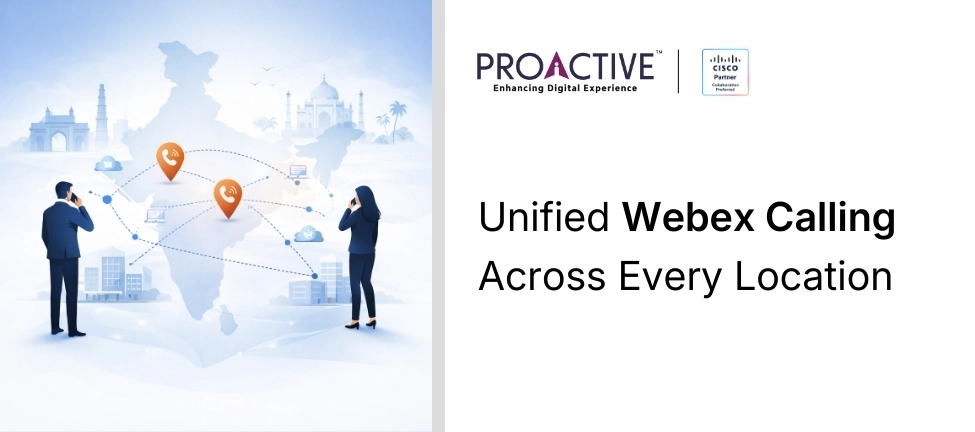
They have a fragmentation problem. When each branch office runs its own telephony logic, inconsistencies multiply. Dial plans vary. Policies drift. Reporting becomes unreliable. Governance weakens.
If your organisation operates across multiple Indian cities and your voice systems are managed locally at each branch, you do not have scale. You have duplication. Cloud calling for multi-location businesses is about central authority, not just cloud connectivity. Enterprise platforms such as Cisco Webex Calling are built precisely to eliminate this fragmentation by centralising control in a single architecture.
Cloud calling is a business phone system delivered through centralised cloud infrastructure instead of isolated PBX hardware at each office.
For multi-location businesses in India, this means:
With platforms like Webex Calling, call control, user provisioning, analytics, and policy enforcement are managed from a central control hub rather than at the branch level.
Instead of managing separate EPABX systems in Delhi, Mumbai, Bengaluru, Pune, Hyderabad, or Chennai, enterprises operate a unified voice architecture.
Traditional PBX systems were designed for single-location environments.
As organisations expand, these systems create operational friction:
What appears stable at one location becomes inefficient at scale.
Cheap cloud calling collapses under multi-site complexity. Enterprise-grade solutions such as Webex Calling are engineered to handle distributed governance without architectural redesign.
If each branch manages its own numbering logic, growth becomes chaotic.
Demand centralised dial plan governance that scales across cities without redesign. Webex Calling, for example, enables unified numbering and routing policies across locations through centralised cloud administration.
Multi-location governance requires:
Fragmented administration creates security gaps. Enterprise cloud calling platforms such as Cisco Webex Calling provide role-based control and centralised policy frameworks to address this risk.
Here is where most enterprises miscalculate.
They assume cloud calling reliability depends only on the platform.
It depends on the network discipline at every branch.
Multi-location cloud calling requires:
Multi-site voice is a network strategy first, a telephony platform second. Even Webex Calling performance depends on disciplined network architecture.
If onboarding users in a new branch requires hardware deployment, you are still operating in a legacy model.
Cloud calling platforms such as Webex Calling allow user provisioning in minutes, regardless of location, without branch-level hardware upgrades.
Multi-location businesses need:
Webex Calling integrates call analytics and administrative visibility within a single cloud interface, improving governance across distributed operations.
Cloud Calling vs Traditional PBX for Multi-Site Operations
| Consideration | Traditional PBX | Cloud Calling with Webex Calling |
|---|---|---|
| Branch Deployment | Separate hardware per location | Centralised cloud architecture |
| Dial Plan Control | Location-specific | Unified across cities |
| Governance | Decentralised | Policy-driven central control |
| Scalability | Hardware-bound | Software-based expansion |
| Monitoring | Localised | Centralised dashboard |
If your organisation spans more than three cities, decentralised PBX architecture introduces compounding complexity. A unified cloud calling model powered by Webex Calling eliminates branch-level silos.
Ask directly:
If the answer to any of these is unclear, your telephony model is fragmented.
Enterprise platforms such as Cisco Webex Calling are designed to address precisely these governance gaps.
Multi-site cloud calling is not a licensing exercise. It is an architectural discipline.
Proactive Data Systems designs and deploys Webex Calling architectures for enterprises operating across India. This includes structured network readiness assessments across branches, ISP diversity evaluation, QoS framework design, and phased multi-location rollouts aligned with business continuity objectives.
Governance frameworks ensure consistent policy enforcement and performance visibility across every location.
If your organisation manages offices across India and is evaluating cloud calling for multi-location governance, the decision must prioritise architecture and control over price alone.
Proactive is the Cisco Preferred Collaboration Partner, delivering enterprise-grade Webex Calling and cloud calling solutions across India with disciplined multi-location deployment methodology and long-term operational oversight.
Engage Proactive’s collaboration architects to assess your multi-site readiness before rollout.

Kunal Gill Head, Cloud Calling Practice, Proactive Data Systems
We'll get back to you shortly.