Updated: 12 March 2026
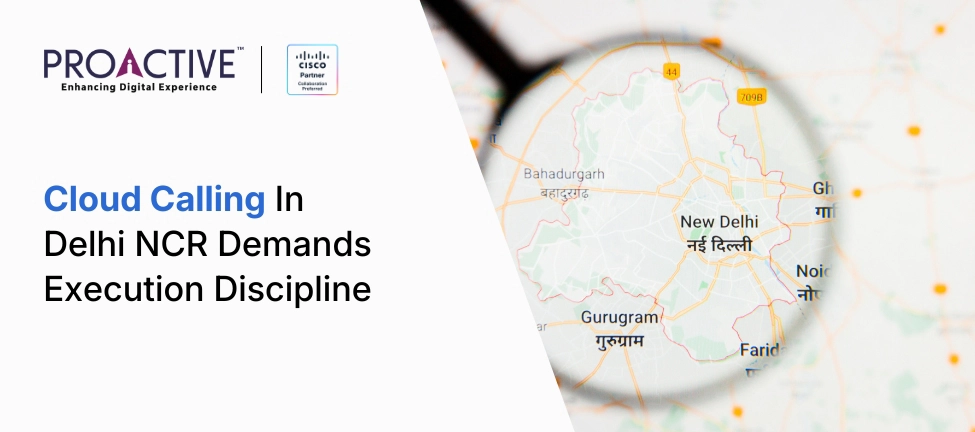
Selecting a cloud calling provider in Delhi NCR is not a routine vendor exercise. Enterprises searching for a cloud calling provider in Delhi NCR are typically evaluating replacement of legacy PBX systems, multi-site upgrades, or migration to regulated cloud telephony models.
For large enterprises operating across Gurugram, Noida, and central Delhi, voice infrastructure affects compliance posture, business continuity, and daily operational flow.
The platform layer of cloud telephony is mature. The differentiator in Delhi NCR is execution under regulatory, network, and multi-site complexity.
If you are evaluating a cloud calling provider in Delhi NCR, the decision should be grounded in architecture, governance, and NCR-specific operating realities, including carrier density, multi-campus routing, and compliance exposure.
Enterprises in Delhi NCR often operate across multiple campuses: Cyber City in Gurugram, Noida technology parks, industrial corridors in Manesar, and central corporate offices in Delhi. A cloud calling provider in Delhi NCR must account for routing, latency, and redundancy across these distinct infrastructure pockets.
This creates recurring challenges:
Inter-office dial plan complexity
Mixed ISP performance across locations
Hybrid workforce patterns
Regulatory scrutiny for the public sector and financial entities
A provider unfamiliar with these realities may underestimate execution risk.
1. Regulatory And PSTN Architecture In The NCR Context
Telecom interconnect, number provisioning, and carrier coordination in India require alignment with licensed service providers. In NCR-based enterprises, this often involves coordinating across multiple sites and traffic profiles.
A credible cloud calling provider in Delhi NCR should demonstrate:
Clear PSTN architecture options, including local gateway models
Documented carrier coordination sequencing
Understanding of call recording and retention controls
Structured compliance mapping before migration
Regulatory readiness must be designed before cutover, not discussed after disruption.
2. Network Readiness Across Distributed Campuses
Cloud calling performance is network-dependent.
In NCR, bandwidth and latency conditions may differ between Gurugram business districts and peripheral industrial zones.
Evaluate whether the cloud calling provider in Delhi NCR conducts:
WAN and internet breakout assessments per site
Latency and jitter validation under load
QoS policy enforcement reviews
Survivability planning for mission-critical locations
Voice stability is an architectural outcome.
3. Migration From Legacy PBX Environments
Many Delhi NCR enterprises still operate legacy PBX or hybrid communication estates.
A capable cloud calling provider in Delhi NCR should present:
Dial plan rationalisation methodology
Phased coexistence models
SBC and gateway design where required
Structured user migration sequencing
Red flag: Compressed migration timelines without documented coexistence planning.
4. Governance And Day-Two Control
Cloud telephony becomes infrastructure only when governance is clear.
Ask:
Who owns configuration control post go-live?
How are moves, adds, and changes tracked?
What monitoring framework governs call quality?
What escalation model exists between the enterprise, provider, and carrier?
In distributed NCR environments, governance discipline prevents operational drift.
5. Sector-Specific Awareness In Delhi NCR
Public sector undertakings, diversified conglomerates, and compliance-heavy institutions are prominent in this region.
Your cloud calling provider should demonstrate awareness of:
Audit documentation standards
Data governance obligations
Multi-entity routing structures
Inter-office security controls
Cloud calling design must align with sector-specific controls.
In the Delhi NCR market, you will encounter three provider categories:
Licence Resellers focused on commercial fulfilment
Deployment Specialists focused on rollout
Managed Execution Partners focused on architecture, governance, and lifecycle control
Clarity on which category you are engaging reduces the mismatch between expectation and delivery.
As a Cisco Preferred Collaboration Partner, Proactive approaches cloud calling engagements in Delhi NCR through structured diagnostics covering network readiness, regulatory mapping, dial plan rationalisation, and governance design before recommending final architecture. The emphasis is on execution control and long-term stability.
Before finalising a cloud calling provider in Delhi NCR, ask directly:
How many multi-site deployments have you executed in the NCR region?
What regulatory mapping has been completed for our sector?
How will legacy systems coexist during transition?
What governance framework governs the first 90 days post go-live?
How do you coordinate with carriers operating in NCR?
Cloud calling procurement is straightforward. Controlled transformation is not.
Choose a cloud calling provider in Delhi NCR that treats voice as regulated infrastructure rather than a feature set. Metro-level execution depth determines long-term stability.

Kunal Gill Head, Cloud Calling Practice, Proactive Data Systems
We'll get back to you shortly.