Updated: 01 December 2025
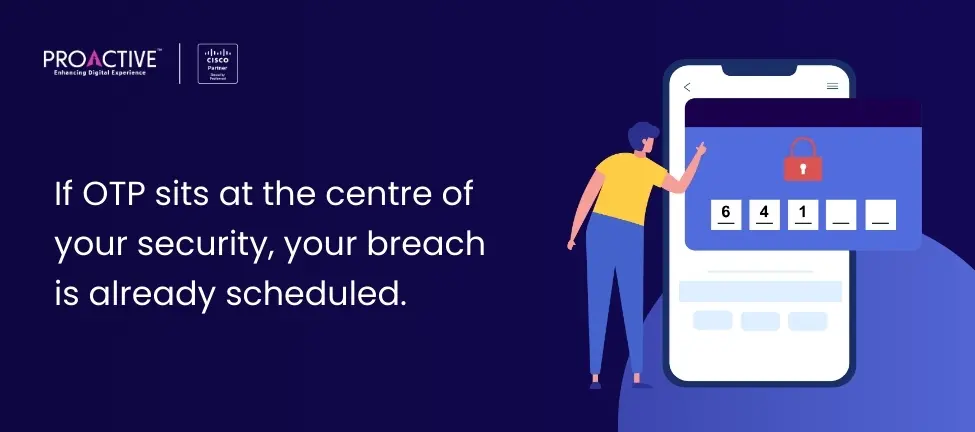
Indian enterprises rely on OTP as though it were a security control. It is not. It is a convenience mechanism that became a national habit. The assumption behind OTP is simple: the person holding the phone is the same person requesting access. In a mobile-first consumer economy, that logic held long enough for banks, government portals, and enterprise systems to adopt it at scale.
It no longer holds. Attackers have learned to compromise users, devices, and channels faster than OTP systems can react. The result is a widening gap between what OTP is designed to protect and what modern threat actors now target. This gap is most visible in India, where SIM churn, handset recycling, and real-time phishing kits create an environment in which SMS-based trust fails more often than organisations care to admit.
Cisco Duo approaches the same problem from a different direction. Instead of assuming that possession equals identity, it evaluates user identity, device posture, and session context before granting access. For enterprises shifting to Zero Trust, the distinction is not cosmetic. It is structural.
OTP was designed for an internet where threats were slower, devices were predictable, and credentials were the primary target. Threat actors now operate in real time. They intercept SMS codes through phishing proxies, capture push approvals before users notice anomalies, and automate credential and OTP harvesting using kits marketed to Indian cybercriminal groups.
The issue is not that OTP is broken everywhere. It is that OTP does not bind identity to the device, session, or behaviour. A code delivered to a phone says nothing about who triggered the request. In India, where SIM-swap fraud is common and phone numbers are recycled at scale, this gap becomes wider.
Network congestion introduces another problem. Delayed OTP messages lead users to retry, sometimes repeatedly. Attackers exploit this impatience by initiating their own authentication attempts in parallel, capturing codes as soon as they arrive. The mechanism designed to provide assurance instead introduces uncertainty.
Duo MFA does not rely on the delivery channel as a proxy for identity. It verifies the user through multiple factors, observes the device’s security posture, and checks for behaviour patterns inconsistent with normal access. The system enforces policy before trust is given.
Each login request is evaluated across attributes that OTP does not see: device health, operating system status, location signals, and session behaviour. This creates a model in which an attacker must compromise several conditions simultaneously, not just intercept a code.
For a CISO, the difference is material. OTP offers a single-point failure. Duo distributes trust across identity, device, and context.
Attackers often choose the path of least resistance. OTP is attractive because it requires minimal disruption to the victim’s environment. Phishing kits collect credentials and codes in one flow. SIM-swap attacks reroute OTP messages at the carrier level. Malware captures codes the moment they appear on the device.
A system like Duo changes the economics of the attack. Even if the attacker captures credentials, the absence of a trusted device fingerprint or a valid contextual signal blocks access. Policy-based controls are harder to bypass than code-based ones. Attackers face friction that raises the cost of attack, which is often enough to deter opportunistic campaigns.
When OTP fails, detection often comes late. Attackers who gain access through compromised OTP flows move laterally through SaaS platforms, internal systems, and identity providers. The burden then shifts to incident response teams, who must untangle privilege escalation, unauthorised API calls, and changes made under legitimate credentials.
This pattern repeats across organisations that treat OTP as their primary defence. The direct financial impact varies, but the operational cost—recovery effort, audit exposure, and user disruption are significant.
A modern access decision cannot rely on a single signal. Identity confirms who the user claims to be. Device trust confirms whether the machine they are using meets basic security standards. Context confirms whether the request aligns with expected behaviour. Cisco Duo evaluates all three before granting access.
Identity is verified through strong factors tied to the user rather than to an SMS channel. Device trust checks operating system integrity, patch levels, and security posture. Context evaluates where the request originates, whether the behaviour matches prior patterns, and whether the session aligns with policy. These layers work together to reduce the chances of compromise.
This model is not theoretical. It is used across regulated sectors and fast-growing ITeS environments where user volumes shift, devices change frequently, and SaaS adoption expands. OTP cannot replicate these checks because it offers no visibility into the device or the behaviour behind the request.
For CIOs evaluating the shift from OTP to Duo, the decision often rests on four questions.
1. Does the organisation depend on cloud applications for core functions?
If the answer is yes, protecting SaaS access becomes critical. OTP offers limited protection for cloud-native workflows because attackers target the session rather than the code.
2. Does the workforce rely on unmanaged or semi-managed devices?
OTP does not measure device health. In hybrid teams where personal devices are common, this gap is significant.
3. Does the organisation operate at a scale where compromised sessions can escalate quickly?
A single compromised account can propagate through SaaS platforms, identity providers, and internal APIs.
4. Does the business face increasing audit or compliance scrutiny?
Identity-driven MFA provides clearer evidence of control than OTP, reducing the burden during audits.
Enterprises that answer yes to these conditions have more to gain from Duo than from OTP.
India’s digital ecosystem has normalised OTP as the default mechanism for authentication. It works well for consumer services where convenience outweighs risk. Enterprise access demands a different standard. The combination of hybrid work, unmanaged devices, and cloud adoption has raised the stakes.
Identity and device trust must be part of the access decision. OTP cannot deliver this. Cisco Duo MFA can. Proactive Data Systems works with organisations to transition from OTP-first access to an identity-driven model built on Cisco Duo. If you want a structured approach that reduces risk without burdening users, we can help design and execute the rollout.

Alok Sah Head, Cybersecurity, Proactive Data Systems
We'll get back to you shortly.