Updated: 04 November 2026
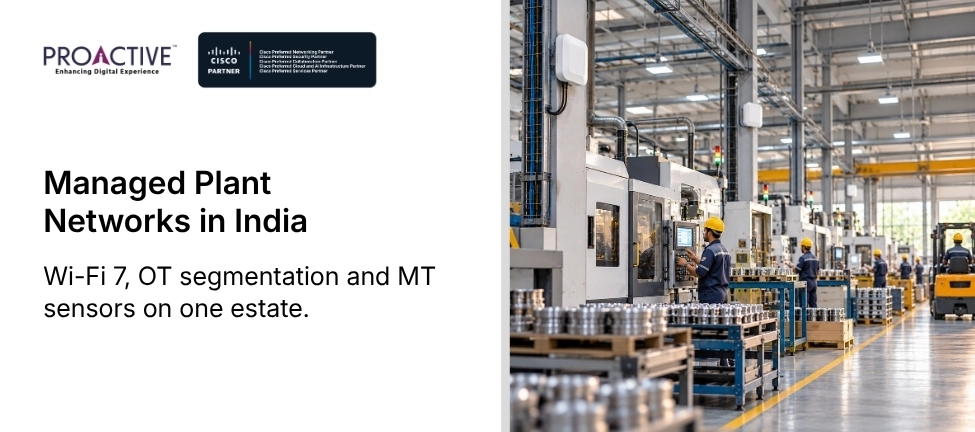
Managed networks for Indian manufacturers cover plant-floor wireless, OT and IT segmentation, MT sensor deployment for cleanroom and environmental monitoring, IEC 62443 zone enforcement, and 24x7 shift-pattern coverage. Delivered on Cisco Meraki, paired with Cisco Cyber Vision where OT visibility is required, by a Cisco Penta-Preferred Partner under the Cisco 360 Partner Program. Backed by a 30-minute response SLA.
Retail measures downtime in missed sales. BFSI measures it in blocked transactions. Manufacturing measures it in the moment a line stops moving, and the operators standing next to it do not know why.
At 11:42 AM, the barcode scanner on Line 3 stops confirming pack completions to the warehouse management system. The operator scans again. Nothing. She waves the shift supervisor over. He calls maintenance, who calls IT. It is now 11:51. The line has been producing units for nine minutes that the WMS thinks do not exist. Downstream, the label printer is queuing jobs against phantom stock. Upstream, the ERP is over-ordering material because inventory reports look low. By the time the network engineer identifies a failed access point in the pack-out zone and rolls a replacement, ninety minutes have passed, and the shift-end reconciliation is going to eat the rest of the afternoon.
The line did not "stop". The line kept moving. The network stopped watching, and the plant paid twice: once in operator time, once in the reconciliation that comes at every level of the stack above the line.
Managed networks in manufacturing exist to close that gap between "the line is producing" and "the systems know the line is producing".
The technology stack in a mid-sized Indian manufacturing plant is dense and heterogeneous. The network has to carry all of it, without the layers interfering.
Level 0-1: process and control. Sensors, actuators, PLCs, motor drives. Deterministic traffic, low tolerance for jitter and dropouts. Historically on isolated fieldbus; increasingly on Industrial Ethernet.
Level 2: SCADA and HMI. Operator interfaces at the line, panel PCs, batch record terminals. Windows-based, often unpatched, often talking to Level 1 through OPC or Modbus.
Level 3: MES and plant operations. Manufacturing execution systems, quality management, laboratory information systems, OEE tracking. Sits between the shop floor and the ERP.
Level 3.5: the industrial DMZ. The controlled boundary where plant traffic hands off to IT. If this layer does not exist, the plant is one flat broadcast domain, and every ransomware advisory targeting corporate IT is also a plant advisory.
Level 4: business systems. ERP, HR, finance, procurement. Corporate IT, corporate policy, corporate patching cycle.
Level 5: enterprise WAN and internet. Cloud services, remote access, third-party OEM connections.
A managed plant network organises this stack cleanly, keeps the industrial DMZ real, and gives the operations team confidence that a compromise at Level 4 does not walk into Level 1.
Ten years ago, the standard defence for a plant network was "we have an air gap". In 2026, on almost any Indian plant floor of any scale, that claim does not survive a serious audit. Industry 4.0 pushed OEMs and process consultants to connect PLCs to MES to ERP for real-time visibility. Predictive maintenance vendors want telemetry from motor drives. Insurance underwriters want cyber controls documented. Foreign customers want IEC 62443 attestations before renewing supply contracts.
The air gap is gone; the segmentation is what replaces it. And segmentation as an operational discipline (documented zones, enforced conduits, quarterly reviews) is what a managed contract delivers reliably. In-house teams often design segmentation well and then watch it erode as OEM engineers add temporary VLANs during commissioning that no one removes.
For enterprises approaching an IEC 62443 programme, our OT security roadmap covers the wider framework. In the managed network context, the practical execution is what matters day-to-day: templates that enforce zones, change control that prevents drift, quarterly audits that catch it early where it happens.
Wi-Fi 7 (802.11be) matters on the plant floor because it materially reduces latency variability at density. Multi-Link Operation lets a device talk on 2.4, 5 and 6 GHz simultaneously; 320 MHz channels in the 6 GHz band open bandwidth headroom; deterministic wake-time and Multi-User Multi-Input Multi-Output improve behaviour under load. For handheld scanners, AGV/AMR fleets, augmented-reality inspection tools and cleanroom camera systems, the difference is measurable.
What does not change: coverage design still requires a professional site survey, especially in high-metal environments (steel, aluminium, welding bays), around large motors, and in the presence of legacy 2.4 GHz devices that will pull down cell performance. Rugged access points still need to be specified for temperature, humidity, dust and vibration.
Managed contracts on Meraki wireless include the site survey, the coverage design, the ongoing RF tuning, and the client-health monitoring that catches degradation before an operator raises a ticket. Chains that hand this to an internal team typically find the wireless deteriorates six months after installation, as furniture, machinery and neighbouring RF sources shift.
Meraki MT sensors and MV cameras are Meraki-first citizens: they configure themselves through the same dashboard, share the same operational team, and appear in the same alert stream as the switches and access points.
MT sensors. Temperature, humidity, water leak, door open, air quality. In pharma cleanrooms, they monitor temperature and humidity to Schedule M and 21 CFR Part 11 discipline. In cold-storage warehouses they monitor freezer performance. In server rooms and MDF/IDF closets they detect environmental failures before equipment does. In utility corridors, they detect water leaks that would otherwise be found after damage.
MV cameras. Line surveillance for safety review after an incident. Loss prevention in warehouses. Queue and dwell analytics at gate-in. Quality-team review of specific stations. Video is stored in the Meraki cloud, retention configured per site.
A managed contract typically folds MT and MV into the same operational scope as network. One dashboard, one team, one escalation path. For chains that today buy sensor monitoring, camera systems and network from three separate vendors, the consolidation is a material efficiency gain.
The standard is not the point. The discipline is.
IEC 62443 (adopted in India as IS 16335) prescribes a zone-and-conduit architecture: group assets by security-level requirement, enforce the traffic between zones through defined conduits, and review both zones and conduits regularly. On a Meraki network paired with Cisco Cyber Vision for OT device visibility, this is executable as an operational routine rather than an architectural aspiration.
Zone definition. Documented per site, mapped against the Purdue model. Reviewed quarterly.
Conduit enforcement. Meraki firewall policy applied per template. Any exception recorded with owner and expiry date.
Continuous verification. Cyber Vision passively observes OT devices, catalogues them by protocol, and alerts on new devices or new conversations that fall outside declared zones.
Change control. No change goes into a plant's Meraki configuration without a review against the zone architecture. No temporary VLANs left permanently.
An IEC 62443-aligned plant is not built. It is run. Managed contracts are the delivery vehicle that keeps the discipline alive between annual audits.
Continuous-process plants (cement, steel, refining, some chemicals, some pharma) run three shifts, seven days a week, three sixty-five days a year. A network incident at 2:47 AM on Sunday morning is not different in cost or severity from an incident at 11 AM on Tuesday. The shift on-site expects the network to work; the internal IT team is not sitting at desks.
This is where in-house support models struggle in a way that in a discrete-manufacturing single-shift plant they would not. A single rota engineer covering three shifts, weekends, and leave is unsustainable inside a plant IT function. Managed contracts run a dedicated 24x7 NOC that treats the 2:47 AM incident with the same 30-minute response SLA as the 11 AM incident.
The economics work because the managed operator amortises the NOC across a large book of customers. The plant benefits from the equivalent of a dedicated 24x7 operations team without funding one of its own.
Indian manufacturers rarely have only one plant. The typical mid-sized manufacturer runs three to eight plants across two to four states, plus warehouses, depots, sales offices and a corporate HQ. Each site has slightly different network needs; the estate as a whole has to look and feel like one network to the IT function.
Meraki Auto-VPN between sites, Meraki templates by site type (plant, warehouse, sales office, HQ), and dashboard tagging by function and site are what make this work. Under a managed contract, the templates are enforced across the whole estate, additions are provisioned zero-touch, and reporting rolls up to plant, region and enterprise views without the IT team building a spreadsheet.
The multi-plant customer at the centre of the ticket-reduction case we published elsewhere (a speciality chemicals and paints manufacturer, forty-seven sites, 2,800 users) is a representative pattern. The interventions there (template standardisation, licence hygiene, dashboard tagging, monitoring tuning, change control, single escalation path) apply to almost every multi-plant Indian estate.
Different manufacturing sectors need different emphases.
Automotive. High shop-floor densities of handhelds and AGVs. Paint shops with strict environmental control. Just-in-time flows that make WMS-to-line integration critical. Managed contracts here often emphasise wireless density design and continuous MT monitoring in the paint shop.
Pharma. Cleanroom monitoring under Schedule M and Ind AS 21 CFR Part 11 discipline. Batch record system availability during runs. Segregation of GxP-scoped systems from general IT. Managed contracts here often emphasise MT sensor discipline, audit-ready configuration control, and Cyber Vision for OT device inventory.
FMCG and food processing. Cold-chain warehouses, high site count, low-latency handheld scanning. Managed contracts emphasise multi-site rollout speed and MT sensor deployment across cold-chain sites.
Chemicals and heavy engineering. Continuous-process sites, three-shift operations, safety-critical instrumentation. Managed contracts emphasise 24x7 coverage, IEC 62443 zone discipline, and long-run reliability over feature richness.
Textile, garments, discrete assembly. Multiple line configurations, seasonal peak demand, contractor labour cycles. Managed contracts emphasise template-driven rollout and adoption support for new line reconfigurations.
Three models. Full walkthrough sits in the CapEx or OPEX decision guide.
CapEx suits enterprises with a stable footprint and comfortable capital availability. Hardware bought against a rolling refresh plan.
OPEX suits enterprises adding sites (new plants, new warehouses, new depots) at pace. Per-site subscription pricing means each addition is a known cost.
Managed-Only suits enterprises with a recently refreshed Meraki estate that want to hand operations to a specialist without renegotiating asset ownership.
Multi-plant estates often mix models: OPEX for the newest plant with active line commissioning, CapEx at the two flagship sites where governance requires ownership, Managed-Only for depots and sales offices where hardware is stable.
Two days at your largest plant site, with your Head of Plant IT, OT Engineering lead and, ideally, EHS or Quality if regulated production is in scope. We take a snapshot of your current plant network estate, run it against the audit template (Purdue zone integrity, wireless coverage under real traffic, MT and MV coverage adequacy, IEC 62443 alignment, change control discipline, ticket signature), and hand you a written finding by end of week. If the estate is well-run, we say so. [email protected].
Disclaimer: Plant profile examples, ticket signatures, wireless design considerations and regulatory references (IEC 62443, IS 16335, Schedule M, 21 CFR Part 11) in this piece are indicative and drawn from typical Indian manufacturing engagements. Actual outcomes vary by plant type, process discipline, regulator scope and commercial tier. Regulatory compliance mapping is operational guidance; a qualified auditor or validation consultant is the definitive voice on GxP or IEC 62443 scope for any specific site.
We'll get back to you shortly.