Updated: 21 October 2026
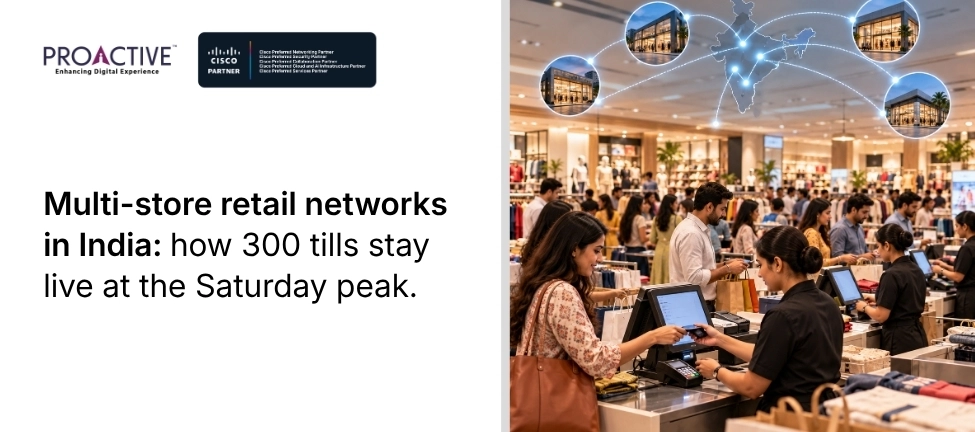
Managed retail networks in India cover store rollouts, point-of-sale resilience, guest Wi-Fi, PCI DSS segmentation and multi-hundred-store dashboards under one 24x7 service. The economics turn on stores per hour of downtime and how fast a failing till, VPN or wireless is caught before a customer walks. Proactive runs Cisco Meraki estates for retail chains at 300-store scale, delivered as a Cisco Penta-Preferred Partner under the Cisco 360 Partner Program.
Written for Retail CIOs, Heads of Store Operations, IT Directors and Loss Prevention leads at Indian multi-store chains in fashion, grocery, quick-service F&B, consumer electronics, jewellery, pharmacy and speciality retail.
A modern Indian retail store does one thing at 7:30 PM on a Saturday: convert footfall into transactions. The network is the invisible layer that decides whether that conversion happens or does not. Cards decline. Loyalty lookups time out. The kitchen display system freezes at a QSR. Cameras stop recording, so tomorrow's shrinkage investigation opens with a gap in the tape. The queue at the till stretches. Somebody in the third position gives up and puts the basket down.
Retail CIOs do not measure downtime in the same way BFSI or manufacturing do. They measure it in tills-per-hour-per-store, at peak, on the day it hurt. A network that works fine Monday morning and fails at 7:45 PM on Diwali eve is not a working network. It is a network that failed at the only moment that mattered.
Managed retail networks exist to close the gap between "the tools said it was up" and "customers actually completed transactions".
The standard Indian multi-store profile, from small format to flagship.
Small store (200 to 800 sq ft). One Cisco Meraki MX security appliance with built-in LTE failover, one MS switch for PoE, two MR wireless access points (one staff, one guest), typically two to four MV cameras for loss prevention. Kiosk formats simplify further, sometimes to a single ruggedised Meraki appliance with cellular fallback and one Wi-Fi radio.
Standard store (800 to 3,000 sq ft). MX at the front, dual MS switches (one for tills and staff, one for cameras and back-of-house), three to six MR access points for staff and customer separation, MV camera coverage tuned for loss prevention and queue management, and MT sensors where cold chain or environmental monitoring is in scope.
Flagship or department store (3,000 sq ft and up). Multiple MX for resilience, extensive MS switching, dense MR wireless for both staff and guest experience, comprehensive MV coverage, MT sensors for HVAC and cold chain, and often an on-premise server segment behind the MX for local loyalty or inventory caching.
The network in every case connects back to a central data centre or cloud through Meraki Auto-VPN, keeps the cardholder data environment (CDE) isolated from staff and guest traffic, and offers a captive-portal guest Wi-Fi that respects Indian consent norms and doubles as a footfall analytics source.
Retail downtime almost never starts at the till itself. It starts at one of four points upstream.
The last-mile broadband link. Retail sites, especially in tier-two and tier-three Indian cities, sit on broadband circuits with variable SLAs. When the primary link degrades, the till stops responding to card authorisations because the backend cannot be reached.
The LTE failover. When configured correctly, LTE takes over in seconds, and the customer never notices. When configured incorrectly (or when the SIM has been swapped in a store and nobody updated the profile), the failover does not fire, and the store goes dark.
The Auto-VPN tunnel back to HQ. Loyalty, inventory and CRM sit centrally. If the tunnel drops, the till may still accept cash but stops accepting loyalty, gift cards or centralised promotions.
The card acquirer path. The payment terminal itself may be fine, but the acquirer connection through the network may be broken. This is the single most common "the till is down" ticket that turns out to be a network path issue, not a terminal fault.
A managed retail network monitors all four continuously, catches degradation before it hits the till, and opens a ticket the moment any one of them wobbles. The customer at the register sees a working transaction.
Indian retail chains that treat guest Wi-Fi as an afterthought waste one of the strongest owned marketing assets they have.
A properly designed guest Wi-Fi network on Meraki delivers three things at once. A captive portal that captures a mobile number and consent under Indian data protection norms, feeding into the loyalty platform. Footfall analytics that show unique visitors, dwell time and repeat visit patterns per store per hour. And, critically, isolated traffic that never touches the cardholder data environment.
The last part matters because it collapses the guest network out of PCI DSS scope entirely. Which brings us to the next question retail CIOs quietly worry about.
Any Indian retailer processing card-present transactions falls into PCI DSS scope for the cardholder data environment. Where segmentation reduces the CDE to the specific network segment carrying card data, the rest of the store network (staff, guest, cameras, back-office) drops out of scope. This makes annual PCI DSS assessment materially cheaper and reduces audit workload.
The Meraki architecture supports this cleanly. Separate VLANs for CDE, staff, guest, cameras and IoT. The MX firewall enforces east-west policy between them. Logging feeds into the customer's SIEM with the retention needed for PCI DSS Requirement 10. Change control captures every rule addition or modification with reviewer sign-off, which is what a QSA (Qualified Security Assessor) wants to see during the annual assessment.
Under a Managed Networks contract, the segmentation is designed once, applied through templates across every site, and audited quarterly. The alternative (per-store segmentation done during opening by whoever was on site) is where PCI DSS scope quietly leaks over time.
Retail chains open, close and relocate stores continuously. A managed retail network needs the rollout function to run as an assembly line.
Template design. Every store profile (small, standard, flagship, kiosk) has a Meraki configuration template locked at head office. The template covers VLANs, SSIDs, firewall policy, Auto-VPN, camera settings and MT sensor thresholds. Changes to the template are peer-reviewed and versioned.
Zero-touch provisioning. Meraki devices ship directly to the new store address. The moment they are powered on and get an internet connection, they check into the customer's Meraki dashboard, download the template, and configure themselves. The store's IT installer (often a local franchisee or a store manager, not a network engineer) does not need to log into the device.
Store opening SLA. For a well-run rollout on a Meraki estate, a new store network can be live inside 24 to 48 hours of hardware arrival on site, assuming the broadband circuit is provisioned in parallel. Typical rollout cadence for expanding chains sits at four to ten stores a week, with the managed operator carrying the entire operational burden.
Multi-hundred-store dashboards. Once the estate crosses 100 stores, IT dashboards designed for network engineers become useless to the operations team that runs the business. A retail Ops Head needs to know which stores are currently affected, not which access point has a firmware warning. Managed contracts typically include a business-language operations dashboard with plain-English site health, active incidents and their business impact, and quick filters by region or store cluster.
Two adjacent capabilities most retail CIOs eventually use.
Meraki MV cameras. Ship to the store, self-provision, upload footage to the Meraki cloud. Loss prevention teams can review footage remotely, set alerts on unusual activity, and export clips for incident investigation. Camera analytics on newer MV models can also assist with queue length monitoring at peak, which the store manager cares about more than the IT team does.
Meraki MT sensors. Temperature and humidity monitoring for cold chain in grocery, QSR, dairy and pharmacy. Water leak sensors for storage. Open-door sensors for after-hours security. All feeding into the same dashboard, with alerts routed to the store manager and the operations desk simultaneously.
For a retail chain that has separate contracts for network, cameras and cold chain today, folding all three into one Managed Meraki estate collapses vendor overhead materially.
Retail estates produce a specific ticket signature. Wi-Fi complaints during shift change (staff logging into personal apps at the moment paying customers arrive). Guest Wi-Fi captive portal issues (usually credential-related, sometimes carrier-side SMS OTP delays). PoS card decline tickets, most of which trace to network path issues rather than terminal faults. Camera storage or connectivity tickets. New store opening backlogs.
A managed retail estate we run with a national F&B chain, 300-plus stores, sits at around 400 to 500 tickets a month across the estate. Of those, roughly 60 per cent are resolved without customer-side action because monitoring catches the issue and the NOC fixes it before the store manager notices. The remaining 40 per cent surface as store-manager-raised tickets and are resolved against the same 30-minute-response, 3-hour-P1 SLA that applies to the wider Managed Services book.
For the retail chain, the shift is measurable in the metric that matters: transaction completion rate at peak. Every till that stays live for the Saturday rush is one more basket that closes.
Three commercial models, chosen by store profile and expansion plan.
CapEx suits chains with a stable footprint and comfortable capital availability. Hardware is bought against a rolling refresh plan.
OPEX is the strongest fit for chains in active expansion. Per-site subscription pricing means each new store opening is a known cost, and refresh is handled inside the term. Growth-stage retail chains often standardise on OPEX for exactly this reason.
Managed-Only fits chains that already own a Meraki estate at scale and want to hand operations to a specialist while keeping the asset side untouched.
Full walkthrough sits in the CapEx or OPEX decision guide.
Two hours with your Head of Store Operations, IT Director and, ideally, a QSA if PCI DSS is in scope. We take a snapshot of your current retail network estate, run it through the audit template (segmentation, template hygiene, LTE failover configuration, PCI DSS scope, guest Wi-Fi analytics, ticket signature), and hand you a written finding by end of week. If the estate is well-run, we say so. If we can add value, we quote the fix.
Disclaimer: Store profile examples, ticket signatures, rollout timelines and commercial patterns described here are indicative and drawn from typical Indian multi-store retail engagements. Actual outcomes vary by store format, footprint scale, PCI DSS scope and commercial tier. PCI DSS references are operational guidance; a Qualified Security Assessor (QSA) is the definitive voice on compliance scope for any specific merchant.

Pulkit Singh AGM, Enterprise Networking, Proactive Data Systems
We'll get back to you shortly.