Updated: 27 May 2026
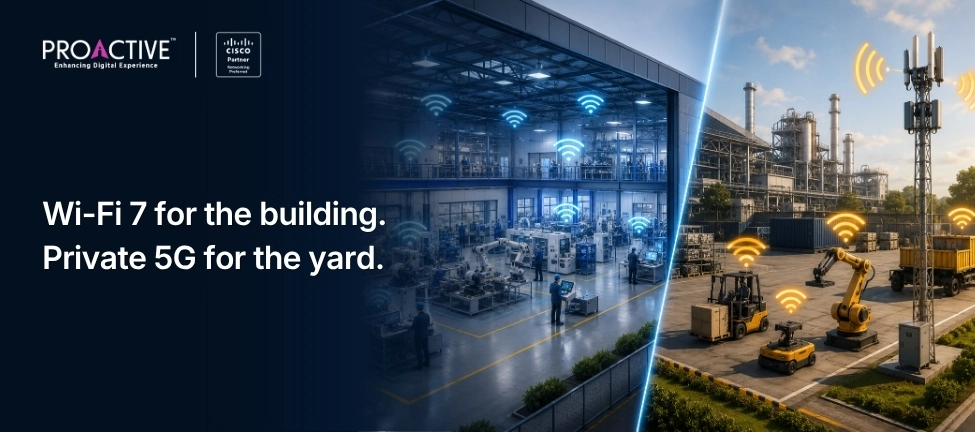
For most Indian factories, Wi-Fi 7 is the right network to build on: it is cheaper, supports every device, and covers indoor connectivity, dense IoT and handhelds. Private 5G is the better choice for large campuses, outdoor yards and fast-moving autonomous vehicles that need guaranteed, interference-free coverage. Many large sites will run both, split by use case.
Build a new plant or launch a serious automation programme, and the wireless question arrives early: private 5G, or Wi-Fi 7? Both are credible industrial networks. They are not interchangeable. The right choice depends on the size of the site, what moves across it, and how much guaranteed performance the work demands.
Both carry data wirelessly. How they do it is what separates them.
Wi-Fi 7 runs on unlicensed, shared spectrum. It is inexpensive, every device supports it, and most IT teams already know how to run it.
Private 5G runs on licensed or dedicated spectrum, so it is interference-free and predictable. A centralised scheduler decides exactly when each device transmits, which makes latency deterministic. One 5G cell covers what would take dozens of Wi-Fi access points, and cellular handover is built for assets moving at speed across a wide area.
How Do They Compare For A Factory?
The trade-offs, side by side:
| Private 5G | Wi-Fi 7 | |
|---|---|---|
| Spectrum | Licensed or dedicated, interference-free | Unlicensed, shared |
| Coverage per radio | Wide. One cell replaces dozens of access points | Shorter. More access points for the same area |
| Mobility and handover | Seamless, built for fast wide-area movement | Strong within a building |
| Device ecosystem | Smaller, needs SIMs, higher device cost | Universal, every device supports it |
| Deployment cost and skills | Higher capex, spectrum, specialist skills | Lower, familiar to most IT teams |
| Best for | Large campuses, outdoor yards, critical mobile control | Indoor connectivity, dense IoT, general use |
No column wins outright. Each technology is strong exactly where the other is weaker.
Private 5G earns its higher cost in specific conditions.
Scale and outdoors. A large campus or an outdoor logistics yard would need dozens of Wi-Fi access points and careful design. A handful of 5G cells covers the same ground.
Wide-area mobility. Autonomous mobile robots and vehicles that travel across a whole site need seamless handover. Cellular was built for exactly that.
Critical control. Machine control and safety systems that need guaranteed, sub-10-millisecond latency benefit from 5G's deterministic scheduling, where contention-based Wi-Fi cannot promise the same.
Private 5G costs more than Wi-Fi to deploy. International benchmarks put an enterprise private 5G network at roughly USD 250,000 to 1 million, about ?2 crore to ?8.5 crore, well above an equivalent Wi-Fi build.
The money goes to four things Wi-Fi does not need: spectrum, a 5G core, cellular radios, and a SIM or module in every device. Specialist integration skills add more.
The comparison is not fixed, though. Private 5G needs far fewer radios. A 250,000 sq ft plant might take around 20 5G radios against 50 to 80 Wi-Fi access points. On a very large or outdoor site, where access point counts and design cost climb, that gap narrows. Cost is a question of site, not only technology.
In India, private 5G carries one extra hurdle, and it is the one to settle first: spectrum.
Under the Department of Telecommunications' 2022 Captive Non-Public Network framework, an enterprise has two routes. It can lease 5G spectrum from a telecom operator or obtain spectrum directly from the DoT. Direct allocation is open only to companies with a net worth of at least ?100 crore, and it remains an evolving process, with rules and demand notices still being refined through 2025 and beyond.
The device ecosystem, once a real constraint, is now largely in place. For most manufacturers, leasing through an operator is the realistic route. Either way, spectrum is a decision to make at the start of the project, not midway through it.
So which should you build? For the large majority of factory use cases, Wi-Fi 7 is the default: lower cost, universal device support, and enough capability for indoor connectivity, IIoT and handhelds. Whether to move to Wi-Fi 7 now is a separate decision, covered in our guide to that upgrade. Private 5G is the considered addition, justified where scale, outdoor coverage, wide-area mobility or critical control demand it. Most large sites run both.
Proactive Data Systems designs industrial wireless across Cisco Wi-Fi 7 and private cellular, and holds Cisco Preferred Partner status under the Cisco 360 Partner Program for Networking.
Request an industrial wireless assessment. We map your site, your moving assets and your critical use cases, and recommend the right mix. Write to [email protected] or fill out the form.

Deepak Sinha Senior Presales Manager, Enterprise Networking
We'll get back to you shortly.