Updated: 24 February 2026
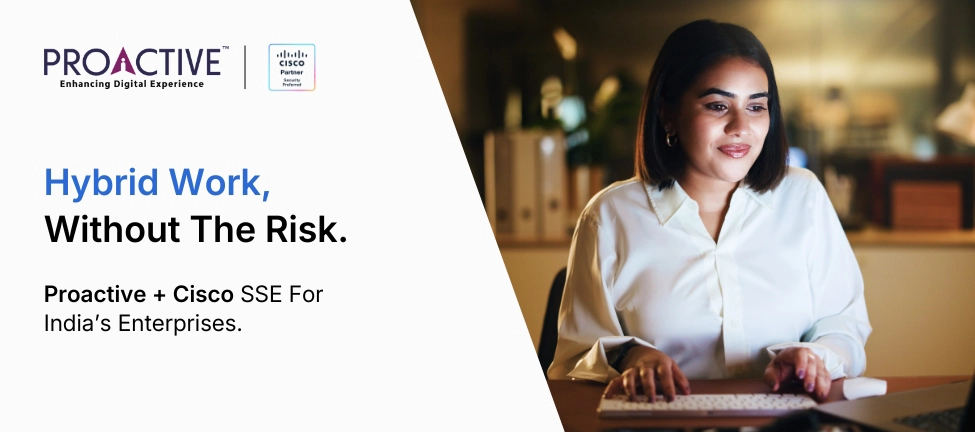
Your staff work from Noida, Pune, Coimbatore and Gurugram. Your plants run in Sanand and Sriperumbudur. Your data lives in SaaS and private apps. Attackers probe for weak paths. You cannot leave this to chance. Secure remote access for hybrid work now drives uptime, client trust and audit success. Security service edge (SSE) gives you a clean way to meet that need without dragging legacy debt.
This guide turns SSE into real outcomes. It blends Cisco Secure Access with the on-ground delivery of Proactive Data Systems, a Cisco Preferred Security Partner in India. You get design that fits Indian network realities, rollouts that stick, and support that answers when it matters.
SSE brings secure web gateway (SWG), cloud access security broker (CASB), data loss prevention (DLP) and zero trust network access (ZTNA) into one cloud service. When you do it right, you get four gains that your board will accept.
Cut attack paths, not access: Move from broad VPN to ZTNA per app. Verify user, device and context on each request. Remove flat network risk and reduce lateral movement. Your SOC sees cleaner signals and fewer false positives.
Protect data where people work: Use DLP and CASB to keep source code, CAD files and client data in the right hands across Microsoft 365, Webex, Google Workspace and GitHub. Apply policy by user, device posture and location. Map controls to DPDP Act data classes and CERTIn incident expectations.
Improve user experience: Send traffic to the closest point of presence, inspect once, and apply policy in the cloud. Users stop raising slow link tickets. Measure and show the gain with digital experience monitoring.
Simplify operations: One policy plane for web, SaaS and private apps. Fewer agents. Fewer consoles. Clear ownership between network and security teams.
Cisco Secure Access, with Duo, Umbrella, Secure Web Gateway, CASB/DLP and ThousandEyes, maps cleanly to these needs. Proactive tunes the stack to Indian ISP routes, last-mile shifts and data residency choices. You buy outcomes, not spare parts.
Do not jump to tools. Anchor your rollout in a short risk review.
Crown jewels: List assets that keep revenue flowing. In IT/ITeS, this is client data in SaaS and code repos. In manufacturing, add PLM, ERP, MES and supplier portals.
User journeys: Map how staff, vendors and outsourced teams reach those assets from homes in Tier2 cities, plants, partner sites and shared devices. Note unmanaged endpoints and shift patterns.
Threats that bite here: Focus on phishing, token theft, OAuth abuse, misconfigured SaaS, insider misuse and device compromise.
Pick controls with intent: ZTNA for private apps, SWG + CASB for SaaS, DLP for sensitive data, device posture checks, phishing-resistant MFA, and continuous monitoring.
1) Go ApplicationFirst, Not NetworkFirst
Publish private apps behind ZTNA connectors so users never see your network. Avoid broad VPN ranges. Reduce blast radius and audit scope.
2) Keep Trust Low And Fresh
Use phishingresistant MFA with platform biometrics or security keys, plus device health checks. Refresh risk during the session. Do not grant daylong tokens.
3) Put Data Controls Near The User
Inspect web and SaaS traffic in the cloud. Use inline DLP for patterns and exact data match for code and CAD. Apply tenant controls for sanctioned SaaS. Block risky unsanctioned apps and offer safe options.
4) Measure Digital Experience
Watch last mile, ISP and SaaS paths with ThousandEyes or builtin probes. Route to the best SSE PoP in India. Fix facts, not guesswork.
5) Plan For Plants And Branches
Plants need steady access to ERP, PLM and supplier portals. Pair SSE with SDWAN to hold a good path and apply the same controls to office and shop floor. Keep a small failsafe for critical apps.
6) Keep Admin Blast Radius Small
Use least privilege in the admin plane. Split duties for netops and secops. Log every change. Stream into your SIEM from day one.
Problem: A BFSI client asked for strict controls on code and client files. Split VPN caused lateral movement risk and slow links at monthend.
Approach: Proactive rolled out Cisco Secure Access or ZTNA and SWG, Duo MFA with device checks, CASB for SaaS controls, and DLP with exact data match for code patterns. ThousandEyes tracked two ISPs and the nearest SSE PoP.
Outcome: VPN use fell 90 per cent. Access ticket time fell 40 per cent. The client cleared the review without extra conditions. Developers used GitHub and Microsoft 365 with a policy that followed them. Page load times improved by 25 per cent at peak.
Problem: Vendors needed PLM and supplier portal access from outside. A legacy SSL VPN exposed wide subnets. Plant WiFi varied by shift.
Approach: Proactive set ZTNA per app, SWG for web, CASB for SaaS, and DLP for CAD and BOM exports. SDWAN + SSE kept smart paths. Duo enforced phishing-resistant MFA for vendors with keys.
Outcome: No lateral paths for vendors. DLP stopped test data leaving unsanctioned drives. Supplier logins rose, and help desk calls fell. Cutover did not touch production. Vendor access reviews took half the time.
Problem: Token theft led to a risky login into a staging tenant. VPN slowed CI/CD.
Approach: ZTNA to staging and admin apps, CASB OAuth risk checks, Duo with verified push, tenant restrictions for sanctioned SaaS.
Outcome: No broad network access. Build speeds rose 18 per cent as split tunnels went away. OAuth risk events dropped and were triaged in minutes.
SSE vs Legacy VPN, An Where SASE Fits
Many tams search for "SSE vs legacy VPN" and "SASE vs SSE for hybrid work". Here is the short view
| Area | Legacy VPN | SSE with ZTNA | SASE |
|---|---|---|---|
| Access Model | Network, broad subnets | Per app, identity and device context | SSE plus SDWAN under one cloud |
| User Experience | Hairpins and slow links | Closest PoP, inspect once | Same as SSE, adds network edge |
| Security Posture | High lateral risk | Low blast radius, strong DLP/CASB | Same as SSE, with SDWAN policy |
| Ops & Scale | Complex split tunnelling | One policy plane, fewer agents | Single fabric for net + sec |
| Best Use | Short term legacy needs | Replace VPN for hybrid work | Converged edge for branch + remote |
Bottom line: SSE is the fastest way to replace legacy VPN for hybrid workforces. Move to ZTNA per app, apply SWG + CASB + DLP, then decide if you need full SASE with SDWAN.
Prove Value In 30 Days: Pick two use cases. Common picks: replace VPN for one private app and enforce SWG + CASB for Microsoft 365. Measure help desk load and page times.
Harden Identity And Devices: Turn on phishing-resistant MFA for admins and remote users. Enforce device posture. Block high-risk devices from sensitive apps.
Publish Private Apps Behind ZTNA: Start with admin portals, then ERP and code repos. Reduce overlapping VPN. Keep a tight exception list and review it weekly.
Turn on SaaS Controls and DLP: Classify data types, map to DPDP Act. Move from monitor, to warn, to block. Apply tenant controls and keep users on sanctioned apps.
Integrate Telemetry: Stream logs to SIEM. Correlate identity, device and app signals. Build playbooks to respond in minutes.
Scale and Simplify: Retire legacy proxies and point tools. Consolidate agents. Keep one policy model and one change process.
Boards and auditors expect proof. With SSE you can show:
Access tied to identity, device, location and risk
Data policy across web, SaaS and private apps
Full audit trails for admin and user actions
Measured user experience
CERTInready incident logging and DPDP Act-aligned data handling
Proactive builds reports that map to ISO 27001, SOC 2 and sector needs. Your team can answer audits without a war room.
You need a partner that knows the Cisco Secure Access stack and the ground truth of India’s networks. Proactive brings Cisco-certified architects who have solved edge cases in IT/ITeS and manufacturing. They plan for fibre cuts, 4G fallbacks and ISP routes. They script clean migrations and sit with your admins till the change holds. Cisco brings depth in SSE, ZTNA, SWG, CASB, DLP, Duo and ThousandEyes. You get a single, proven path to secure remote access for hybrid work in India.
ZTNA live for the top 10 private apps
Phishing-resistant MFA and device posture for all remote users
SWG and CASB policies for SaaS, with tenant controls
DLP policies for code, CAD and client data
Telemetry into SIEM with clear playbooks
Experience monitoring across the last mile, ISP and SaaS
Decommission plan for VPN and legacy proxies
Weekly exception review and a monthly control health report
Faster vendor and new hire access
Better user experience at home, branch and plant
Audit trails that satisfy clients and regulators
Lower spend on overlapping tools over time
You want secure remote access for hybrid work that users accept, auditors sign off, and your CIO can fund with confidence. Proactive Data Systems, a Cisco Preferred Security Partner in India, will design, deploy and run your SSE solution with clear milestones and measured results. Start with a 30-day pilot for two use cases. Get a rollout plan, budget, risk log and success metrics you can present next month.
Book a working session with Proactive’s SSE architects. Bring two apps and one SaaS suite. Leave with a plan you can act on.
Proactive Cybersecurity Team
We'll get back to you shortly.