Updated: 15 May 2026
Migrating from VPN to SASE replaces remote-access and branch VPNs with cloud-delivered, identity-based access. For IT and ITeS firms, the move is best done in five phases: inventory access, shift internet traffic to a cloud security layer, replace remote-user VPN with Zero Trust Network Access, converge branches with SD-WAN, then decommission the old appliances.
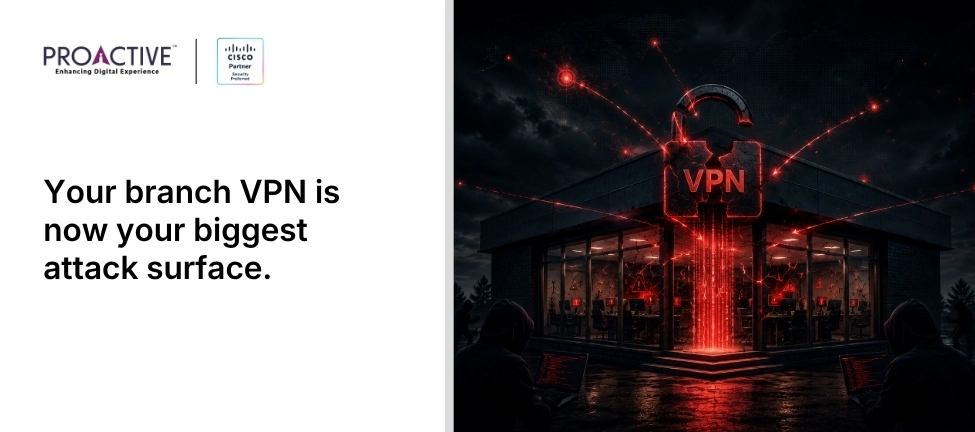
For two decades, the branch VPN was how distributed IT and ITeS firms stayed connected. It is now one of their largest liabilities. VPN appliances sit exposed to the internet and grant flat network access once breached. The replacement, SASE (Secure Access Service Edge), is well understood. The question CIOs actually face is how to migrate without disrupting a live operation.
Three reasons, and all three matter more for IT and ITeS firms than for most.
First, exposure. A VPN concentrator is an internet-facing appliance. Compromised VPN credentials were the initial access vector in 48% of ransomware attacks in a single quarter of 2025, and VPN devices featured in 58% of ransomware incidents last year.
Second, flat access. Once a VPN session is established, the user reaches the whole network segment. Least privilege becomes impossible to enforce.
Third, third parties. For firms running client and vendor connections, this is decisive: 69% of breaches trace back to third-party VPN access.
SASE converges networking and security into one cloud-delivered service. It pairs SD-WAN for the network with a security service edge: Zero Trust Network Access, a secure web gateway, a cloud access security broker and firewall-as-a-service. Cisco delivers this through Cisco Secure Access for the security layer and Meraki SD-WAN for the branch. Instead of a tunnel into the network, each user reaches named applications, by identity, inspected at the edge.
| Traditional Branch VPN | SASE | |
|---|---|---|
| Access model | Full network access once connected | Per-application, identity-based |
| Traffic path | Backhauled to a data centre | Direct to cloud, inspected at the edge |
| Scaling | New appliance per site | Cloud service, no appliance |
| Visibility | Limited, per tunnel | Unified across users, sites and apps |
| Attack surface | Internet-facing appliance | No inbound appliance to exploit |
A SASE migration succeeds when it is sequenced. Five phases, lowest risk first:
Inventory access. Map every site, remote user and third party, and the applications each one needs to reach. The migration is only as good as this list.
Move internet and SaaS traffic first. Route web traffic through the cloud security layer. Low risk, immediate security gain.
Replace remote-user VPN with ZTNA. Give remote staff per-application access by identity, then retire the remote-access VPN concentrator.
Converge the branch with SD-WAN. Replace branch VPN routers with SD-WAN, steering traffic directly and securely from each site.
Decommission and consolidate. Retire the remaining VPN appliances, consolidate policy in a single console, and baseline the cost and performance gain.
Each phase stands on its own. A firm can pause after any one of them and still be better off than it was.
For IT and ITeS firms, the migration is also a compliance upgrade. Under the Digital Personal Data Protection Act, and under the security clauses most global clients write into contracts, flat VPN access is hard to defend in an audit. SASE helps on three fronts: per-application access enforces least privilege, traffic inspection and data-loss controls govern what leaves the network, and unified logging gives auditors a single clear record. A VPN gives auditors none of that.
VPN to SASE migration is no longer a someday project. It is a budget decision being taken now, and the firms that sequence it well replace risk with control without a single disruptive cutover.
Proactive Data Systems holds Cisco Preferred Partner status under the Cisco 360 Partner Program for Security, and has migrated distributed Indian enterprises from legacy VPN to Cisco Secure Access.
Request a SASE readiness assessment. We map your current VPN and access estate and return a costed, five-phase migration plan. Write to [email protected].
We'll get back to you shortly.