Updated: 17 February 2026
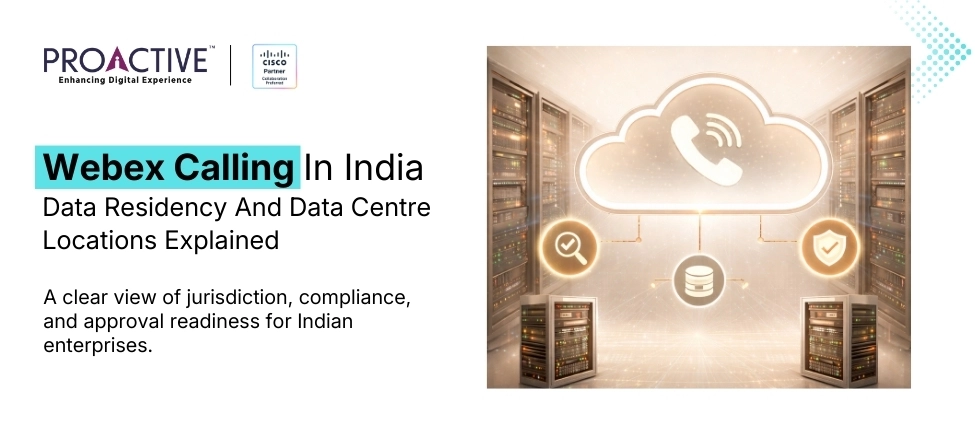
For Indian enterprises evaluating cloud calling, a few questions surface as quickly as data location.
Where is call data stored? Does it remain within Indian jurisdiction? And what role do local data centres play in regulatory compliance?
These are not academic concerns. In India, enterprise voice intersects directly with telecom regulation, lawful access obligations, and audit expectations. As Webex Calling adoption grows, clarity on data residency has become central to approval decisions.
This article explains how data residency applies to Webex Calling deployments in India, what Cisco’s data centre presence means in practice, and how enterprises should interpret location in the context of regulatory-ready cloud calling.
Indian telecom regulations do not treat enterprise voice as a generic cloud workload. When voice connects to the public switched telephone network (PSTN), it falls within a regulated domain that prioritises jurisdictional control, lawful access, and auditability.
For enterprise IT leaders, this translates into a practical requirement. Call detail records, audit logs, and related metadata must remain accessible within Indian jurisdiction when required by competent authorities.
This is not about data ownership or day-to-day access. It is about ensuring that regulatory access pathways exist, are documented, and align with Indian expectations.
Discussions around cloud data location often suffer from imprecision. Not all data carries the same regulatory weight.
In the context of enterprise cloud calling, the focus is on:
This is distinct from general application data or collaboration content. The regulatory lens applies when voice interacts with licensed telecom infrastructure. Understanding this distinction helps avoid unnecessary concern and keeps approvals grounded in actual requirements.
Webex Calling supports regulated deployments in India through architectures that align with Indian telecom frameworks.
In India-ready deployments, call records and associated logs are governed to support jurisdictional access and audit requirements. Cisco operates data centres in India, including locations in Mumbai and Chennai, which support local data residency, audit access, and regulatory clarity.
This presence strengthens governance for Indian enterprises. It allows call-related data to remain within Indian jurisdiction while preserving the operational model of a global cloud platform.
It is tempting to reduce compliance discussions to geography alone. That would be misleading. Indian regulatory compliance for cloud calling depends primarily on deployment architecture, licensed PSTN interconnect models, and governance discipline. Data centre presence supports these outcomes by ensuring jurisdictional control and access.
It does not replace the need for regulated PSTN connectivity. It does not override licensing requirements. And it does not shift regulatory responsibility away from approved interconnect models. In short, location strengthens assurance. It does not create compliance by itself.
For CTOs and CIOs, data residency questions often arise late, during security reviews or audit sign-offs. When addressed in isolation, they can slow decision-making. When addressed as part of a broader regulatory-ready design, they rarely do.
Enterprises that treat data residency as one element of a compliant architecture, alongside PSTN anchoring, emergency calling, and governance, experience smoother approvals and fewer surprises post go-live.
Webex Calling provides the platform capability to support regulated deployments in India. Whether that capability translates into a compliant outcome depends on how the solution is designed and implemented.
Deployment partners play a central role here. Decisions around PSTN interconnects, data governance, and documentation determine whether data residency supports audit confidence or becomes an afterthought.
Enterprises that work with partners experienced in Indian regulatory conditions tend to resolve these questions upfront, rather than during escalation.
Where are Webex Calling data centres located in India?
Cisco operates data centres in India, in Mumbai and Chennai. These facilities support data residency, audit access, and jurisdictional clarity for India-ready Webex Calling deployments.
Does Webex Calling store call data in India?
In regulated India deployments, call detail records and related logs are governed in line with Indian regulatory expectations. Data centre presence in India supports local jurisdictional access and audit requirements.
Is Webex Calling compliant with Indian data localisation rules?
Webex Calling supports compliance when deployed using approved architectures, licensed PSTN interconnect models, and appropriate governance. Data localisation is one component of this broader compliance framework.
Is a local data centre mandatory for Webex Calling compliance in India?
Indian regulatory compliance depends on deployment design and licensed interconnect models. Local data centres strengthen assurance and audit readiness, but compliance is determined by architecture and governance rather than location alone.
Data residency is one part of the compliance picture for enterprise cloud calling in India.
For a structured, CTO-focused view of regulatory expectations, deployment models, and approval readiness, Proactive Data Systems has published a position paper on Webex Calling compliance in India. It examines regulatory roles, PSTN architectures, data governance, emergency calling, lawful access, and partner readiness in detail. Read the position paper here.
Cisco’s data centre presence in India provides important jurisdictional assurance for Webex Calling deployments. It supports data residency, audit access, and regulatory clarity for Indian enterprises.
Yet compliance remains a matter of design discipline rather than infrastructure alone.
For enterprises evaluating Webex Calling, the right question is not where the data centre sits, but whether the overall deployment has been designed to meet Indian regulatory expectations from the outset. When that question is answered clearly, approvals tend to follow.

Proactive Collaboration Team
We'll get back to you shortly.