
Updated: 21 January 2026
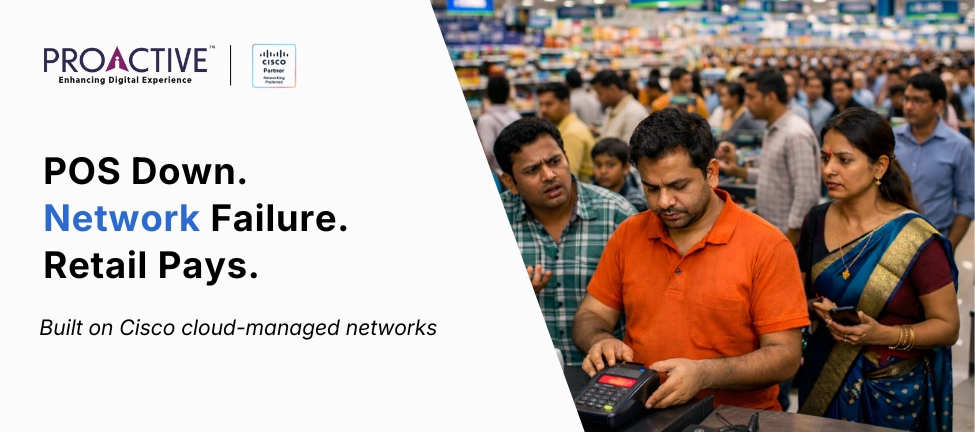
It’s never dramatic.
One counter first. Then another. QR payments spin. A card machine retries. The cashier looks up and says the sentence every retail leader hates:
“POS is down.”
The lights are on. CCTV is recording. WiFi shows connected. Someone runs a speed test. It passes.
And yet, billing has stopped.
This is one of the most expensive failures in retail. Not because it happens often, but because when it does, it hits the only moment that matters: the transaction.
When billing goes offline, the instinct is to blame the application or the payment provider.
Sometimes that’s true.
Most of the time, the problem lives quietly in the network that connects everything together.
Retail networks are built to be flexible. POS systems are built to be intolerant.
That mismatch is where things break.
At peak hours, the network behaves very differently.
The POS doesn’t fail because it’s weak.
It fails because it’s forced to compete.
POS traffic is timesensitive. Delay it by seconds, and the store feels broken.
Yet many networks let it queue behind video, guest traffic, and background syncs.
In theory, everything is important.
In reality, billing should always win.
Networks that don’t enforce this decision leave it to chance.
One access point. One switch. One uplink.
When it struggles, everything connected to it struggles together. Including billing.
Store one works. Store four doesn’t.
Small differences introduced over time only reveal themselves under load.
Speed tests measure potential, not behaviour.
Dashboards show status, not accountability.
They tell you the network is up. They don’t tell you whether the POS is being protected.
Visibility feels like control. It isn’t.
When POS failures start happening, retail teams usually respond quickly.
Sometimes the store comes back online.
The underlying risk remains.
When the POS goes offline, someone has to decide:
Most retail setups don’t have a clear owner for this moment.
So recovery becomes noisy. Slow. Blameheavy.
The first POS outage is alarming.
The third is explained away.
By store ten, teams build workarounds. Cash drawers open. Staff apologise. Customers wait.
The network rarely goes down completely.
It just stops protecting revenue.
Some retailers keep reacting.
Others redesign how the network behaves under pressure.
They make explicit decisions about:
This isn’t about new hardware.
It’s about making the network boring when money is on the line.
When POS works during peak hours:
Nothing happens.
And in retail IT, nothing happening is success.
The question isn’t whether your POS is reliable.
It’s whether your network is designed to protect it when the store is busiest.
That’s where peace of mind lives.
Most retail leaders encounter this somewhere between store two and store ten.
If you want to sanitycheck whether your network is actually protecting billing during peak hours, we’re happy to look at it with you. Not to sell anything. Just to see if it’s already boring enough.
Prefer a quiet conversation? Write to [email protected].
We'll get back to you shortly.
