
Updated: 28 January 2026
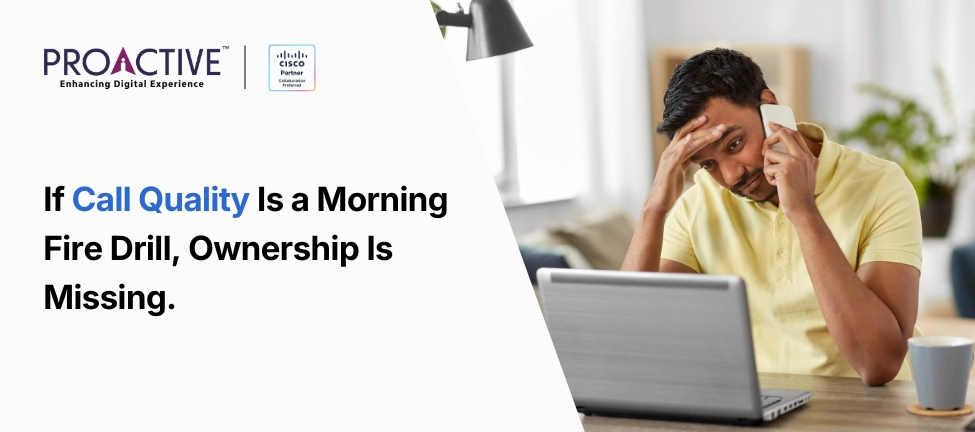
It’s 9 AM.
The workday has barely started.
And the first complaint is already in.
“Calls are breaking.”
“Audio is choppy.”
“I can’t hear the customer.”
Within minutes, IT is pulled into call quality triage.
Not because the platform is down.
Not because anything major failed.
But because voice quality has become unpredictable.
This is not a technology problem.
It is an operating problem.
Voice is unforgiving.
Email can wait.
Chats can lag.
But calls expose problems instantly.
A slight network issue.
A misconfigured device.
A routing change.
A policy tweak.
Anything slips, and users feel it immediately.
That is why call quality complaints are usually the first signal that something deeper is wrong.
In most organisations, call quality monitoring is reactive.
IT hears about problems only after users complain.
There is no early warning.
No continuous quality baseline.
No clear threshold for intervention.
So every complaint becomes a live investigation.
At peak business hours.
With pressure.
With leadership copied in.
That is not ownership.
That is firefighting.
When IT teams are pulled into call quality issues, they are rarely debugging just “voice”.
They are chasing dependencies.
Each team owns a part.
No one owns the outcome.
That fragmentation is what turns small issues into daily disruptions.
Most modern calling platforms provide analytics.
MOS scores.
Packet loss metrics.
Latency graphs.
Visibility helps.
But visibility without ownership changes nothing.
Seeing a problem is not the same as resolving it.
Without clear responsibility, dashboards become post-mortem tools instead of prevention tools.
As organisations grow, call paths multiply.
More locations.
More devices.
More networks.
More usage patterns.
What worked for a single office breaks across multiple sites.
Without proactive quality management, IT teams end up reacting every morning to a different symptom of the same underlying issue.
In a well-run calling environment:
Call quality becomes predictable.
Boring.
Reliable.
That is success.
IT teams are capable.
The problem is not expertise.
The problem is that call quality management never stops.
It requires constant monitoring, tuning, and ownership.
Most IT teams are structured for projects and incidents, not continuous optimisation.
If call quality issues are discovered by users instead of systems, ownership is missing.
If IT is debugging calls during peak business hours, the operating model is broken.
And if this feels routine, the organisation has normalised a problem it shouldn’t.
Modern calling platforms are stable.
Daily call quality firefighting is not normal.
It is a sign that responsibility for runstate operations is unclear.
Until call quality is proactively owned, IT teams will keep starting their mornings in debug mode.
If call quality issues are part of your daily routine, it’s worth asking why.
A short conversation can help identify where ownership is breaking down.
Write to [email protected] to start that discussion.
We'll get back to you shortly.
