Updated: 08 July 2026
An AI factory and a data center look the same from the doorway: rows of racks, blinking lights, the hum of cooling. Inside, they are built for opposite jobs. CXOs keep asking how the two differ, because the answer decides what you build and what it costs. Here is the crisp version.
A traditional data center is built to store and process data, running business applications on general-purpose CPUs. An AI factory is built to produce artificial intelligence, training and running AI models on GPUs as its primary workload. One is measured in uptime and transactions; the other in the AI output, the tokens, it generates. That shift in purpose, from processing data to manufacturing intelligence, drives every other difference between them.
A data center is a facility and its infrastructure, compute, storage and networking, that runs an organisation's applications and data. It is optimised for general business workloads: virtual machines, databases and applications, on CPU-based servers, with power, cooling and networking sized for that kind of work. It has been the backbone of enterprise IT for decades and remains the right home for the vast majority of business workloads.
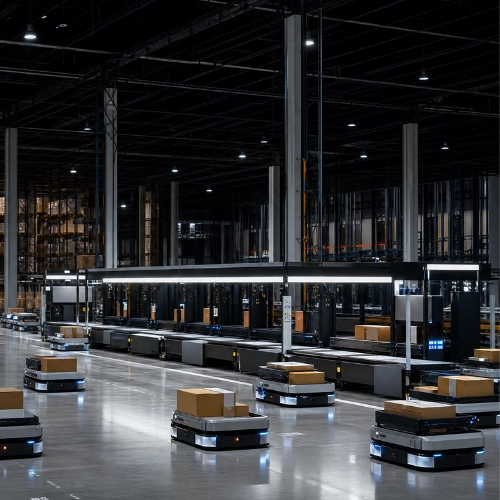
An AI factory is infrastructure purpose-built to train and run AI models at scale. It pairs GPU-accelerated compute with storage fast enough to feed the GPUs, a low-latency network so they work as a cluster, and the high power and cooling density that dense GPU racks demand. The term, popularised by NVIDIA, captures the idea that the facility manufactures intelligence, measured in the tokens its models produce, rather than simply storing and serving data.
The difference shows up in every design choice. The table sets them side by side.
| Aspect | Traditional Data Center | AI Factory |
|---|---|---|
| Primary job | Run business applications | Train and run AI models |
| Core hardware | General-purpose CPUs | GPU accelerators |
| Networking | Standard, north-south traffic | Low-latency east-west fabric |
| Power & cooling | Lower-density racks, air-cooled | High-density racks (25–40 kW), often liquid-cooled |
| Measured by | Uptime, transactions | Tokens produced, cost per token |
Yes, usually in stages rather than a rebuild. Making a data center AI-ready means adding GPU compute, upgrading storage and networking to feed it, and confirming the facility can power and cool the much higher density, often with liquid cooling. Most enterprises do not replace their data center; they add AI-factory capability as a specialised tier inside or alongside it, so the same environment runs both business applications and AI workloads.
No. An AI factory makes sense when you run sustained, large-scale AI training or inference, particularly on data that must stay under your control. For occasional or experimental AI, renting capacity in the cloud is usually the better choice. The question is not whether AI matters, but whether your AI workloads are steady and sensitive enough to justify building the infrastructure to run them yourself.
Understanding the difference is the easy part; deciding what your enterprise needs, and building it without a forklift rebuild, is the work that follows. Proactive Data Systems designs and builds both traditional data centers and AI-ready infrastructure for Indian enterprises. We are a Cisco Preferred Cloud and AI Partner, Dell Platinum Partner and NetApp Preferred Partner, with 35 years in enterprise IT, more than 1,500 organisations served, and a 24/7 service desk in India. To work out which you need, you can ask Proactive for an AI-readiness assessment.

Proactive Data Center Team
We'll get back to you shortly.