Updated: 24 June 2026

An AI factory looks like any other data center from the doorway: rows of racks, blinking lights, the hum of cooling. Inside, it is built for a different job, to turn data into intelligence, measured in the tokens its models produce rather than in uptime. This infographic breaks an AI factory into its four layers, shows what each one does, and explains why the whole thing only works when they are balanced.
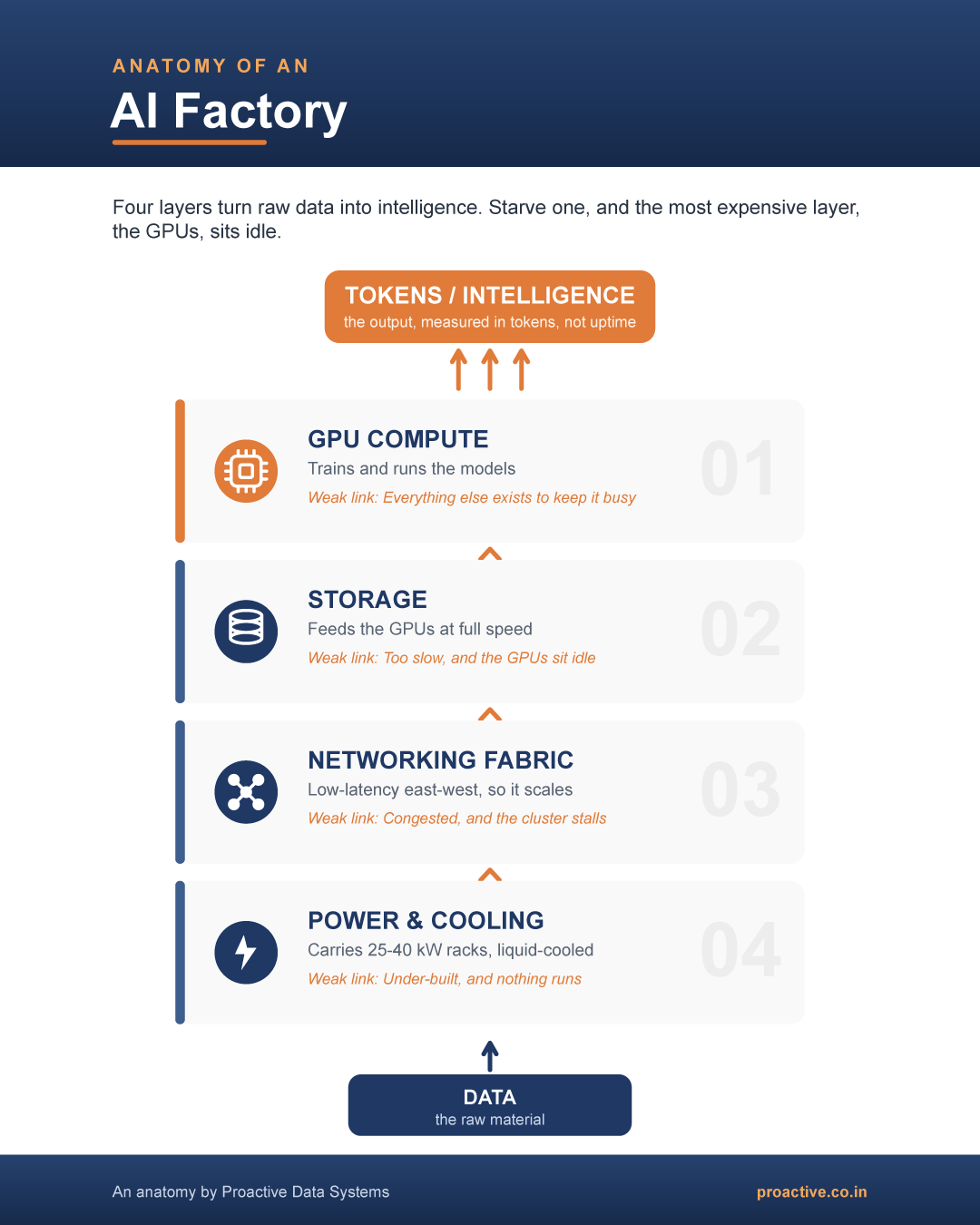
The four layers of an AI factory, and how each keeps the GPUs productive. Weaken any one, and your most expensive layer, the GPUs, sits idle.
An AI factory is built from four layers that work as one system to turn data into intelligence. Its output is measured in the tokens the models produce, not in uptime and transactions.
GPU Compute does the work: it trains and runs the models. It is the workhorse, and everything else in the factory exists to keep it busy.
Storage feeds the GPUs fast enough not to starve them. If storage is too slow, the GPUs sit idle waiting for data.
Networking Fabric provides the low-latency, east-west connectivity that lets the cluster scale. If it is congested, the whole cluster stalls on the slowest link.
Power and Cooling carries the density AI demands, racks of 25 to 40 kW, often with liquid cooling. If it is under-built, nothing above it can run.
The discipline of building an AI factory is balance. Starve any one layer and the GPUs, the most expensive asset in the stack, sit idle. That is why sizing the four layers together matters more than buying the biggest GPUs and hoping the rest keeps up.
Proactive Data Systems designs and builds AI-ready infrastructure for Indian enterprises across all four layers. To size an AI factory for your models, ask for an AI-readiness assessment.

Gaurav Dhansukh Patel Manager, Data Center, Proactive Data Systems
We'll get back to you shortly.