Updated: 26 June 2026
You bought the GPUs. You are using maybe half of them. Not because they are slow, but because they are waiting. A 2025 analysis by Run:ai attributed nearly 40% of enterprise GPU idle time to input/output wait, the GPU sitting idle while storage struggles to deliver the next batch of data. That is the most expensive idleness in the data center: accelerators that cost a fortune, parked, because the supply line behind them cannot keep up. The bottleneck is almost never the GPU. It is the storage feeding it.
This is the part of AI infrastructure that gets the least attention and quietly caps the return on the part that gets the most. If your AI is slower or costlier than expected, your storage is the first place to look.
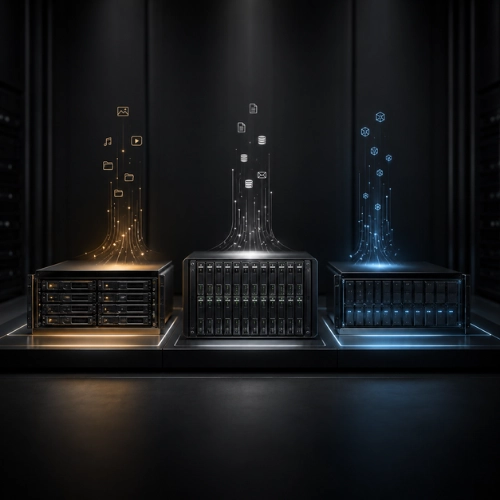
Because a GPU is only productive when it has data to work on, and during training, it needs that data continuously and at high speed. The model reads through enormous datasets, repeatedly, epoch after epoch, and writes large checkpoints along the way. Every one of those reads and writes runs through the storage system. If storage cannot deliver data as fast as the GPUs consume it, the GPUs stall and wait. Storage is not a passive shelf for AI data; it is the supply line that determines how busy your most expensive hardware ever gets.
You measure two things. The first is GPU utilisation: well-run training clusters sustain 80 to 95%, and anything consistently below 50% signals that the GPUs are waiting on something, often data. The second is I/O wait: if the proportion of time the system spends waiting on storage stays high through an epoch, the workload is storage-bound, not compute-bound. The symptoms are familiar to any team running real AI: training runs that take longer than the hardware should allow, checkpoints that take an age to write, and a nagging sense that the cluster is not delivering what was paid for. Those are not GPU problems. They are supply-line problems.
More than most enterprise storage was built to deliver, and sustained, not in bursts. As a working figure, each modern training GPU can consume on the order of 1 to 5 GB/s of data. Multiply that across a cluster of dozens of GPUs, and the aggregate throughput the storage must sustain becomes very large, and it must be delivered in parallel, to many GPUs at once, with low latency, not as a single fast stream. Checkpointing adds sharp write bursts on top, as large model states are saved. The defining demand is sustained, parallel, high-throughput access, which is a different problem from the one traditional storage was designed to solve.
Because it was optimised for a different workload. Conventional enterprise arrays were tuned for virtual machines and transactional applications: many small, random operations, measured in IOPS, with capacity and resilience as the priorities. AI training is the opposite shape, large, sustained, parallel, sequential throughput to feed many GPUs continuously. A storage system that performs beautifully for a database or a VM estate can choke a GPU cluster, not because it is bad, but because it was never meant for this. Pointing AI workloads at general-purpose storage and expecting GPU-scale throughput is the most common reason clusters underperform.
Storage built for sustained, parallel throughput: NVMe all-flash for low latency and high bandwidth, often arranged as a parallel or scale-out file system so many GPUs can read at once without contention, and connected over a network fast enough not to become the new bottleneck. The right design also matches the storage to the stage of the AI workflow, because the demands differ across it.
| AI Stage | Storage Demand | Typical Fit |
|---|---|---|
| Data preparation | High-throughput reads and writes over large datasets | Scale-out, high-throughput storage |
| Training | Sustained, parallel, low-latency reads to feed many GPUs | NVMe all-flash, parallel file system |
| Checkpointing | Burst writes of large model states | High write bandwidth |
| Inference and RAG | Fast model loading; low-latency retrieval | NVMe all-flash; fast vector store |
| Archive | Cost-efficient capacity for cold data | High-density capacity tiers |
The point is not to put everything on the fastest tier, which wastes money, but to feed each stage with storage that matches its demand, with the hot path, training, on storage fast enough to keep the GPUs at full utilisation.
Storage shapes the rest of the AI lifecycle, too. Inference needs models loaded quickly and, in retrieval-augmented systems, a fast vector store so retrieval does not add latency to every answer. Data pipelines that prepare and transform datasets move large volumes and can bottleneck on storage just as training does. Even a well-fed training cluster can be let down by a slow data-preparation stage upstream or a sluggish retrieval layer downstream. Storage is a thread that runs through the whole AI workflow, not a concern for training alone.
You diagnose before you spend. Measure GPU utilisation and I/O wait during real workloads to confirm that storage, not the model code or the network, is the constraint, because the cure differs for each. Once storage is identified as the bottleneck, match it to the workload: bring the training hot path onto NVMe all-flash with a parallel file system, ensure the network between storage and GPUs is not the limiting factor, and tier the colder data to cost-efficient capacity. Size the storage alongside the GPUs and the network as one system, not as an afterthought once the accelerators are bought. The instinct to fix slow AI by buying more GPUs is often exactly wrong; more starving GPUs simply idle in parallel.
The cheapest performance gain in most AI estates is not more compute; it is feeding the compute you already own. Diagnosing the bottleneck, designing storage that matches the workload, and sizing it alongside the GPUs and the fabric is where an experienced partner turns idle accelerators back into productive ones.
Proactive Data Systems designs and delivers AI storage and infrastructure for Indian enterprises, matching the platform to the workload across NVMe all-flash and scale-out storage from NetApp, Dell, Hitachi Vantara and HPE. We are a Cisco Preferred Cloud and AI Partner, Dell Platinum Partner and NetApp Preferred Partner, with 35 years in enterprise IT, more than 1,500 organisations served, and a 24/7 service desk in India. We diagnose where your GPUs are starving and design the storage to feed them. To find out, you can ask Proactive for an AI storage assessment.

Rokendra Singh Product Manager, Data Center, Proactive Data Systems
We'll get back to you shortly.