Updated: 03 March 2026
Enterprises that run long-standing Avaya or other legacy PBX estates rarely move because the system has failed. They move because the operating model around it has changed.
Hardware refresh cycles tighten. Skilled telephony engineers become harder to find. Multi-site expansion stretches dial plans that were never designed for global scale. Integration with identity, collaboration, compliance, and analytics systems becomes complex.
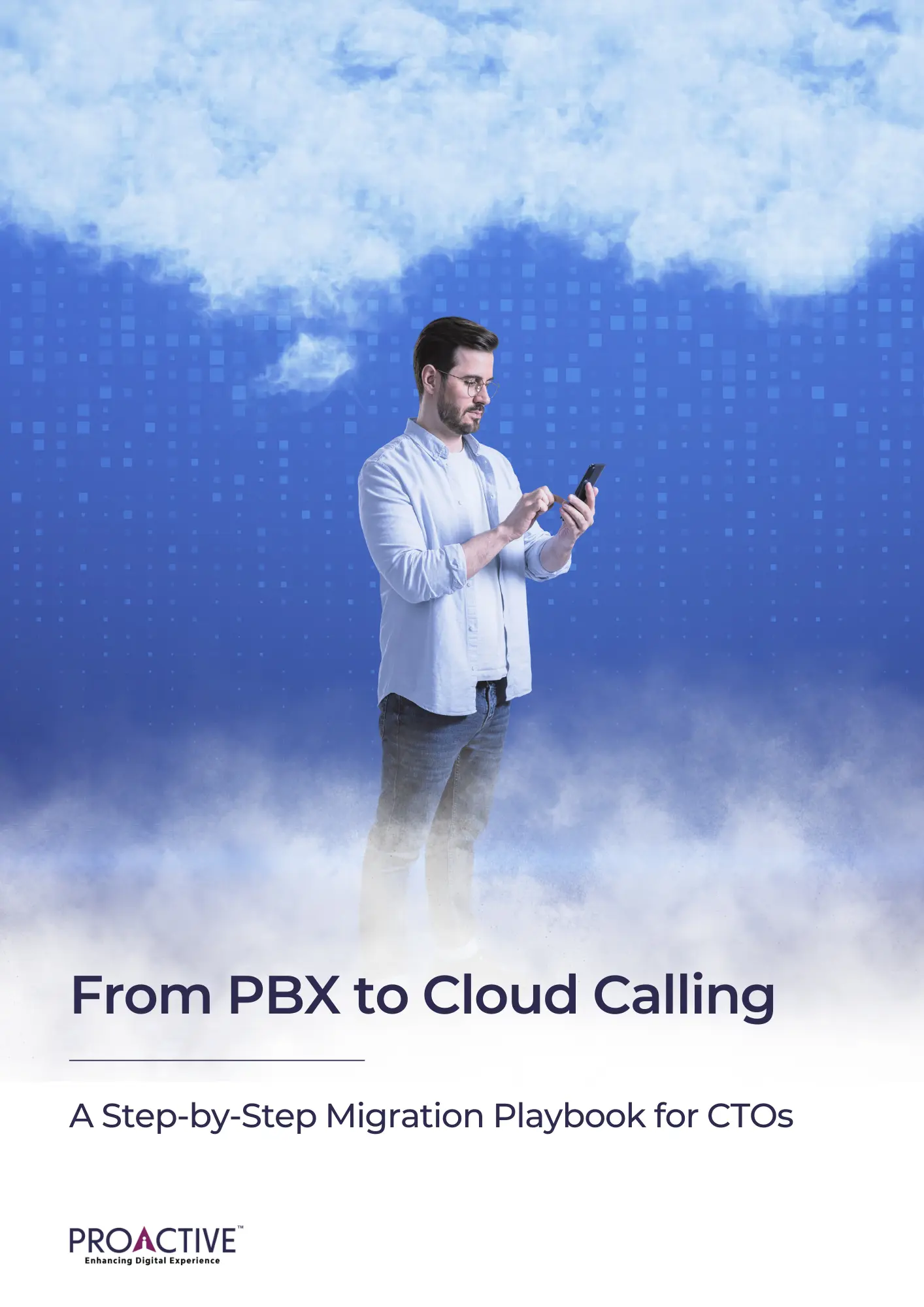
If you are planning to migrate Avaya to a cloud phone system, the goal is not a replacement for its own sake. It is a controlled modernisation of voice architecture without destabilising the business.
This guide reflects what typically happens in large estates with thousands of users and multiple sites. In most enterprises, the decision to migrate has already been made at a board or executive level. The remaining question is whether the transition will be controlled or chaotic.
Many enterprises underestimate the real footprint of their PBX.
Beyond core call control, you may have:
Complex dial plans layered over the years
Vectoring logic and hunt group customisation
Inter-site extension routing
Analog devices on shop floors
Fax lines embedded in workflows
Contact centre integrations
External recording platforms
Emergency routing configurations per geography
Before you replace PBX with cloud calling, perform a structured estate discovery. Document every trunk, every DID range, every routing rule, and every dependency. Dial plan normalisation and E.164 alignment often expose inconsistencies that were never formally documented.
Migration risk hides in these details. In structured programmes, this discovery phase is run as a formal assessment workshop with documented routing maps, dependency registers, and risk scoring before any target platform is selected.
Legacy PBX environments often accumulate numbering schemes that reflect organisational history rather than design discipline.
Standardise extension ranges. Remove redundant or unused DIDs. Align routing logic across sites. Clarify how internal extension-to-extension calling works between plants or offices.
Cloud calling platforms operate best when dial logic is simplified before transition. If you migrate complexity without rationalisation, you reproduce technical debt in a new environment.
Cloud calling places voice on your data network. That changes dependency patterns.
Evaluate:
WAN redundancy per site
Latency and jitter under peak load
Internet breakout design
QoS enforcement across branches
Session Border Controller requirements for hybrid connectivity
In many Avaya to cloud migration scenarios, coexistence with existing SIP trunks or carrier contracts is required. SBC design and gateway configuration must be planned before user migration begins.
Voice reliability is an architectural outcome, not a platform promise. In large migration programmes, disciplined architecture reviews and carrier coordination routines often determine success more than the chosen brand.
Few large enterprises execute a single-day cutover.
Common models include:
Site-by-site phased migration
Department-level pilot groups
Parallel run between PBX and cloud systems
Hybrid telephony where specific trunks remain on-prem temporarily
Number porting is executed by licensed telecom providers in accordance with local regulatory requirements. Your role is to sequence, validate, and coordinate so that inbound and outbound continuity is preserved.
Parallel operation reduces operational shock and allows validation of routing, emergency calling, and recording alignment before full transition. Enterprises that treat coexistence as optional frequently discover late-stage routing defects that are expensive to reverse.
Voice is customer data.
Review:
Recording retention policies
Access controls
Audit trail requirements
Data residency obligations
Emergency calling mapping per location
In India and other regulated markets, telecom licensing, number provisioning, and interconnect arrangements must align with authorised service providers and applicable regulations. Cloud architecture must be structured accordingly. Compliance design cannot be retrofitted after migration.
Cloud calling integrates tightly with identity systems. Clean up the directory data before migration. Standardise naming conventions. Remove dormant accounts. Clarify ownership for moves, adds, and changes.
One of the operational gains of migrating from Avaya or legacy PBX to cloud calling is centralised administration. That benefit materialises only when identity discipline is enforced from the outset.
Voice systems influence daily routines.
Train reception teams, supervisors, and support staff in advance. Validate voicemail behaviour, call forwarding logic, and escalation paths.
Expect a short adjustment period post go-live. In structured programmes, support tickets rise temporarily and then stabilise as users adapt.
Migration does not end at cutover.
Establish a governance model for:
Configuration changes
New site onboarding
Carrier coordination
Performance monitoring
Periodic dial plan review
Cloud calling becomes stable infrastructure when operational ownership is defined clearly. Leading enterprises formalise this through migration war rooms, change control boards, and defined escalation paths during the first 90 days after cutover.
Enterprise cloud calling platforms are evaluated based on architectural alignment. Organisations with existing Cisco networking and collaboration infrastructure may assess Cisco Webex Calling for continuity and integration. Microsoft-centric enterprises may prioritise Teams Phone. Others may align with Zoom-based environments.
Platform selection should follow architectural compatibility and operating model maturity rather than brand loyalty. In enterprise engagements, Proactive typically begins with estate diagnostics, network validation, dial plan rationalisation, and regulatory mapping before recommending a migration path. The objective is to reduce execution risk, not accelerate product selection.
If you are preparing for legacy PBX migration, ask:
Have we mapped every routing dependency and dial plan rule?
Is our network engineered for voice at scale?
Is our PSTN and compliance model aligned with regulations in every geography?
Do we have a phased migration and coexistence plan?
Who owns day-two operations?
Replacing a legacy PBX is not about abandoning a proven system. It is about building a voice architecture that can scale, integrate, and remain governable over the next decade.
Cloud calling succeeds when migration discipline matches technical complexity. Enterprises that approach legacy PBX migration as a controlled transformation programme rather than a technology refresh consistently experience lower disruption, faster stabilisation, and clearer operational ownership.
Proactive Data Systems is a leading Cisco Preferred Collaboration Partner in India. Write to us at [email protected] for modern cloud calling solutions.

Kunal Gill Head, Cloud Calling Practice, Proactive Data Systems
We'll get back to you shortly.