Updated: 14 June 2026
A server is the easiest piece of infrastructure to buy on price, and the easiest to buy wrong. Choose the form factor, the sizing or the source carelessly and you pay for it every month for the next five years, in performance you do not have, power you did not budget for, or support you cannot get when a board fails. The headline price is the smallest part of what a server actually costs you.
That is the gap between a listing and a specification. A listing sells you a box. A specification matches the machine to the workload it has to carry, the power envelope it has to live in, and the refresh cycle ahead, and it is the difference between a server that quietly does its job for years and one that becomes a problem.
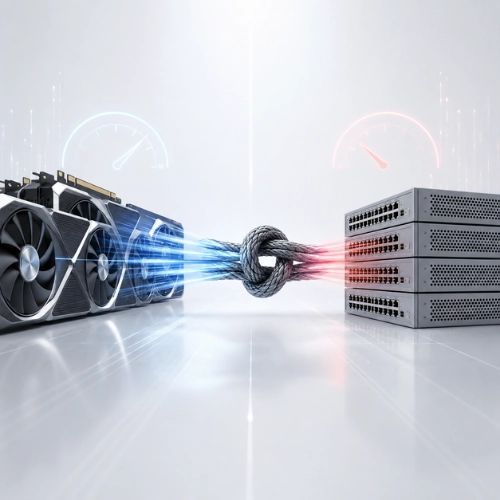
It depends on density, workload and how you plan to grow. Rack servers are the flexible default, easy to mix and scale. Blade servers concentrate density and shared infrastructure, suiting consolidated estates. GPU servers are a different class, built for AI and accelerated workloads, with the power and cooling demands to match. The table maps the three.
| Form Factor | Best For | Trade-off To Weigh |
|---|---|---|
| Rack server | General workloads, flexibility, mixed estates | Floor space and cabling at scale |
| Blade server | Density, consolidation, shared power and networking | Higher up-front chassis investment; vendor lock to the chassis |
| GPU server | AI, machine learning and accelerated workloads | High power and cooling density; needs a facility that can carry it |
The mistake is defaulting to a familiar form factor for every workload. The right estate often mixes all three, each where it fits.
From the workload and its future, not from a spec sheet's top line. Sizing means matching cores, memory, storage and accelerators to the workload's real demand, then weighing the power envelope it will draw and the refresh cycle you are committing to. Over-specify and you pay for headroom you never use; under-specify and you are back in the market within two years. The right size is the one that fits the workload today and the growth you can reasonably forecast, at a power and cost profile you can live with.
Because the cheapest quote often hides the expensive parts. Server prices vary widely for real reasons: configuration, licensing, support tier, and whether the kit is genuine, fully warranted, OEM-supplied hardware or grey-market stock with no support path. A listing that undercuts everyone may be selling unsupported or parallel-imported equipment, which becomes a serious problem the day a component fails or a security patch is needed. Partner-grade procurement costs more on the line item and far less over the life of the machine, because the warranty, the support and the accountability are real. Understanding why prices differ is worth more than chasing the lowest number.
The enterprise lines built for reliability, support and lifecycle: Cisco UCS, Dell PowerEdge, HPE ProLiant, Lenovo ThinkSystem and IBM among them. Each has strengths for different workloads and estates, which is why the platform should be chosen for your environment, your management tooling and your refresh strategy rather than fixed to one vendor. Multi-OEM choice is what keeps the recommendation honest.
GPU servers belong to the AI conversation as much as the compute one. They deliver the accelerated performance that AI training and inference need, but they draw far more power and heat than standard servers, so the facility has to be confirmed able to carry them before they are racked. If you are building AI-ready infrastructure, size the GPU servers to the models you will run and design the power and cooling around them, rather than treating a GPU server as an ordinary box with a card added.
A server is easy to quote and easy to mis-specify. The value is in sizing it to the workload, sourcing it genuine and warranted, and standing behind it for its whole life, which is where a lifecycle partner beats a listing.
Proactive Data Systems specifies, supplies and supports enterprise compute and GPU servers for Indian organisations. We are a Cisco Preferred Cloud and AI Partner, Dell Platinum Partner and NetApp Preferred Partner, with 35 years in enterprise IT, more than 1,500 organisations served, and a 24/7 service desk in India. We are multi-OEM by design, so the platform follows your workload rather than a quota, and we supply genuine, fully warranted hardware across Cisco UCS, Dell PowerEdge, HPE ProLiant, Lenovo and IBM, with local spares and accountability from specification to day-two support.
Send us your workloads and your refresh plans, and we will specify the right servers and a clean bill of quantities. Ask us for a compute assessment.
Disclaimer: This page provides general guidance on enterprise compute, not a quote. Server prices vary by configuration, licensing, support tier and source. Obtain a formal quotation for your specific requirement before purchasing.

Rokendra Singh Product Manager, Data Center, Proactive Data Systems
We'll get back to you shortly.