Updated: 19 March 2026
An IT services firm with delivery centres in Bengaluru, Hyderabad, Pune, and Noida hires 300 engineers in one quarter. Laptops and system access are provisioned within hours through automated workflows. Telephony provisioning still takes three to five days because extensions, routing rules, and DID allocations are manually managed per office. In high-growth IT and ITeS environments, this lag is not cosmetic. It affects billable readiness, SLA compliance, and client perception.
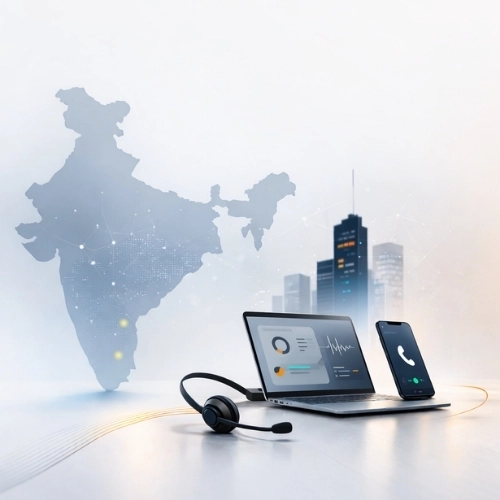
Cloud telephony for IT/ITeS companies refers to a centrally governed voice infrastructure delivered through cloud calling platforms across multiple offices, integrated with identity, security, and workflow systems. When designed correctly, it reduces provisioning friction, standardises routing logic, and aligns communication with contractual governance requirements.
For technology firms operating across India and supporting global clients, the objective is not migration alone. It is operational control at scale.
IT and ITeS organisations scale through rapid hiring cycles, distributed delivery centres, and client-specific support teams operating across time zones.
Under these conditions, legacy PBX environments create structural constraints:
Inconsistent dial plans across offices
Manual provisioning for new hires and project transitions
Fragmented call recording repositories
Limited visibility into call quality across locations
Difficulty aligning routing logic with SLA tiers
In contract-driven environments, misrouted calls or incomplete call traceability can escalate into SLA breaches or audit findings. Telephony architecture directly influences client-facing performance.
Cloud telephony and cloud calling platforms centralise control while distributing endpoints.
For multi-office IT firms, this enables:
Provisioning cycles reduced from days to hours through identity-driven automation
Standardised dial plan governance across all locations
Centralised call recording aligned to client retention policies
Real-time visibility into call quality metrics per site
Integration with CRM, ticketing, and service management systems
Secure remote access for hybrid and offshore teams
When integrated with identity systems such as Microsoft Entra ID, user lifecycle management can align directly with HR onboarding and exit workflows, reducing orphaned accounts and access exposure. This is operational consolidation, not feature enhancement.
Enterprise cloud telephony for IT companies must be engineered around network, identity, and security architecture.
Key design elements include:
WAN redundancy across delivery centres with defined failover policies
Latency and jitter validation under peak support load conditions
QoS enforcement for voice across wired and wireless infrastructure
Survivability planning for high-priority client support teams
Dial plan rationalisation before migration to eliminate legacy inconsistencies
Phased coexistence models for legacy PBX transition
In multi-geo IT organisations, global DID management and time-zone-aware routing logic become critical. Call flows should adapt to regional business hours while preserving internal extension logic across continents. Migration discipline determines whether operational stability is preserved during cutover.
IT and ITeS firms frequently operate under client-imposed audit frameworks.
Enterprise cloud telephony design should address:
End-to-end encryption of signalling and media streams
Role-based administrative access controls
Detailed configuration change logging
Segregation of duties between voice administration and security oversight
Structured retention policies mapped to client contracts
For firms serving BFSI or healthcare clients, incomplete call traceability can expose the organisation to compliance findings. Voice infrastructure must integrate into the broader security monitoring stack rather than operate independently.
Enterprise cloud telephony platforms such as Webex Calling from Cisco provide centralised administration, policy enforcement, and integration with broader networking and security environments.
For IT and ITeS organisations, Webex Calling can support:
Global number allocation across delivery centres
Centralised policy enforcement
Integration with Cisco networking and security frameworks
Scalable user management aligned to rapid hiring cycles
Platform capability is consistent. Architectural integration and governance discipline determine measurable outcomes.
Common breakdown patterns include:
Deploying each office independently without unified dial plan governance
Migrating users without validating global routing logic
Ignoring identity integration until post go-live
Underestimating carrier provisioning timelines
Failing to formalise a 90-day stabilisation governance model
In high-SLA IT environments, these gaps surface immediately through ticket spikes, routing errors, and client escalation.
Multi-office IT rollouts require a structured sequence, not compressed cutovers.
Validate WAN readiness, QoS enforcement, identity integration points, and existing dial plan inconsistencies.
Rationalise extensions, routing logic, hunt groups, and numbering strategy across all offices before migration.
Migrate a defined user group across one or two offices. Validate call quality, routing logic, CRM integration, and recording governance.
Execute phased migration by location, aligned to hiring cycles and client delivery schedules.
Monitor call quality metrics, provisioning accuracy, routing exceptions, and support ticket volume. Adjust policy where required.
Formalise change control, administrative segregation, KPI reporting, and periodic compliance reviews.
Structured deployment reduces risk during scale.
Enterprise cloud telephony in IT and ITeS firms must sit inside the security stack.
Security controls should include:
SIP signalling secured over TLS
Media streams protected using SRTP
Role-based administrative access with defined privilege tiers
Configuration change logging with audit traceability
Log export or API integration into SIEM platforms
In contract-driven IT environments, misrouted or untraceable calls can escalate into SLA penalties. Security and routing governance must therefore operate together.
Multi-office IT firms typically move through three stages:
Cloud calling enabled across locations with limited central oversight.
Unified dial plans, central administration, structured provisioning, and consistent call recording governance.
Telephony metrics tied to SLA performance, identity-driven lifecycle management, automated compliance reporting, and periodic architecture reviews.
Level 3 firms treat cloud telephony as core infrastructure, not a collaboration add-on.
In one deployment, a mid-sized IT services firm operating six delivery centres across India standardised its cloud telephony architecture during a 1,200-seat expansion. User provisioning time reduced from four days to under four hours through identity-linked automation.
Telephony-related support tickets reduced by 28 per cent within the first quarter after stabilisation. Audit-ready call traceability reports, previously requiring days of manual collation, became available the same day.
Enterprise-grade deployments typically target:
Provisioning time reduction from multi-day cycles to same-day activation
Centralised visibility into call quality metrics across all offices
Reduction in telephony-related support tickets after stabilisation
Improved audit readiness through centralised recording governance
Without measurable outcomes, migration remains cosmetic.
When evaluating cloud telephony for IT/ITeS companies with multiple offices, you will encounter:
Licence Resellers focused on transaction fulfilment
Deployment Specialists focused on installation
Managed Execution Partners focused on architecture, governance, and lifecycle control
Multi-location IT enterprises require the third category.
As a Cisco Preferred Collaboration Partner, Proactive approaches cloud telephony deployments for IT and ITeS organisations through structured diagnostics covering network readiness, dial plan rationalisation, compliance mapping, identity integration, and governance design before activation. Engagements include defined stabilisation phases and operational handover models to maintain SLA integrity as headcount grows.
Before committing to cloud telephony or cloud calling across multiple IT offices, ask:
How will provisioning cycles align with hiring velocity?
How will global routing logic adapt to time zones and client-specific requirements?
How is encryption, access control, and audit logging structured?
What coexistence model governs migration from legacy PBX systems?
What measurable KPIs define post-deployment success?
Cloud telephony for IT/ITeS companies with multiple offices succeeds when architecture, identity, security, and governance operate as one system. Choose a partner that treats voice as mission-critical infrastructure aligned to contractual performance, not as a peripheral tool.

Manav Nahar AVP, Collaboration, Proactive Data Systems
We'll get back to you shortly.