Updated: 02 November 2026
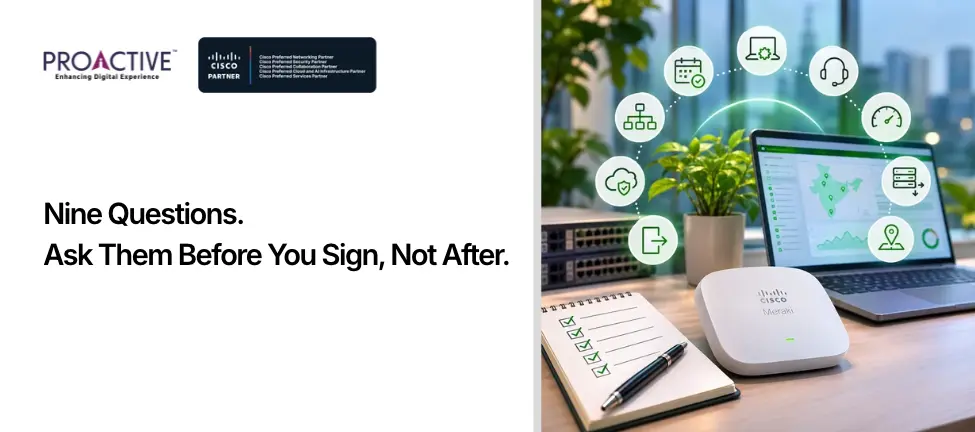
Before signing a managed Meraki services contract in India, ask nine questions: who owns the dashboard organisation, who owns the co-termination date, what 24x7 means in writing, how branch rollouts are run, how fast changes land, what reporting you get, whether the India region is in the contract, how many migrations the partner has done, and what happens at exit.
Proactive Data Systems, a Cisco Preferred Partner across all five architectures that has managed Indian networks since 1991, puts these in front of every prospect because the answers decide the next five years more than the monthly fee does.
The most expensive line in a managed Meraki contract is usually the one that is not there. Fees, device counts and SLAs are negotiated hard. Dashboard ownership, licence ownership and exit are left to assumption, and assumption is where managed services go wrong. Meraki makes some of this unusually consequential, because the dashboard is the network: whoever controls the organisation controls your estate.
Who owns the dashboard organisation and its admin rights?
Who owns the co-termination date and the renewal?
What does 24x7 mean on paper?
How are branch rollouts actually run?
What is the change turnaround, and is there an emergency path?
What reporting lands in your inbox, and how often?
Is the Meraki India region written into the contract?
How many Catalyst-to-Meraki migrations, with numbers?
What happens at exit?
Your company should own the Meraki organisation, with the partner holding delegated admin access, not the other way round. If the partner creates the organisation under its own account and manages you as one network among many customers, your network's history, configuration and licences live in an account you do not control.
This matters more with Meraki than with almost any other platform, because there is no configuration file to take home. Meraki's own guidance for MSPs notes that splitting a customer out of a shared organisation needs Meraki Support, is not reversible, drops the event and change logs, and leaves user accounts to be recreated by hand. A partner who insists on hosting you inside its organisation is building the exit cost into day one. The right structure is simple: your organisation, your ownership, the partner as a named administrator with the rights the contract specifies.
Insist that licences are held in your organisation and that the partner's duty to flag the co-termination date, in writing, at 90 and 30 days is in the contract. Meraki's co-term model puts every device in the organisation on one expiry date, and once that date passes, you have a 30-day grace period before the organisation is shut down until licensing is applied.
Thirty days sounds generous until it coincides with a financial year close and a purchase-order cycle. The failure mode Proactive sees most often is not malice but drift: licences bought by one person, the renewal reminder going to an inbox that no longer exists, and a managed partner who assumed the customer was watching the date. Put the obligation on the partner, name the person who receives the notice on your side, and ask how the partner handles mid-term device additions, since adding a device type over its licence limit starts the same clock.
Ask for three numbers: time to acknowledge, time to respond with an engineer, and time to resolve by severity, and ask whether the NOC answering at 3 am is the partner's own or subcontracted. "24x7 support" with no numbers next to it is a marketing phrase, not a service level.
Then ask where the NOC is and who staffs it. A partner running its own 24x7 NOC in India with Meraki-certified engineers on shift is a different proposition from a helpdesk that pages someone. Ask how many P1 incidents the NOC handled last quarter and what the average resolution time was. If the partner cannot produce that, it does not measure it, and what is not measured is not managed. Proactive Data Systems runs its own 24x7 NOC in India, staffed from a bench of 100+ engineers, which is why we expect to be asked this question and why we answer it with numbers.
Ask who travels to the site, who deals with the ISP, and what happens when the branch has one broadband line and a power supply that drops twice a day. A Meraki rollout is simple in the dashboard and hard in a Tier 3 city, and the partner's answer tells you which of the two they have done.
The practical items: dual WAN or SIM failover on every MX as a standard, not an option; a site survey before shipping hardware; network templates built and tested before the first device leaves the warehouse; a site acceptance test that someone on your side signs. Ask whether the partner has engineers in the cities where your branches are or flies them in. Proactive has offices in eight cities, including Indore and Chennai because the branch, not the head office, is where rollouts succeed or fail.
A standard change on a managed Meraki estate should land within one business day, and an emergency change within hours, with both written into the contract. The dashboard makes changes fast; the partner's ticketing process is what makes them slow.
Ask how a change request is raised, who approves it on your side, and what the partner does when your head of sales needs a new SSID for a client demo in an hour. Then ask the opposite question: what stops the partner from making a change you did not ask for? Admin roles in the Meraki dashboard can be scoped, and a partner who proposes read-only access for monitoring and scoped write access for named engineers is thinking about your control, not just its convenience.
You should receive a monthly report covering uptime by site, incidents by severity with resolution times, changes made, licence status against the co-term date, and firmware position across the estate. Anything less is the dashboard with a logo on it.
The test is whether the report tells you something you would act on. Which branch had the most Wi-Fi complaints. Which switch ports are running hot. Which devices are on firmware two releases behind and why. A good managed partner uses the Meraki dashboard's data to tell you where the next problem is coming from; a weak one forwards the dashboard's own summary and calls it a review. Ask to see a redacted report from an existing customer before you sign.
If your regulator, auditor or data protection officer cares where management data lives, the Meraki India region should be named in the contract, not assumed. Organisations can be hosted on Meraki's India region, where account and organisation data stays in the country; organisations on the global region are a different matter.
This is a one-line clause that saves a long conversation later, particularly for BFSI, healthcare and anyone preparing for DPDP audits. Ask the partner whether your organisation will be created in the India region, whether they have run estates there before, and whether they understand its limits, because the India region is isolated from global dashboards and a handful of integrations are not available on it. A partner who has not heard of the India region has not managed a regulated Indian estate recently.
Ask for the number of sites migrated, the largest single estate, and two references you can call. "We do Meraki" is not an answer; "forty-two branches for a Mumbai NBFC in eleven weeks, and here is the IT head's number" is.
The reason to push here is that most Indian estates are not greenfield. There is a Catalyst core, a legacy firewall and a wireless controller somewhere, and the partner's job is to bring the branches under the dashboard without breaking the parts that stay. Ask how they handle Catalyst switches that remain, whether under hybrid mode on the dashboard or left under CLI, and how they sequenced the last migration to avoid a big-bang cutover. Proactive has delivered this across more than 1,500 customers since 1991, and we would rather you call two of them than take our word for it.
The contract should state that your organisation, licences and admin ownership stay with you, that the partner's access is removed within a defined period, and that a documented handover, including site records, templates and open tickets, is delivered before the final invoice. Exit terms are the cheapest clause to negotiate on day one and the most expensive on the last day.
Because Meraki configuration lives in the cloud rather than in files, the exit question collapses into the ownership question from item one. If you own the organisation, exit is a matter of removing an administrator. If you do not, exit is a migration project you did not budget for. Ask the partner to describe, step by step, what happens if you give notice, and watch whether the answer involves Meraki Support.
| S.No. | Question | The Answer You Want | Warning Sign |
|---|---|---|---|
| 1 | Dashboard ownership | Your organisation, partner as named admin | Partner hosts you inside its own organisation |
| 2 | Co-term and renewal | Licences in your organisation; 90 and 30 day notices in contract | "We'll remind you" |
| 3 | 24x7 on paper | Acknowledge, respond, resolve times by severity; own NOC | "24x7 support" with no numbers |
| 4 | Branch rollouts | Site survey, dual WAN standard, signed acceptance | Hardware shipped, engineer dialled in |
| 5 | Change turnaround | One business day standard, hours for emergency, scoped admin | Ticket queue with no SLA |
| 6 | Reporting | Monthly: uptime, incidents, changes, licence, firmware | Dashboard summary forwarded |
| 7 | India region | Named in the contract, partner has run estates on it | Partner has not heard of it |
| 8 | Migration record | Sites, largest estate, two references | "We do Meraki" |
| 9 | Exit | Ownership stays, access removed, handover documented | Exit involves Meraki Support |
Proactive Data Systems has been managing India's networks since 1991, and a prospect armed with these nine questions is easier to work with, not harder. We own none of our customers' organisations. Our 24x7 NOC is in India and staffed by our own engineers. Our branch rollouts start with a survey, not a shipment. More than 1,500 customers and eight offices mean the reference calls are a phone call away.
Write to us at proactive.co.in or fill out the web form to start your journey.
Disclaimer: Meraki licensing behaviour, grace periods and organisation management rules are as documented by Cisco Meraki in October 2026 and may change. Confirm current terms against Cisco documentation and your contract.

Deepak Kumar Sinha Senior Presales Manager, Enterprise Networking
We'll get back to you shortly.