Updated: 10 November 2026
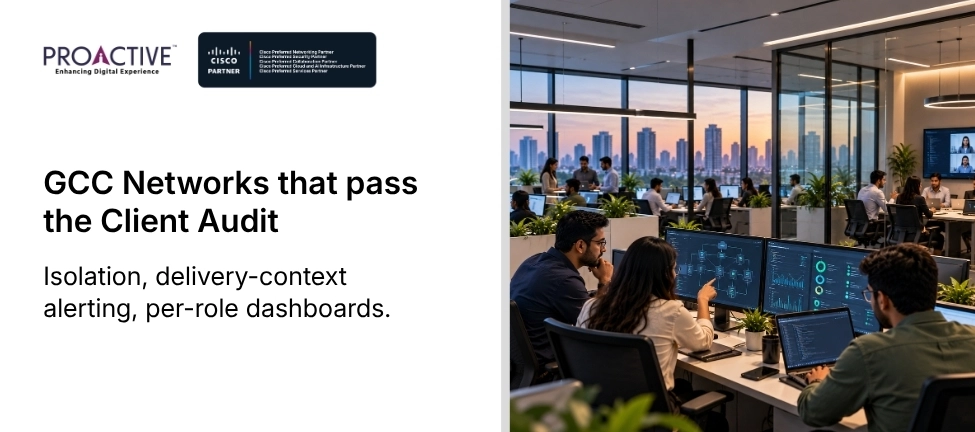
Managed networks for global capability centres (GCCs) in India cover per-client segmentation and VLAN isolation, delivery-context alerting, custom Meraki dashboards for CTO, CISO and CFO views, client-side connectivity (VPN and SD-WAN), and audit-ready evidence for client compliance frameworks (SOC 2 Type II, ISO 27001, HIPAA, GDPR).
Delivered by a Cisco Penta-Preferred Partner under the Cisco 360 Partner Program.
Written for GCC CTOs, Heads of Delivery, CISOs, CFOs and IT Directors in Indian captive centres serving BFSI, technology, pharma, retail and industrial parent organisations.
Most enterprise networks alert like this: "SITE-B AP-014 offline, 08:32." An engineer knows what to do. A delivery head does not.
A GCC network alert, done well, reads like this: "Client Onboarding Site B, VPN tunnel to Bank of America production environment degraded, 08:32, four active developers affected, next scheduled deployment 14:00." The delivery head reads it and understands both the technology and the delivery risk in one line. The CFO gets the version that says the pipeline hours at risk. The CISO gets the version that says whether client PII is in the affected segment.
This is not a dashboard difference. It is a model difference. Standard enterprise IT sees the network as one thing. A GCC delivers services to multiple external clients, each with their own compliance regime, their own data isolation demands, their own audit calendar. The network has to reflect the delivery model, not just carry the packets.
That is what a delivery-first managed model actually looks like.
India hosts over 1,600 GCCs employing roughly 1.9 million people, per NASSCOM's most recent industry reporting. The typical Indian GCC is larger than a mid-sized Indian enterprise, more security-scrutinised than a typical BFSI branch estate, and less standardised than any of them because every parent organisation brings different tooling, compliance frameworks and delivery preferences.
Four features distinguish a GCC network from a regular enterprise network.
Multiple external clients on one physical estate. A single delivery floor may host teams working for three or four different client parents simultaneously. Each client expects its data, its systems and its network segment to be isolated from every other.
Client-side compliance audits. SOC 2 Type II is annual. ISO 27001 is annual. HIPAA and GDPR audits are triggered by client contracts and can be short-notice. The GCC is the audited entity for its own controls, and often a shared responsibility target for the client’s own annual assessments.
Multi-time-zone delivery. A GCC serving a US client works overnight in Indian time. A GCC serving European clients works staggered hours. A GCC serving multiple time zones needs the network live around the clock for delivery reasons, not just for tail-end availability.
Direct connections into client environments. VPN tunnels into client production estates, SD-WAN into client cloud tenants, dedicated circuits into client data centres. The GCC network extends into a dozen client networks and has to speak each client’s routing, DNS and access-control language.
None of these is a niche requirement. All four are baseline for the average Indian GCC. A managed contract has to be built for them.
The single most important segmentation decision on a GCC network is between clients.
Client A's delivery team must not be able to reach client B's systems. Client A's developer laptop must not be able to route to client B's VPN. Client A's shared drives, printers, code repositories and CI/CD pipelines must sit in a segment that only client A's team can access. If client A's compliance auditor discovers that client B's team could theoretically reach client A's data, the audit fails, and the contract escalation is immediate.
On a Meraki estate, this is delivered through per-client VLANs on the switching, per-client SSIDs on the wireless with 802.1X authentication tied to client-specific identity groups, and MX firewall policy that enforces east-west isolation between client segments. Under a managed contract, the isolation is designed once per client, applied through templates as new clients are onboarded, and audited quarterly. Any exception (temporary shared resource, joint project) requires named approval from both client accounts.
The auditor's question is precise: "Show me the network map, name the isolation controls, walk me through the policy that prevents client cross-contamination." The managed contract's job is to make that answer routine.
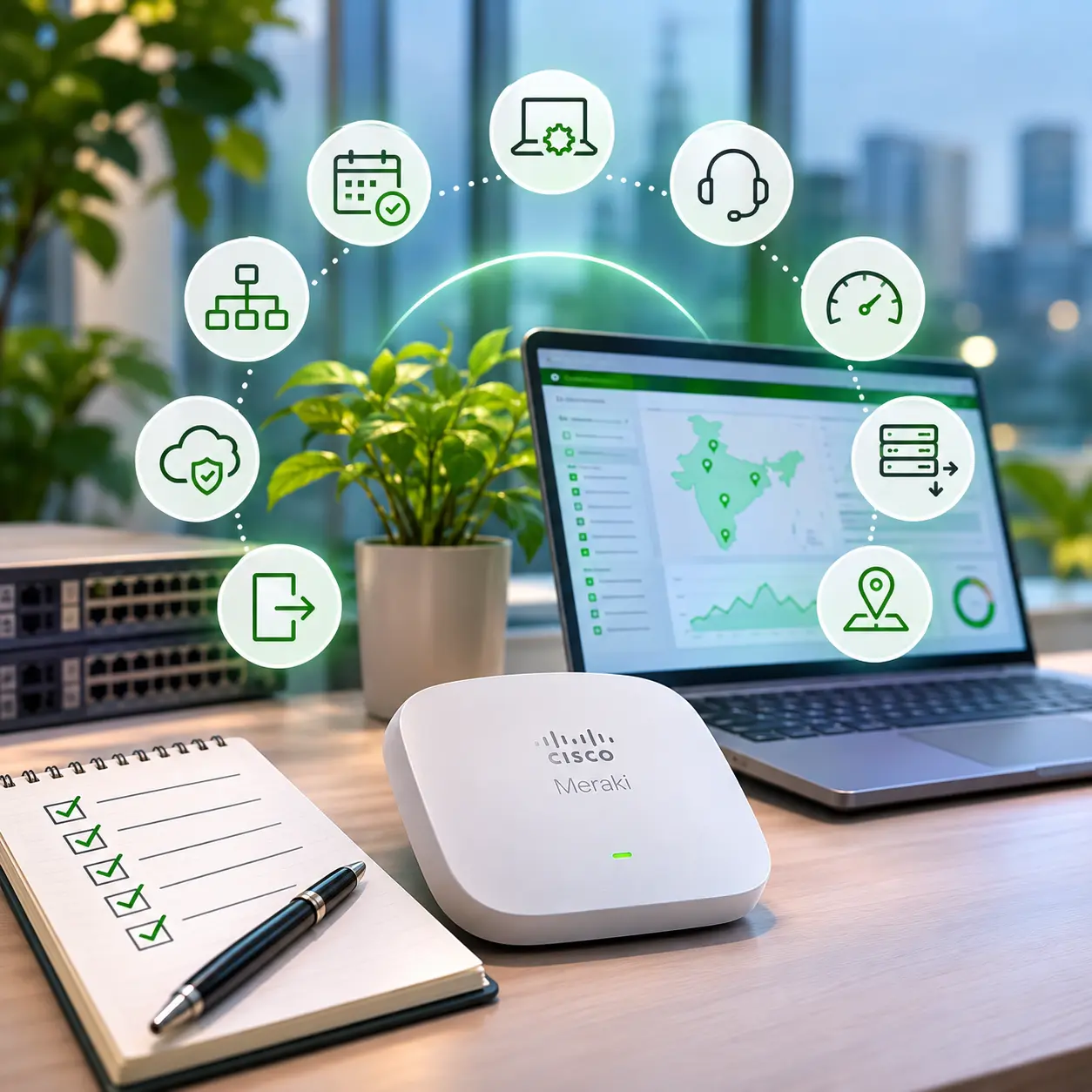
The Meraki dashboard is elegant. It is also written in the vocabulary of network engineers. For a GCC CTO, CISO or CFO, that vocabulary is unusable at the pace of delivery decisions.
We build a custom dashboard on top of Meraki, connected via a read-only API, hosted on the customer's own VM. Data stays with the customer. What changes is the view.
CTO view. Per-client delivery health. Which client teams are affected by which incidents. Pipeline hours at risk. Client-facing SLA position. New site or new client onboarding status.
CISO view. Per-client segmentation integrity. Anomalous cross-segment traffic. Client-compliance status per framework (SOC 2, ISO 27001, HIPAA). Last audit finding closure state. Threat events with client-context tagging.
CFO view. Service utilisation against contract. Effective per-seat network cost. Capacity headroom against client expansion plans. Renewal-window alerts.
None of these are Meraki-native views. They are built on Meraki's data. Under a managed contract, the dashboard is stood up on Day 1, tuned across the first four weeks against the actual delivery reality, and iterated quarterly as new clients are added. Six-month IT project, this is not. Read-only API, no agents, no changes to the customer's Meraki configuration.
The dashboard is the leadership view. The alert stream is the operational view. Both need translation from network vocabulary to delivery vocabulary.
A well-tuned GCC alert stream tags every event with:
Delivery segment (Client A onboarding team, Client B production support, Client C R&D lab).
Client system in scope (the specific client VPN, application, or SaaS tenant affected).
Delivery impact category (active developers affected, pipeline stage impacted, scheduled milestone at risk).
Compliance scope (whether the event touches a segment carrying client PII, PHI or PCI data).
This is the tagging work that turns "SITE-B AP-014 offline" into a line a delivery head can act on. It is done once, at onboarding, and maintained as the delivery footprint evolves. The maintenance is where in-house teams often lose the discipline; managed contracts have it as a defined operating rhythm.
Four frameworks dominate GCC audit calendars.
SOC 2 Type II. Annual audit by a licensed CPA. Trust Services Criteria: Security, Availability, Confidentiality, Processing Integrity, Privacy. The auditor asks for evidence of controls over the network, over access, over change management, over incident response, over monitoring, over vendor management. Managed contracts produce most of that evidence automatically through their normal reporting cycle.
ISO 27001. Annual surveillance audit, three-yearly recertification. Framework for an Information Security Management System (ISMS). Network controls sit in Annex A, most relevantly A.13 (communications security), A.12 (operations security) and A.14 (system acquisition). Managed contracts on a Cisco-standardised estate typically satisfy the operational substance of these controls.
HIPAA. For GCCs serving US healthcare parents. Administrative, Physical and Technical Safeguards under the Security Rule. Network segmentation of PHI-bearing systems is a technical safeguard requirement. Managed contracts implement and evidence the segmentation.
GDPR and equivalent regional frameworks. For GCCs serving EU parents (or handling EU data on behalf of a global parent). Article 32 requires appropriate technical and organisational measures. Segmentation, encryption, access control and audit logging are core. India's DPDP overlay applies to any personal data of Indian individuals processed by the GCC, with the 13 May 2027 hard enforcement date approaching.
The overlap between frameworks is more than the differences. A well-run managed contract produces evidence artefacts that satisfy multiple frameworks at once: segmentation maps, access logs, change control records, incident response evidence, monitoring dashboards.
A GCC serving US East Coast clients has peak load between 6 PM and 2 AM Indian time. A GCC serving UK clients peaks 1 PM to 10 PM. A GCC serving Asia-Pacific peaks in the morning. A large GCC serving multiple time zones has no genuine off-peak.
For network operations, this means 24x7 coverage is not an option; it is the baseline. In-house GCC IT teams that try to run overnight monitoring as a rota consistently burn out the small night team inside eighteen months. Managed contracts run a dedicated NOC in India with a three-shift roster; the third shift is staffed at the same competence level as the day shift because it is doing production work, not just watching.
The 30-minute response, 3-hour P1 restoration SLA applies to a 2:47 AM incident with the same rigour as a 2:47 PM one. That is what a GCC serving a US client is buying.
Beyond the client isolation question, a GCC network typically carries three broad categories of internal traffic: development environments (dev, test, staging labs), delivery workloads (production support, client-facing systems, VPN tunnels to client environments) and corporate LAN (HR, finance, general productivity, guest Wi-Fi).
Segmentation between these three is standard practice, but the details matter. Developer laptops need broad internet access for open-source repositories, container registries, and cloud SDKs. Delivery segments need restricted egress with strict allow-lists. Corporate segments need vanilla enterprise firewall policy. Guest Wi-Fi sits outside everything, with a captive portal and no route to any client or delivery segment.
Managed contracts codify all four as templates, apply them consistently as new delivery floors are added, and audit quarterly. This is where the difference between a network built once and a network run continuously becomes visible.
Three commercial models, chosen with GCC growth pattern in mind.
CapEx suits GCCs at established scale with a stable footprint and parent-organisation preference for asset ownership.
OPEX is the strongest fit for GCCs in expansion mode, whether adding delivery floors, opening satellite locations, or standing up new client-dedicated segments. Per-site or per-user subscription pricing means growth is transparent and refresh is handled inside the term.
Managed-Only suits GCCs with a recently refreshed Cisco or Meraki estate that want to hand operations to a specialist without disturbing the asset side.
Growth-stage GCCs almost always land on OPEX or a mix of OPEX and Managed-Only. Full walkthrough sits in the CapEx or OPEX decision guide.
Two days at your primary delivery floor, with your CTO or Head of Delivery, CISO and IT Director. We take a snapshot of the current network estate, walk the client-isolation architecture, review the delivery-context alerting maturity, run the segmentation against your active client compliance frameworks, and hand you a written finding by end of week. If the estate is well-run, we say so. If we can help you tighten audit posture or dashboard relevance, we quote the fix.
Disclaimer: Framework references (SOC 2 Type II, ISO 27001, HIPAA, GDPR, DPDP) in this piece are drawn from currently published guidance and are for operational orientation, not audit or legal advice. Compliance status for any specific GCC depends on site-specific controls, audit outcome and client contract interpretation. A qualified auditor, information security consultant or data protection officer is the definitive voice on framework-specific scope.
We'll get back to you shortly.