Updated: 30 October 2026
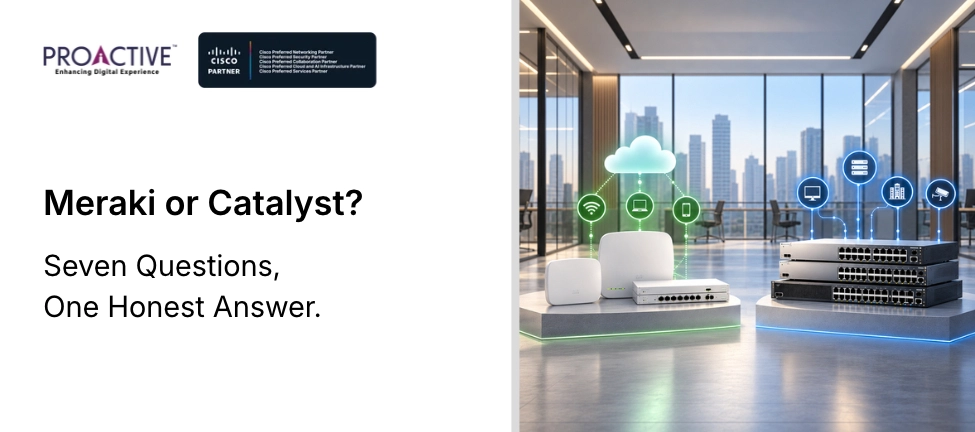
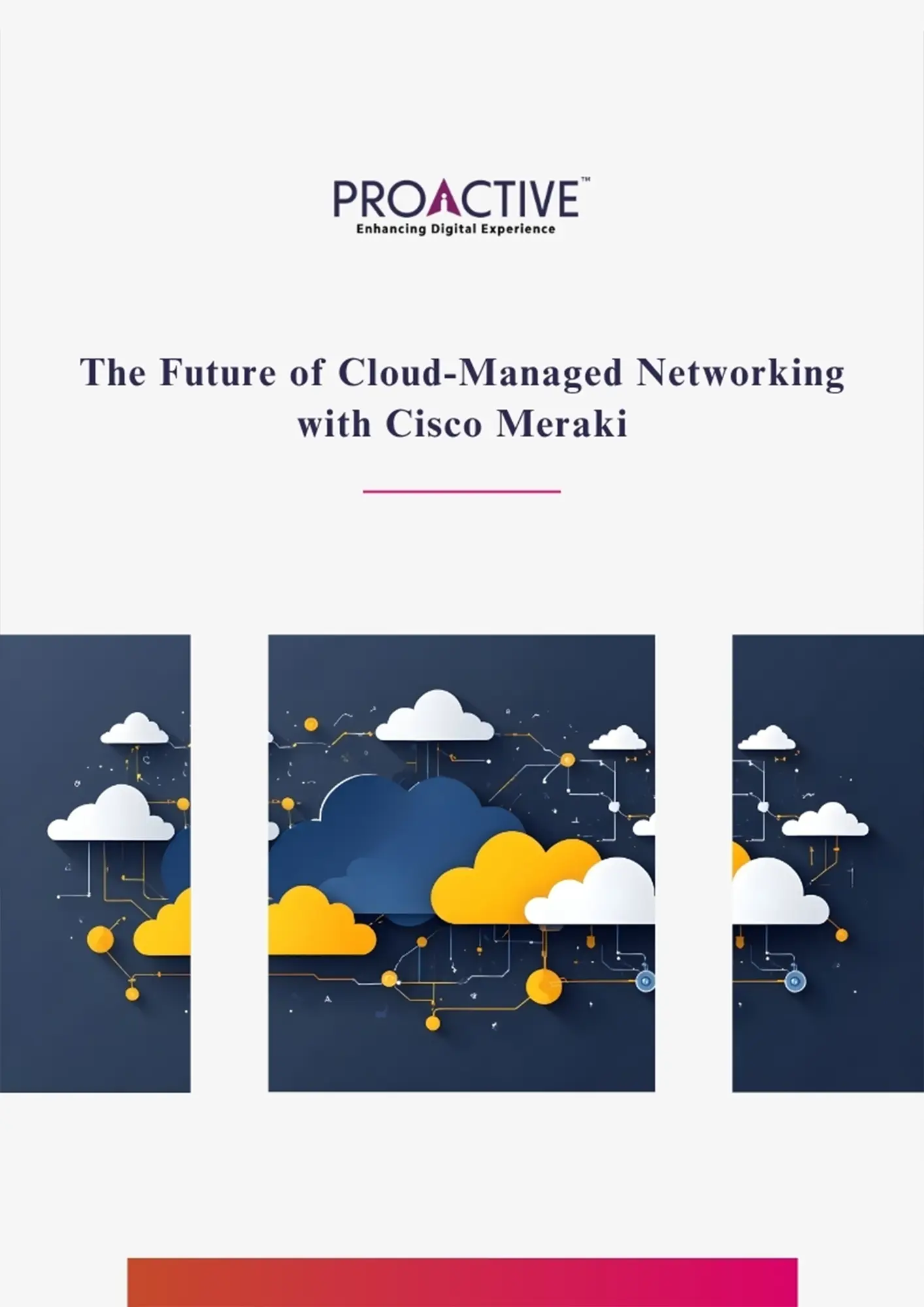
Choosing between Cisco Meraki and Catalyst comes down to seven operational questions, not features: sites per engineer, control depth, WAN behaviour, five-year licence cost, data residency, mixed-estate design and who takes the 3 am call. Proactive Data Systems, a Cisco Preferred Partner across all five architectures with 35 years in Indian enterprise infrastructure, uses this list with every customer before a price list is opened.
Most Meraki-versus-Catalyst arguments are settled by the wrong people. The engineer who loves the CLI wins the room, or the finance head who dislikes subscriptions does, and the network gets chosen by temperament. Both platforms are Cisco. Both are good. The difference is operational, and answering the seven questions in order usually makes the decision for you.
How many sites do you have, and how many engineers per site?
Do you need CLI-level control or dashboard-level control?
What happens when the internet link drops?
What do the licence economics look like over five years?
Where does your management data live?
Can you run both?
Who manages it at 3 am, and what does that cost?
If you have more sites than network engineers, Meraki wins by default. A cloud dashboard lets two people run forty branches, while a CLI-managed estate needs someone who can reach each box. Catalyst earns its place where the site count is small, the sites are large, and there is an engineer on the floor.
This is the question that decides most Indian mid-market cases, and it has little to do with features. Axtria, a life-sciences analytics firm with offices across eight Indian locations, came to Proactive with the familiar shape: connectivity across sites was hard to keep consistent, updates ate engineer time, and the team was lean by design. They went full-stack Meraki, firewalls, switches and access points on one dashboard, and the result was a network run by a small IT team rather than one that needed to grow. Vishwajeet Singh, Axtria's Director of IT, put it plainly: centralised control and scalability let them manage diverse locations easily.
Flip the numbers, and the answer flips. A single 2,000-seat campus with a four-person network team gets more from Catalyst's depth than from Meraki's simplicity.
Meraki covers roughly 90 per cent of what a branch network needs through a browser, with guardrails; Catalyst gives you everything IOS XE can do, including the remaining 10 per cent for complex routing, custom QoS or unusual integrations. If your design needs that 10 per cent, choose Catalyst. If it does not, you are paying for complexity you will not use.
The honest test is to list the features your current network actually uses, not the ones it could. Most branch estates in India run VLANs, a handful of SSIDs, basic QoS for voice, and a site-to-site VPN. Meraki does all of that without a console cable. Campus cores running advanced routing, deep multicast or bespoke automation are a different matter, and that is Catalyst territory.
There is now a middle path. Catalyst 9200 and 9300 switches can be connected to the Meraki dashboard in hybrid operating mode, which keeps full CLI access while adding dashboard visibility and alerts. It is not full cloud management, but it means "Catalyst" no longer has to mean "no dashboard".
A Meraki network keeps forwarding traffic when it loses the cloud, because the cloud carries the management plane, not the data plane. A branch with a dead WAN link still switches, still routes locally and still serves Wi-Fi to connected clients. What stops is change: no new configuration, stale statistics and, depending on firmware and settings, some new wireless clients held until the dashboard returns.
This is the most common objection Proactive hears in Indian boardrooms, and the most misunderstood. Meraki's own behaviour-on-disconnect documentation is worth reading in full before you decide, because the details vary by product line and firmware. The short version: a safe configuration keeps running, and an unsafe one rolls back to the last known good state. Catalyst, managed locally, has no such dependency. If your branches sit on a single ISP with no 4G fallback, that difference is real. If you design the WAN properly, with dual links or SIM failover on the MX, it mostly disappears.
Meraki is a subscription on every device, and the hardware stops being manageable when the licence lapses; Catalyst is perpetual hardware with a software subscription, and the switch keeps working if that subscription expires. Over five years, the totals often land closer than the first quote suggests, but the shape of the spend is different.
The trap is comparing year-one quotes. Meraki's co-termination model pulls every device onto one renewal date, which is simple to administer and painful to budget if a large wave of licences expires together. Catalyst's model spreads differently and keeps the hardware useful past the subscription. Ask your partner for a five-year view of both, with GST and support included, before you compare anything. If the partner cannot produce that table, that tells you something too.
Since 2024, Meraki organisations can be hosted in an India region, on two active data centres run by a MeitY-empanelled cloud provider, reachable at dashboard.meraki.in, with account and organisation data stored in India. For BFSI, healthcare and anyone reading the DPDP rules carefully, this removes the objection that used to end the Meraki conversation.
Two caveats. The India region is isolated: you cannot manage an India organisation and a Singapore one from the same dashboard, and a few integrations are not available there. And if you already run Meraki on a global region, moving to India means a new organisation and a manual migration. Catalyst managed locally has none of this, because the management data never leaves your premises in the first place. Which one matters depends on your regulator and your auditor, and that is a conversation to have before the purchase order, not after.
Yes. A Catalyst core with Meraki at the branches is a normal design, not a compromise, and most Indian enterprises Proactive works with run exactly that. So is a Catalyst campus with Meraki wireless, or a Catalyst estate brought under the Meraki dashboard in hybrid mode for visibility.
The question is not "which one" but "which one where". The usual split is Catalyst where the engineers are and the traffic is heaviest, Meraki where the sites are many and the staff are few. Cisco has spent the last few years making the two talk to each other precisely because customers refused to choose, and that is the right instinct.
Whoever answers the phone when the Pune branch goes dark at 3 am is the real cost of your network, and it is rarely on the hardware quote. Meraki lowers the skill needed for day-to-day operations, which widens the pool of people who can do it. Catalyst needs a deeper bench, in-house or contracted.
Price both honestly. A Meraki estate still needs someone to own firmware rings, licence renewals and alert tuning; the dashboard does not do that by itself. A Catalyst estate needs certified engineers on call. Proactive Data Systems runs both platforms for customers from a 24x7 NOC in India, which is why this question is worth asking us directly: the answer changes the five-year number more than any licence tier does.
| S.No. | Question | Points to Meraki | Points to Catalyst |
| 1. | Sites vs engineers | Many sites, few engineers | Few large sites, engineers on site |
| 2. | Control depth | Dashboard covers your needs | You use advanced IOS XE features |
| 3. | WAN resilience | Dual links or SIM failover in place | Single ISP, no fallback, local management essential |
| 4. | Licence shape | Prefer one renewal, predictable opex | Prefer perpetual hardware, flexible software spend |
| 5. | Data residency | India region meets your regulator | Management data must never leave premises |
| 6. | Mixed estate | Branch and wireless layer | Core and campus layer |
| 7. | 3am operations | Small team, or a managed NOC | Deep in-house bench |
Proactive Data Systems sells and manages both platforms, and has no reason to steer you to one. What we bring is the assessment before the quote: a look at your sites, your team and your WAN, and a five-year cost view of both options with GST and support included. More than 1,500 customers, 100+ engineers and a 24x7 NOC mean we have already run the estate you are about to build, in both flavours.
Write to us at [email protected] or fill out the web form. Our network experts will be in touch soon.
Disclaimer: Product behaviour, licence models and India region features are as documented by Cisco Meraki at October 2026 and may change. Confirm current details against Cisco documentation before purchase.

Pulkit Singh AGM, Enterprise Networking, Proactive Data Systems
We'll get back to you shortly.