Updated: 19 June 2026
A procurement lead at a Delhi insurer had two numbers on her desk and a problem between them. The network refresh her CISO wanted, to clear a stack of end-of-life switches before the audit, carried a list price she could not get past the finance committee. The old switches, meanwhile, were about to become a disposal cost: someone would have to pay to haul them away. Two expenses, pointing the same direction.
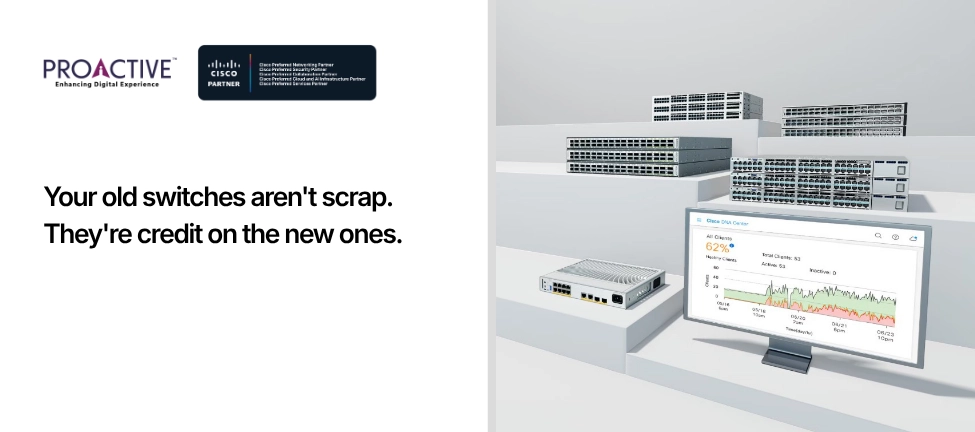
She was treating the old hardware as rubbish. Cisco treats it as currency. Through the Technology Migration Program, those dying switches were not a disposal bill. They were a discount on the new ones, and the haulage was free. The refresh that finance had rejected came back, re-priced, and passed.
If you are about to spend on a Cisco refresh and you are scrapping old gear to make room, you may be throwing away the very thing that pays for part of it. Here is how the program works, what it is worth, and where the catch sits.
The Cisco Technology Migration Program, or TMP, is Cisco's global trade-in scheme. You return eligible old equipment and receive a trade-in credit toward the purchase of new Cisco products. The credit comes off your new order, so a refresh that replaces what you traded costs less than the same refresh bought cold (Cisco TMP terms).
The idea is straightforward. Cisco would rather fund your move to new equipment than watch you stretch old switches past their support life or drift to a competitor at refresh time. So it puts a value on what you are retiring and lets that value reduce what you are buying. For a procurement team, TMP turns the end-of-life problem from a pure cost into a part-funded upgrade.
The mechanics are simple, and they run through your partner, not through you. Your partner builds a trade-in quote in Cisco's ordering system, listing the equipment you are retiring against the new equipment you are buying. Cisco assigns a credit, and that credit is applied when the order is placed, lowering the price of the new gear (Cisco TMP terms).
Two conditions decide eligibility, and both catch people out. The equipment you trade must have been in use in your network within the past 90 days, so you cannot resurrect kit retired years ago from a store cupboard. And you must own it outright; leased or rented equipment does not qualify, because it is not yours to trade. Plan the trade-in alongside the purchase, not after the old gear is already switched off and gathering dust, or you risk falling outside the window.
The credit amount is not a fixed published percentage. It depends on what you are trading, what you are buying, and which promotions are running, which is why the figure is quoted per deal rather than advertised. That variability is an argument for a partner who knows which trade-in and promotion combination produces the best number, a point we return to below.
Yes, and this is the part most buyers miss. TMP accepts both Cisco and competitive equipment for trade-in credit. If you are running a mix of brands or moving off another vendor entirely, you can put that hardware toward your new Cisco purchase (Cisco TMP terms).
For a procurement team consolidating a messy, multi-vendor estate, this changes the maths. The competitor switches you assumed had no resale value to Cisco can offset the cost of standardising on Catalyst. The question to ask before any refresh is not "what is our old Cisco worth?" but "what is everything in these racks worth as trade-in credit?" The answer is often larger than expected.
Enough to change a decision, though the exact figure is deal-specific. Because credits vary, treat the examples below as illustrations of the arithmetic, not as quoted rates. The shape of the savings is what matters.
| Scenario | New Cisco List (Illustrative) | Trade-in Credit (Illustrative) | Net Cost |
|---|---|---|---|
| Campus access refresh, old Catalyst traded | Rs.1,00,00,000 | Rs.12,00,000 | Rs.88,00,000 |
| Multi-vendor consolidation incl. competitor switches | Rs.1,00,00,000 | Rs.15,00,000 | Rs.85,00,000 |
| Trade-in plus a running migration promotion | Rs.1,00,00,000 | Rs.20,00,000 | Rs.80,00,000 |
The lesson is not the specific percentages, which your partner will quote against your actual kit. It is that the credit is real money against a budget you were going to spend anyway, and that it stacks with the negotiated discount and any active promotion, rather than replacing it. A refresh priced without exploring TMP is a refresh priced too high. Which version of the net figure would you rather take to your finance committee?
Cisco takes it back and recycles it, at no cost to you. The displaced equipment is collected and processed through Cisco's takeback programme, where more than 99 per cent of what is returned is recycled rather than dumped (Cisco Product Takeback and Reuse). So the disposal cost you were bracing for disappears, and the trade-in credit arrives in its place.
This matters in India for more than just the savings.
The E-Waste Management Rules make the safe disposal of electronic equipment a legal obligation, not a favour, and "we left it in a corridor" is not a defence an auditor accepts. A documented takeback gives you a clean paper trail for both the asset register and the environmental file. There is a security angle too: retiring switches should leave your premises with their configurations wiped, and a managed takeback through your partner is a controlled way to ensure old devices do not walk out with network details still on them.
They solve different problems, and confusing them is common. Refurbished or used equipment is about spending less on what you buy. TMP is about getting credit for what you retire while buying new. One lowers the entry price and carries the warranty, support and counterfeit questions that come with secondary-market gear. The other keeps you on new equipment with full warranty and support, and uses your old hardware to soften the bill.
For a production network you intend to run for years, the combination that usually wins is new equipment, full support, and a TMP credit against the outgoing kit. You avoid the licensing and entitlement headaches of used hardware and still bring the net cost down. We covered the new-versus-refurbished-versus-rental trade-off in detail separately; TMP is the lever that often makes "new" affordable enough to settle that debate.
The catch is that you cannot run it yourself. TMP operates through Cisco partners and the Cisco ordering system, so the trade-in quote, the credit, the promotion stacking and the takeback logistics all sit with whoever holds that access. The program rewards the buyer whose partner knows it well and works it hard, and quietly under-serves the buyer whose supplier treats trade-in as an afterthought.
So the real question is not whether TMP can cut your refresh cost. It can. The question is whether the partner pricing your refresh is actually pulling that lever, or quoting you list and pocketing the simplicity. Ask any bidder a single question: what trade-in credit have you built into this quote, and against which of our old devices? The answers will sort the partners from the box-shifters quickly.
A refresh quote without a trade-in line is an incomplete quote. Building the complete one is exactly the work a real partner does.
Proactive Data Systems is a 35-year-old system integrator with more than 1,500 customers and a Cisco Preferred Partner in Networking, Security, Collaboration, Cloud and AI, and Services. We assess your retiring estate, Cisco and competitor alike, build the trade-in quote, stack it with the right promotions, and arrange the takeback and recycling, so the credit lands on your order and the old hardware leaves cleanly and compliantly. CCIE-led design for the new network, a 24x7 NOC in India to run it, and a procurement process that finds the money already sitting in your racks.
Planning a refresh, or staring at a pile of end-of-life switches you assumed you would have to pay to remove? Ask Proactive to price it with TMP built in. The trade-in number often makes the difference between a refresh approved and a refresh deferred.

Pulkit Singh AGM, Enterprise Networking, Proactive Data Systems
We'll get back to you shortly.