Updated: 13 July 2026
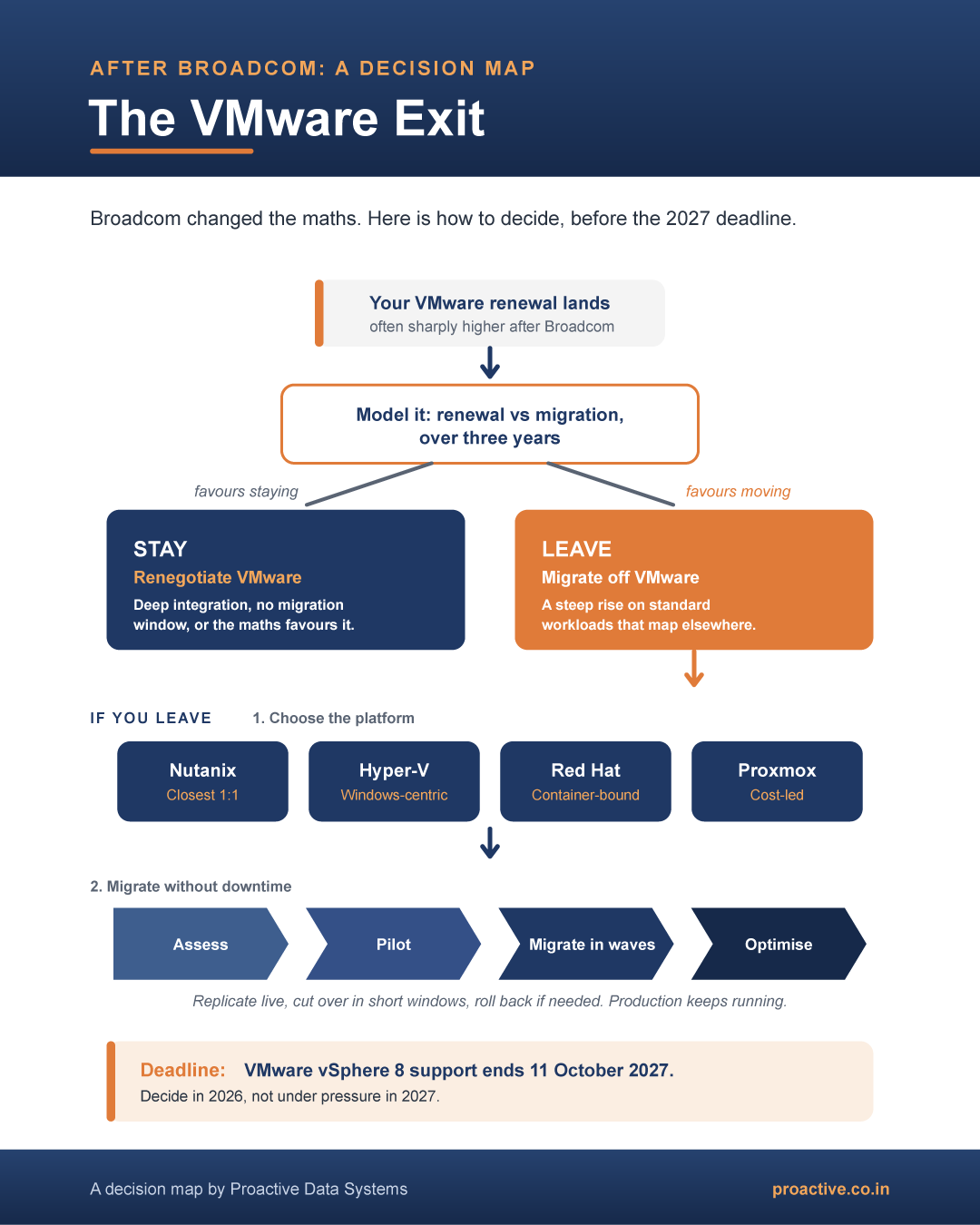
Broadcom changed the maths on VMware, and every renewal now forces a question that used to be automatic: renew, or move? This one-glance decision map walks the choice from the renewal quote to a migrated, optimised platform, so you can decide deliberately in 2026 rather than under pressure in 2027.
In Brief
It starts with the renewal quote, not with a preference. After Broadcom's move to bundled subscriptions, many organisations have seen renewals rise sharply, and that is the moment the question becomes real. The right first step is not to panic-renew or panic-migrate, but to model both paths, renewal versus migration, over three years. That single comparison, done honestly, drives everything that follows.
Both are legitimate answers, and the map treats them that way.
Stay and renegotiate where VMware is deeply integrated, where there is no realistic migration window, or where the three-year maths genuinely favours renewal. Leaving a platform that still earns its cost is not a virtue.
Leave and migrate where the renewal is a steep rise on standard workloads that map cleanly onto another platform. When the premium buys you little you actually use, the exit becomes the rational choice.
Pick the platform for the workload, not the logo. The map narrows it to four common destinations:
| Platform | Best Fit |
|---|---|
| Nutanix | The closest one-to-one replacement for a VMware estate |
| Hyper-V | Windows-centric environments already invested in Microsoft |
| Red Hat | Container-bound and open-source-leaning workloads |
| Proxmox | Cost-led moves where budget is the deciding factor |
There is no universally best answer. The right destination depends on how your workloads are built and where your team's skills already sit.
In four stages, so production keeps running throughout: assess the estate, pilot a representative slice, migrate in waves, then optimise on the new platform. The technique that makes it safe is to replicate live, cut over in short windows, and keep the ability to roll back if a wave misbehaves. Done this way, a VMware exit is a controlled programme, not a high-wire act.
VMware vSphere 8 reaches end of general support on 11 October 2027. That sounds far off, but a considered migration, model, choose, pilot, migrate in waves, optimise, takes many months, and doing it well needs slack that a looming deadline removes. Deciding in 2026 buys you the room to migrate on your terms. Deciding in 2027 hands the timing to the calendar.
Modelling the three-year maths, choosing the right destination platform, and migrating in waves without downtime is exactly the work Proactive Data Systems does for organisations rethinking VMware after Broadcom. We are multi-platform by design, across Nutanix, Microsoft, Red Hat and more, so the recommendation follows your workloads, not a quota.
As a Cisco Preferred Cloud and AI Partner, Dell Platinum Partner and NetApp Preferred Partner with 35 years in enterprise IT and a 24/7 service desk in India, we can model your renewal against migration and build the path. Ask Proactive for a VMware migration assessment.

Proactive Data Center Team
We'll get back to you shortly.