Updated: 17 July 2026
An illustrative case study based on representative AI-infrastructure engagements. The organisation is not named; the protagonist's name has been changed on request. Figures are indicative of outcomes typical of such projects.
The situation: A manufacturer's computer-vision quality model worked brilliantly in pilot, but the existing data center could not feed a GPU cluster, and the obvious fix, a full rebuild, was too costly and too disruptive to production to contemplate.
The move: Rather than rip and replace, the team made the facility AI-ready in stages, confirming what the building could carry, then adding GPU compute, a fast storage feed and an AI networking fabric in phases, without touching live workloads.
The outcome: The pilot reached production in months rather than a year, GPUs ran fed rather than starved, and the capex was phased instead of a single painful hit.
The pilot was the easy part. That was the problem.
Priya Kulkarni (name changed on request), who led the digital and AI function at a mid-to-large manufacturer, had a computer-vision model that could spot defects on the line faster and more consistently than human inspectors. In a controlled pilot it was a quiet triumph. The business wanted it in production, on more lines, immediately. And that is where the trouble started, because the model did not run on the factory floor alone. It needed to be trained and retrained in the data center, and the data center was never built to feed a GPU cluster.
Her infrastructure team laid out the honest options. The most complete was a full rebuild: tear out the existing environment, put in a purpose-built AI factory, start fresh. It was also the most expensive, the most disruptive to the production systems the company ran every day, and the slowest to deliver value. For a promising pilot that still had to prove its return at scale, betting the whole data center on it was the wrong shape of risk. So they asked a better question: what is the least we can change to make this facility genuinely AI-ready, and can we do it in stages?
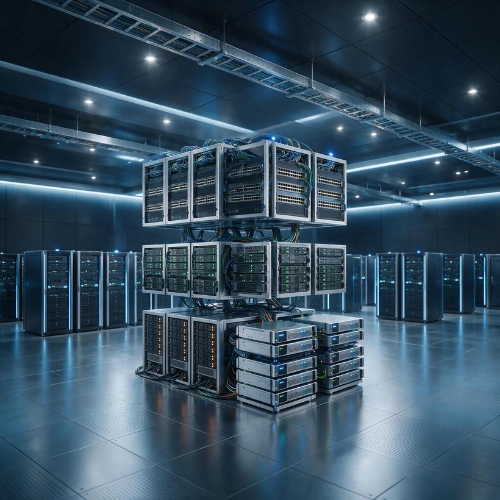
A GPU is a fast consumer of data and power. Drop a cluster into a data center that cannot feed it with data or supply it with power and cooling, and you have not built an AI factory; you have bought an expensive bottleneck that idles while everything around it struggles to keep up.
That was the real risk here. The existing estate had compute and storage sized for conventional business applications, connected by a network built for their traffic patterns, in a facility whose power and cooling were planned long before anyone said the word GPU. Simply buying accelerators and racking them would have starved them, on data, on bandwidth, or on power, and delivered a fraction of what the pilot had promised. The question was never just which GPUs to buy. It was whether the whole stack around them, storage, fabric, power, could keep them busy.
The team chose to make the data center AI-ready in deliberate stages, adding only what the AI workload actually required and confirming the facility could carry each step before taking it.
The principle was simple. A forklift rebuild treats AI-readiness as a single, enormous event. Staging treats it as a sequence: prove what the building can support, add the AI compute, feed it properly, connect it fast, and expand only as the workload earns it. It meant the existing production environment kept running untouched throughout, the capital went out in phases tied to results rather than in one speculative lump, and the business could stop at any stage if the returns did not follow. For a pilot moving to production, that optionality was worth as much as the performance.
The Build: Three Moves, in Order
Making the facility AI-ready came down to three additions, sequenced so each was ready before the next depended on it.
First, AI compute: a right-sized GPU platform on NVIDIA-accelerated servers, scaled for the training and retraining the vision models actually needed, not for a hypothetical future cluster.
Second, the storage feed: fast all-flash storage sized to keep those GPUs supplied, because the fastest accelerator in the world is worthless waiting on slow disks.
Third, the AI fabric: low-latency, high-bandwidth networking between compute and storage, so data moved at the speed the GPUs demanded rather than the speed the old network allowed.
Underneath all three sat the unglamorous first check: confirming the power and cooling envelope could carry the new density before anything was ordered. Dense AI racks draw far more power and throw far more heat than the estate was designed for, and the staged approach meant that limit was verified, and where needed addressed, up front rather than discovered under load.
The Outcome: AI in Production, on Terms the Business Could Manage
The pilot that had been stuck at the edge of production crossed into it, and did so without the company betting its data center to get there.
| Measure | Before | After |
|---|---|---|
| AI status | A pilot that worked but could not scale | Vision models trained and running in production |
| Path to production | A full rebuild, a year or more away | Live in months, in stages |
| GPU performance | Would have starved on old storage and network | Fed by fast storage and an AI fabric, kept busy |
| Capital | One large, speculative outlay | Phased, tied to proven results |
| Existing workloads | At risk in a rip-and-replace | Untouched throughout |
Kulkarni summarised that the staging did not just save money; it changed the nature of the decision. Instead of a single, career-sized bet on a full AI build, she had a sequence of smaller, reversible steps, each of which had to earn the next. The vision models went into production on more lines. The data center that fed them was ready for what came after: more models, more workloads, without another disruptive event. And the business had learned that AI-readiness was something you could grow into, not only something you rebuilt for.
The instinct to rebuild is understandable, and occasionally right. But for most manufacturers taking a working AI pilot to production, the expensive, all-at-once rebuild is the enemy of ever shipping. The win here was discipline: add only what the workload needs, feed the GPUs properly so they are never the bottleneck, confirm the facility can carry each step, and let results fund the next stage.
That staged path is exactly the work Proactive Data Systems does: making existing data centers AI-ready with the right GPU compute, the storage and fabric to keep it fed, and the power and cooling to carry it, added in stages, not a forklift rebuild. We build the AI stack on NVIDIA-accelerated servers from Dell, HPE, Cisco and Lenovo, and we confirm the facility can carry it before anything is racked. As a Cisco Preferred Cloud and AI Partner, Dell Platinum Partner and NetApp Preferred Partner with 35 years in enterprise IT and a 24/7 service desk in India, we take an AI pilot to production without betting the data center. To map your own staged path, ask Proactive for an AI-readiness assessment.
We'll get back to you shortly.