Updated: 25 June 2026
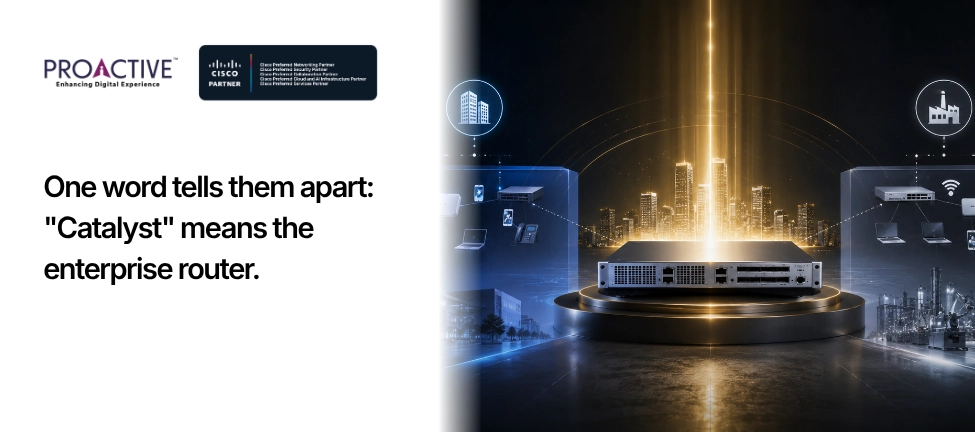
Cisco has two completely different product lines with almost the same name, and they are not variants of one another. The Catalyst 8000 is an enterprise router for the branch and WAN edge. The Cisco 8000 Series is a service-provider and web-scale machine for the core of the Internet. They share a number, they even both include an "8200", and they have nothing else in common.
If a search or a vendor conversation has you unsure which 8000 someone means, this post settles it in a minute. The one word that tells them apart is "Catalyst", and the rest follows from there.
They are built for opposite ends of the network. The Cisco Catalyst 8000 Edge Platforms are enterprise routers for SD-WAN, branch and WAN-edge connectivity, running Cisco IOS XE (Cisco Catalyst 8000). The Cisco 8000 Series routers are service-provider and web-scale platforms for the core, backbone and peering, powered by Cisco Silicon One and running IOS XR (Cisco 8000 Series).
Different audience, different role, different operating system, different silicon, different scale. The shared "8000" is a coincidence of naming, not a sign of a shared family. Here is the contrast in full:
| Catalyst 8000 (Edge Platforms) | Cisco 8000 Series (Routers) | |
|---|---|---|
| Built for | Enterprises | Service providers, web-scale and hyperscalers |
| Role | SD-WAN, branch and WAN edge, cloud access | Core, backbone, peering, data-centre interconnect |
| Operating system | IOS XE | IOS XR |
| Silicon | Enterprise ASICs (and x86 for virtual) | Cisco Silicon One (Q100, Q200) |
| Scale | Up to tens of Gbps | Multi-terabit (10+ Tbps) |
| Models | 8200, 8300, 8500, 8000V | 8100, 8200, 8800 (8804–8818) |
| Managed by | Catalyst SD-WAN Manager | Service-provider tooling and automation |
The enterprise one. The Catalyst 8000 Edge Platforms are Cisco's current WAN-edge and SD-WAN routers, the successors to the ISR and ASR generations most enterprises grew up on. The Catalyst 8200 suits a branch, the 8300 a larger branch or regional headend, the 8500 an aggregation or data-centre edge, and the 8000V is the virtual, cloud version. All run IOS XE with Catalyst SD-WAN built in.
If you run an enterprise network, connect branches, or build an SD-WAN, this is the 8000 you mean. It is the router that sits in your sites, not in a carrier's core.
The service provider one. The Cisco 8000 Series routers are high-scale platforms built on the Cisco Silicon One ASIC, delivering multi-terabit throughput, and running IOS XR. They are made for the core and backbone of large networks: carrier transport, internet peering, data-centre interconnect, high-capacity aggregation, and the fabrics behind web-scale and AI/ML workloads.
This is not a device an ordinary enterprise buys for a branch. It is the machine a telecom operator or a hyperscaler uses to move traffic at the scale of the internet itself. If the conversation involves Silicon One, IOS XR or terabits, it is the Cisco 8000 Series, not the Catalyst.
Because Cisco reused the number across two unrelated lines, and even repeated model numbers within it. Both families carry "8000". Both include an "8200". The Catalyst has an 8500; the Cisco 8000 has an 8800. Read quickly, they blur together, which is exactly how the wrong platform ends up in a search, a quote or a design discussion.
The reliable tell is the word "Catalyst". If the product is a "Catalyst 8000", "Catalyst 8200", "Catalyst 8300" or "Catalyst 8500", it is the enterprise edge router on IOS XE. If it is a "Cisco 8000", "8100", "8200" or "8800" without "Catalyst", and the context is service provider, core or Silicon One, it is the high-scale IOS XR platform. The operating system is the second tell: IOS XE means Catalyst, IOS XR means the 8000 Series.
By your role, not the number. If you are an enterprise connecting branches, building an SD-WAN, or sizing a WAN edge, you want the Catalyst 8000, and the 8200, 8300 or 8500, depending on the site. If you are a service provider or a web-scale operator building a core, a peering edge or a high-capacity backbone, you want the Cisco 8000 Series.
The two almost never compete for the same deal because they answer different questions. The only real risk is naming confusion: ordering, searching for, or being quoted the wrong family because the numbers look alike. Confirm the word "Catalyst" and the operating system, and the ambiguity disappears.
Most 8000 confusion is harmless until it reaches a purchase order or a design document, where the wrong platform is an expensive correction. A quick check of the family name and the operating system removes the doubt.
Proactive Data Systems, a Cisco Preferred Networking Partner with 35 years of experience and more than 1,500 customers, specifies the right platform for your role, the Catalyst 8000 for enterprise WAN and SD-WAN, sized to each site, so you never order the wrong 8000. If a quote or design has you second-guessing which platform you are looking at, ask us to confirm it.

Proactive Enterprise Networking Team
We'll get back to you shortly.