Updated: 09 March 2026
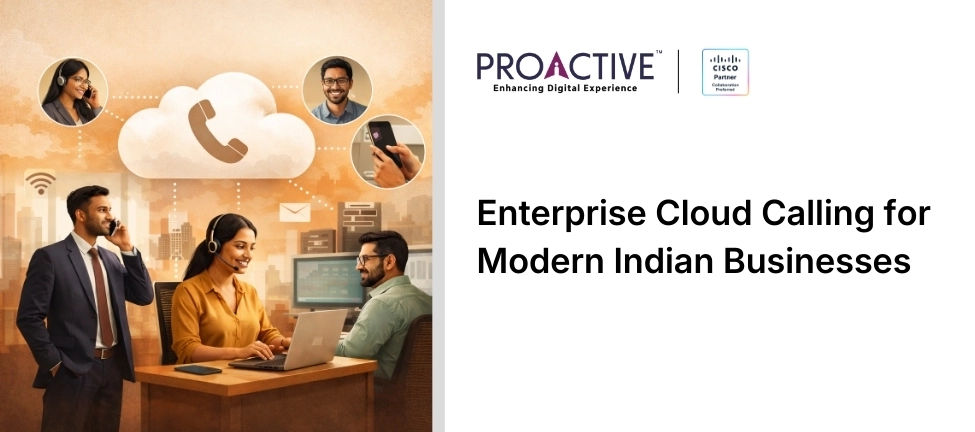
Cloud calling is a business phone system delivered over the internet instead of through on-premise PBX hardware. It allows organisations to make and receive calls using cloud infrastructure, centralised management platforms, and IP-based connectivity rather than physical telephone exchanges installed in offices.
In simple terms, cloud calling replaces legacy EPABX systems with a hosted solution managed in secure data centres. Users can place and receive business calls from desk phones, laptops, or mobile devices while IT teams manage policies, users, and call flows from a central console.
For Indian mid-market and enterprise companies, cloud calling is not just a technology shift. It is an operational decision that affects scalability, compliance, cost control, and user experience.
Cloud calling operates on Voice over Internet Protocol technology. Instead of routing calls through copper lines and on-site switching hardware, calls are transmitted over IP networks to a cloud provider’s infrastructure.
The core components include:
When a user places a call, the signal travels through the organisation’s network to the cloud platform. Call routing, voicemail, IVR, hunt groups, and analytics are managed centrally in the cloud.
This architecture removes the need for physical PBX upgrades, maintenance contracts, and hardware lifecycle management.
The shift toward cloud telephony in India is driven by business realities, not trends.
1. Multi-Location Operations
Many Indian enterprises operate across Delhi NCR, Mumbai, Bengaluru, Pune, Hyderabad, and other cities. Managing separate PBX systems at each location increases cost and complexity. Cloud calling centralises management while maintaining local numbers.
2. Workforce Mobility
Hybrid work is now permanent. Cloud calling allows employees to use business numbers on mobile devices without exposing personal numbers.
3. Scalability Without Hardware Delays
Adding users to a traditional PBX often requires new cards, licenses, or physical expansion. Cloud calling allows user provisioning within minutes.
4. Cost Predictability
Instead of periodic capital expenditure for hardware refresh, organisations move to subscription-based operational expenditure.
5. Centralised Control and Analytics
Modern platforms provide real-time visibility into call volumes, quality metrics, and usage patterns.
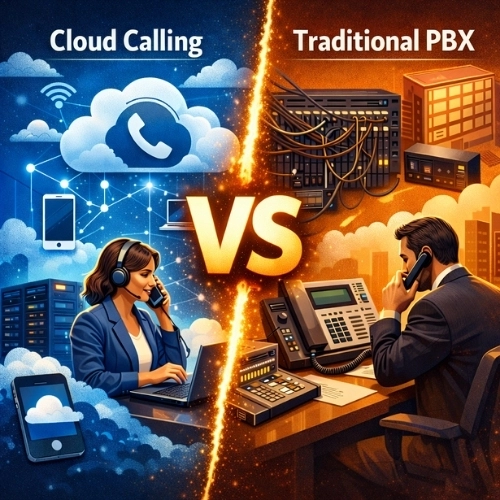
Cloud Calling vs Traditional PBX
| Feature | Traditional PBX | Cloud Calling |
|---|---|---|
| Infrastructure | On-site hardware | Hosted in cloud data centres |
| Scalability | Hardware dependent | Software-based scaling |
| Maintenance | Requires AMC and upgrades | Managed through cloud platform |
| Multi-site support | Complex and siloed | Centralised control |
| Mobility | Limited | Device agnostic |
For enterprises planning expansion, traditional PBX systems often become operational bottlenecks.
Many organisations assume that once the system is deployed, the work is done. In reality, most telephony failures happen after deployment.
Common issues include:
Cloud calling is reliable when network readiness, bandwidth planning, and ongoing governance are treated seriously.
A structured deployment typically includes:
Enterprises operating across multiple Indian states must consider ISP variability, redundancy planning, and failover architecture.
Security depends on platform architecture and deployment design.
Enterprise-grade cloud calling platforms provide:
For large enterprises, selecting a solution backed by established infrastructure providers reduces operational risk.
Cloud calling costs are influenced by:
The cheapest option is rarely the most reliable. Enterprises should evaluate the total cost of ownership, not just monthly subscription rates.
Successful cloud calling transitions require more than software activation.
Proactive begins with a structured network readiness audit, evaluates ISP resilience, validates QoS policies, and designs a phased rollout plan aligned to business continuity requirements.
Post-deployment, ongoing monitoring, governance frameworks, and adoption support ensure the system performs consistently across all locations.
If your organisation is evaluating cloud calling across multiple offices or planning to replace legacy PBX systems, a structured assessment is the right first step.
Proactive Data Systems is a Cisco Preferred Collaboration Partner, delivering enterprise-grade cloud calling solutions across India with disciplined deployment methodology and long-term operational oversight. Speak with Proactive’s collaboration architects to evaluate your readiness before rollout.

Kunal Gill Head, Cloud Calling Practice, Proactive Data Systems
We'll get back to you shortly.