Updated: 11 September 2026
The hardware is identical whoever sells it. A Catalyst 9300 from one partner is the same switch as a Catalyst 9300 from another. So choosing a Cisco partner is not choosing a box. It's choosing everything around the box: the design, the sourcing, the support, and whether anyone answers the phone two years from now when a core switch fails.
Get that choice wrong and it doesn't show up on day one. It shows up later, as a botched migration, an unsupported outage, a licence nobody registered, or a quote that ballooned after you signed. By then the partner has your money and you have the problem.
These twelve questions surface the difference before you commit. A real partner answers them easily. A box-seller starts to squirm.
Because the partner is the part that varies. Cisco sets the product; the partner decides whether it's designed correctly, sourced genuinely, priced honestly, deployed cleanly and supported for years. Two partners quoting the same switch can deliver wildly different outcomes, one a network that runs quietly for a decade, the other a project that needs rescuing.
For a CIO, the partner is a multi-year relationship dressed up as a purchase. The questions below are how you tell which kind you're about to sign.
The 12 Questions to Ask a Cisco Partner
Take this list into the conversation:
| S. No | Ask Your Cisco Partner | Why It Matters |
|---|---|---|
| 1 | Are you a Cisco Preferred Partner, and in which specialisations? | Tier and specialisation signal capability and pricing access |
| 2 | Who designs my network, and do you have CCIEs on staff? | Senior certification separates real design from box-quoting |
| 3 | Do you run a 24x7 NOC, and where is it? | Someone must answer when a switch fails at 2 a.m. |
| 4 | Do you hold spares in India, and how fast is replacement? | Local spares turn an outage into an hour, not a week |
| 5 | Do you cover networking, security, collaboration, cloud/AI and services? | One accountable partner beats stitching several together |
| 6 | Will you register the deal with Cisco? | Deal registration unlocks the best pricing |
| 7 | Will you quote a complete bill of quantities? | A bare-box quote hides cost and gaps |
| 8 | Can you show similar deployments and references? | Proof of delivery at your scale and vertical |
| 9 | Do you operate the network after you build it? | Build-and-vanish leaves you unsupported on day two |
| 10 | Do you have engineers and presence near my sites? | Local hands matter for deployment and support |
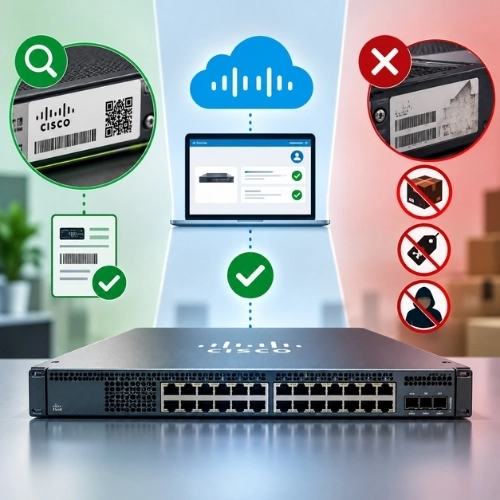
| 11 | Do you source only through authorised channels and verify serials? | Guards against grey-market and counterfeit risk |
| 12 | How long have you run networks, and for how many customers? | Track record predicts reliability |
The rest of this guide groups them into what they're really testing.
Start with credentials, because they gate everything else. Ask whether the partner is a Cisco Preferred Partner, the top designation in Cisco's 360 Partner Program that replaced the old Gold, Premier and Select roles in 2026, and which specialisations they hold (Cisco 360 Partner Program). Tier and specialisation aren't vanity badges; they reflect proven capability and, in practice, access to better pricing.
Then ask who actually designs your network, and whether the partner has CCIEs on staff. The CCIE is the industry's benchmark expert certification, and its presence tells you a senior engineer, not a salesperson with a configuration tool, is standing behind your design. A partner who can't name the engineer designing your network is quoting boxes, not building a network.
This is where most of the real value, and most of the disappointment, lives. Ask whether they run a 24x7 network operations centre, and where it is. A network that matters needs monitoring and someone to call around the clock, and "we'll raise a ticket with Cisco" is not a support model.
Ask whether they hold spares in India. Hardware fails; what decides the impact is how fast it's replaced, and a spare on a shelf in-country is the difference between an hour of downtime and a week waiting on logistics and customs. And ask the blunt one: do you operate the network after you build it? A partner who hands over and disappears leaves you owning the complexity alone. One who runs it afterwards has a stake in getting the design right the first time.
Three questions expose whether the commercial relationship is straight. Ask whether they'll register the deal with Cisco, because a registered deal unlocks the best available pricing, and a partner who won't is leaving your money on the table or keeping it.
Ask for a complete bill of quantities, hardware, licence, optics, support, GST, not a bare-box price. An incomplete quote isn't cheaper; it's hiding the licence and optics you'll pay for later, and comparing two incomplete quotes is meaningless. And ask directly whether they source only through authorised Cisco channels and verify serial numbers. In a market full of grey and counterfeit stock, a partner who can't or won't confirm genuine, authorised sourcing is a risk you don't need.
Finally, test the scope and the history. Ask whether they cover networking, security, collaboration, cloud and AI, and services, because a modern network touches all of them, and one accountable partner across the estate beats stitching four vendors together and referring when something breaks.
Ask for references and similar deployments at your scale and in your sector, real proof they've delivered what you're buying. Ask about local presence near your sites, since deployment and support are easier with engineers who can reach you. And ask the simplest question of all: how long have you been running networks, and for how many customers? Years in business and a large, retained customer base are the hardest things for a box-seller to fake, and the best predictor that the partner will still be standing behind your network years from now.
Watch for the pattern, not a single answer. The red flags cluster: a bare-box quote, no NOC, no local spares, a build-and-vanish model, vagueness about who designs the network, and evasiveness about sourcing. Anyone might be explainable. Together they describe a reseller, not a partner.
The green flags cluster too: top-tier designation, named CCIE designers, a 24x7 India NOC, spares in-country, a complete transparent BoQ, authorised sourcing, breadth across portfolios, and a long track record with references. A partner who answers all twelve without hesitation is telling you they've built this relationship before and intend to stand behind it.
Choose on the answers, not the lowest headline price. The cheapest quote from the weakest partner is the most expensive network you'll ever run.
We wrote these questions because we're comfortable answering them. Proactive Data Systems is a Cisco Preferred Partner, the top tier of Cisco's 360 programme, with 35 years of experience and more than 1,500 customers. Our networks are designed by a CCIE-led bench, sourced only through authorised channels with serials verified, quoted as complete, transparent bills of quantities, and run afterwards from a 24x7 NOC in India with spares held locally, across networking, security, collaboration, cloud and AI, and services.
Put the twelve questions to us, and to anyone else you're considering. The answers will tell you who's a partner and who's a box-seller. If you're choosing a Cisco partner for a refresh, a rollout or a managed network, ask us all twelve, we'll answer every one.

Manav Nahar AVP, Collaboration, Proactive Data Systems
We'll get back to you shortly.